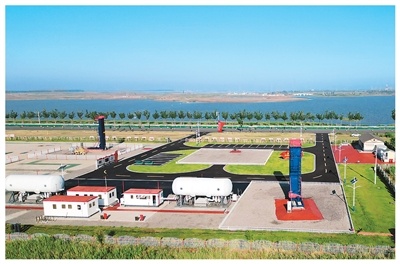
CCUS技术(二氧化碳捕集

Search documents
给“碳捕手”装上绿色引擎(瞰前沿)
Ren Min Ri Bao· 2025-10-31 22:04
Core Viewpoint - The latest report from the World Meteorological Organization indicates that carbon dioxide levels in the atmosphere are set to reach a historic high in 2024, highlighting the urgent need for effective technologies to mitigate global warming, particularly through Carbon Capture, Utilization, and Storage (CCUS) [1][2]. Group 1: CCUS Technology Overview - CCUS refers to the process of capturing carbon dioxide from industrial production, energy use, or directly from the atmosphere, and either utilizing it or permanently storing it underground [1]. - The technology aims to significantly reduce emissions from major point sources while supporting the transition to a stable energy system and contributing to carbon neutrality goals [1][2]. Group 2: Challenges in CCUS Implementation - The primary challenge in applying CCUS technology lies in the need for effective carbon dioxide absorbents, as CO2 constitutes only 10%-20% of the emissions from processes like power generation and cement production [2]. - Current carbon capture costs in China range from 250 to 450 RMB per ton, with total costs (including transport and storage) reaching 350 to 600 RMB per ton, indicating high energy consumption and costs associated with existing methods [2]. Group 3: Advancements in China's CCUS Technology - Over the past two decades, China has transitioned from following to leading in CCUS technology, achieving several world-firsts and providing valuable experience for the development of new generation CCUS technologies [3]. - Innovations include the development of a new two-phase CO2 absorbent that reduces energy consumption by approximately 30% compared to traditional methods, and the creation of the world's largest carbon capture facility with a capacity of 1.5 million tons per year [3][5]. Group 4: Safety and Monitoring in Carbon Storage - China has implemented a comprehensive monitoring system for carbon storage, utilizing over 500,000 grid points to assess and visualize suitable storage areas [4]. - The country has developed a robust drilling technology system for large-scale safe carbon storage, enhancing the reliability of long-term CO2 sequestration [5]. Group 5: Policy and Market Support for CCUS - Recent policies, such as the guidelines for promoting green low-carbon transitions and strengthening the national carbon market, are expected to drive the further adoption of CCUS technologies [6]. - Infrastructure development is prioritized in industrial clusters to optimize the construction of pipelines and storage facilities, enhancing the economic efficiency of CCUS applications [6]. Group 6: Strategic Pathways for CCUS Deployment - The strategy emphasizes starting with industries that have high and stable CO2 emissions before expanding to lower emission sectors, promoting a collaborative approach to build shared CO2 transport and storage platforms [7]. - The focus on domestic production of key materials and equipment aims to reduce reliance on imports and mitigate risks associated with CCUS technology deployment [7].
中国首个海上碳封存项目累计封存二氧化碳破1亿立方米——把二氧化碳“锁”回深海
Ren Min Ri Bao Hai Wai Ban· 2025-10-21 04:55
Core Insights - China National Offshore Oil Corporation (CNOOC) has announced that its first offshore carbon dioxide (CO2) storage demonstration project, the Enping 15-1 oilfield CO2 storage project, has successfully stored over 100 million cubic meters of CO2, equivalent to the carbon absorption of 2.2 million trees, indicating the maturity of China's offshore CO2 storage technology and capabilities [1][5][17] Group 1: Project Overview - The Enping 15-1 oilfield is the first high CO2 content oilfield in the eastern South China Sea, where conventional extraction methods would release CO2 into the atmosphere, increasing emissions [4][10] - The project utilizes Carbon Capture, Utilization, and Storage (CCUS) technology, which involves capturing CO2 from emission sources, utilizing it, and storing it in geological formations [5][10] - Since its launch in May 2023, the project has operated safely for over 15,000 hours, with a peak daily injection volume of 210,000 cubic meters [7][11] Group 2: Technological Advancements - The project has achieved a full-chain upgrade of CO2 capture, utilization, and storage technologies, with a domestic equipment localization rate of 100% [9][11] - The CO2 is captured, purified, pressurized, and injected into underground reservoirs to enhance oil recovery while permanently storing CO2 [10][12] - The project has developed a complete set of operational standards and procedures, providing significant practical experience and data support for large-scale offshore CO2 storage applications [10][12] Group 3: Future Prospects - CNOOC plans to scale up CO2 injection to over 1 million tons in the next decade, aiming to increase oil production by 200,000 tons [6][12] - The company is also initiating a large-scale carbon capture and storage cluster project in Guangdong, targeting the capture of CO2 emissions from various enterprises for storage in the Pearl River Estuary [16][17] - The development of CCUS technology is expected to support China's dual carbon goals and contribute to global climate governance [17]