CKD等)

Search documents
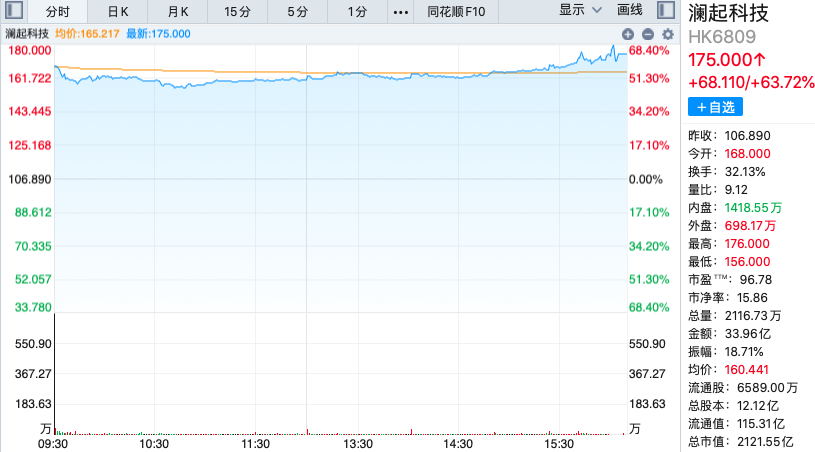
科创板“元老”澜起科技登陆港交所,获阿里、摩根大通等17家基石认购,市值站上2100亿港元
Jin Rong Jie· 2026-02-09 09:24
Core Viewpoint - 澜起科技 successfully listed on the Hong Kong Stock Exchange, enhancing its international presence and funding capabilities, while also experiencing significant stock price appreciation on its debut [1][4]. Group 1: Company Overview - 澜起科技 is a leading fabless integrated circuit design company focused on providing interconnect solutions for cloud computing and AI infrastructure [1]. - The company was founded in 2004 by Yang Chonghe and Stephen Tai, with prior experience in integrated circuit design and engineering management [3]. - 澜起科技 was previously listed on NASDAQ but went private in 2014 after facing allegations of financial misconduct [1][3]. Group 2: Financial Performance - For 2025, 澜起科技 expects a net profit of between 2.15 billion and 2.35 billion yuan, representing a year-on-year growth of 52.29% to 66.46% [6]. - The company reported a significant increase in revenue for 2024, reaching 3.639 billion yuan, a 59% increase year-on-year, with net profit soaring by 213% to 1.412 billion yuan [6]. - The gross profit margins for 澜起科技 from 2022 to 2025 are projected to remain high, with figures of 46.4%, 58.9%, 58.1%, and 61.5% respectively [7]. Group 3: Market Position and Growth Potential - 澜起科技 has become the largest supplier of memory interconnect chips globally, holding a market share of 36.8% in 2024 [3]. - The global memory interconnect chip market is expected to grow from $1.2 billion to $5 billion between 2024 and 2030, with a compound annual growth rate (CAGR) of 27.4% [7]. - The PCIe and CXL interconnect chip market is projected to expand from $2.3 billion to $9.5 billion during the same period, with a CAGR of 26.7% [7]. Group 4: IPO and Investment - 澜起科技's IPO attracted 17 cornerstone investors, including major financial institutions and industry players, raising approximately $450 million, which accounts for 49.82% of the global offering [4]. - The company has faced recent share reductions from major shareholders, with significant amounts of stock being sold [5].