Centaur

Search documents
Nature刊文称“AI可模拟人类心智”,Science同日强烈质疑
Hu Xiu· 2025-07-21 00:43
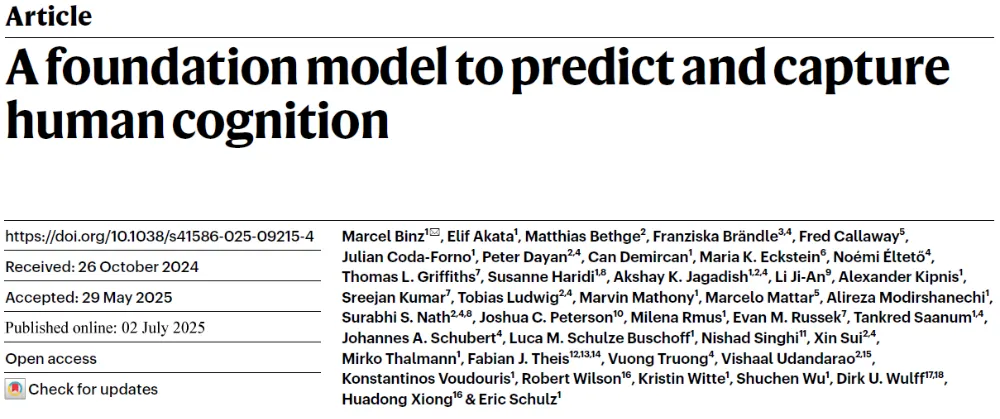
Group 1 - A multinational team published a groundbreaking study in Nature, claiming their AI system can "simulate human cognition" and generate realistic human behaviors [1][7] - The AI model, named "Centaur," is said to have achieved significant accuracy in predicting human behavior across large-scale cognitive tasks [9][18] - The foundation of Centaur is a massive database called "Psych-101," which includes data from over 60,000 participants and more than 10 million choices [10][12] Group 2 - Centaur's architecture is based on Meta's open-source model Llama 3.1, which was fine-tuned using a technique called Quantized Low-Rank Adaptation (QLoRA) [16] - The model demonstrated strong generalization capabilities, accurately predicting behaviors of new participants in various tasks [19][20] - Centaur's internal operations showed remarkable resonance with human brain activity patterns, suggesting a potential alignment in information processing [29][33] Group 3 - Despite the promising results, the scientific community expressed skepticism regarding the claim that Centaur truly mimics human cognition [46][47] - Critics argue that while Centaur can predict human behavior, it does not replicate the underlying cognitive processes, highlighting a significant conceptual gap [51][52] - The scale of the Psych-101 dataset, although impressive, is still considered insufficient to encompass the vast complexity of human cognition [58]

这个AI精准模拟人类行为大脑状态,上Nature了
量子位· 2025-07-14 00:46
Core Viewpoint - The article discusses the breakthrough development of Centaur, a universal computational model capable of accurately predicting human cognition and behavior across various psychological tasks, significantly outperforming traditional models [1][2][10]. Group 1: Model Development - Centaur was developed by a German research team using a large-scale human behavior dataset called Psych-101, which includes data from 60,092 participants and over 100 million choices [12][13]. - The model is based on the open-source language model Llama 3.1 70B and employs a parameter-efficient fine-tuning technique called QLoRA, requiring only 0.15% of the original model's parameters [15][16]. - The training process took only 5 days on an A100 80GB GPU, transforming a general LLM model into one that can "understand" human cognition [19][20]. Group 2: Performance Evaluation - Centaur demonstrated a negative log-likelihood value of 0.44, significantly better than Llama's 0.58, indicating superior fitting to human choices [25]. - The model outperformed 14 classical cognitive models in predicting the behavior of untrained participants, with an average difference of 0.13 [26]. - Centaur achieved a 64% accuracy rate in predicting human behavior, compared to only 35% for artificial agents [27]. Group 3: Behavioral Prediction and Adaptability - The model's response time prediction capabilities were superior, with a conditional R² of 0.87, compared to Llama's 0.75 [28]. - Centaur maintained its predictive accuracy even when the task's narrative context was altered, showing resilience to superficial changes [29]. - The model adapted well to structural changes in tasks, as evidenced by its performance in a modified two-armed bandit experiment [30]. Group 4: Neural Activity Alignment - Centaur's internal representations showed a significant Pearson correlation with human brain activity, particularly in reward-related areas [34][36]. - The model's middle layers exhibited the best predictive performance in language understanding tasks, indicating a strong alignment with human cognitive processing [38][39]. - The findings suggest that Centaur captures fundamental neural characteristics of human cognition, despite not being explicitly trained on neural data [40]. Group 5: Future Implications - The emergence of Centaur indicates the feasibility of constructing computational models that can capture human behavior across domains [42]. - It is proposed that Centaur could serve as a "computational telescope," aiding researchers in extracting key insights from vast behavioral data to advance unified cognitive theory [43]. - The authors suggest that it is time to transition this universal computational model into a comprehensive theory of human cognition [44].