
Codex App

Search documents
不怕你走,就怕你不用AI写代码,OpenAI Codex负责人亲口承认:内部已很少再打开IDE
3 6 Ke· 2026-02-25 05:41
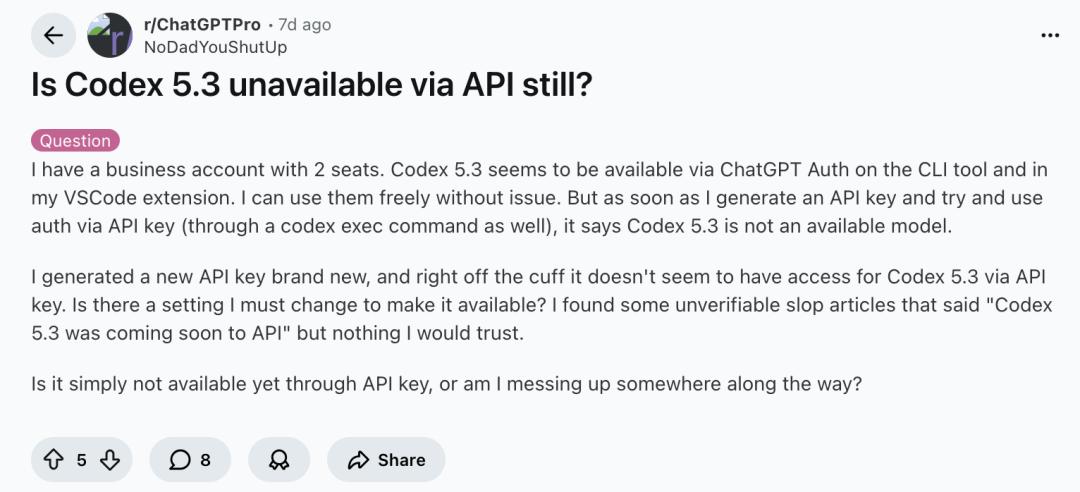
Core Insights - OpenAI has launched its latest programming AI model, GPT-5.3-Codex, which significantly enhances capabilities in reasoning, efficiency, and workflow support compared to its predecessor, GPT-5.2-Codex [1] - The new model shows remarkable performance improvements in various industry benchmarks, with a 25% increase in overall reasoning speed, and aims to enable AI to collaborate with developers throughout the software engineering process [1] Group 1: Model Performance and Feedback - GPT-5.3-Codex has received mixed feedback from developer communities, with some praising its smoother operations and clearer feedback in planning modes, while others criticize the limited API access for integration in custom environments [2][4] - Users have reported that the model's performance in certain editors, like Zed, is still immature, leading some to revert to older versions [4] - Some developers feel that the model does not consistently deliver the advertised performance, particularly in web generation tasks, and find competing models to be more efficient for daily tasks [6] Group 2: Product Vision and Workflow Changes - Alexander Embiricos, the product lead for OpenAI Codex, emphasizes that the goal is to create an AI that acts as an active engineering teammate throughout the software development lifecycle, rather than just improving code writing [6][8] - The internal structure of the Codex team is evolving, with traditional roles becoming less distinct, requiring engineers to possess broader skills and engage in both design and product decision-making [7][8] - The release of GPT-5.2 Codex marked a shift in workflow, where engineers began to delegate entire tasks to AI rather than collaborating in real-time, leading to a significant change in how coding is approached within OpenAI [8][29] Group 3: Future of Engineering Roles - Alexander predicts that the number of engineers will increase in the next five years, as the definition of roles like "software engineer" continues to evolve [8] - The compression of talent stacks is evident, with engineers becoming more versatile and involved in defining problems and ensuring quality rather than merely executing tasks [7][8] Group 4: AI Integration and User Experience - The Codex App is designed to facilitate task delegation and management of multiple AI agents, moving away from traditional IDE functionalities [32] - OpenAI is focusing on making AI tools more accessible and user-friendly, aiming for a future where users can seamlessly integrate AI into their workflows without extensive training [20][32] - The company is also exploring ways to enhance user retention and engagement by lowering the switching costs between different AI tools and ensuring a competitive edge through superior performance and user experience [36][38] Group 5: Market Position and Competitive Landscape - OpenAI acknowledges the competitive landscape and believes that collaboration with other companies can lead to mutual learning and improvement, rather than a monopolistic approach [38] - The company is committed to providing its models to competitors, viewing this as a long-term strategy to enhance its own offerings and maintain a leadership position in the AI space [38]

X @Sam Altman
Sam Altman· 2026-02-09 21:47
More than 1 million people downloaded Codex App in the first week.60+% growth in overall Codex user last week!We'll keep Codex available to Free/Go users after this promotion; we may have to reduce limits there but we want everyone to be able to try Codex and start building. ...
OpenAI Codex App启示录:当代码可以被白领并行生成,软件迎来“通胀时代”
锦秋集· 2026-02-05 15:01
Core Insights - OpenAI's Codex App represents a significant shift in software development, enabling both developers and non-technical users to create and manage AI agents, marking the transition from linear to parallel development [2][3] - The introduction of Skills functionality allows non-technical users to generate tools, indicating a new era of software supply explosion and redefined value [3] Group 1: Paradigm Shift in Software Development - The development methodology is changing from serial to parallel, breaking the constraints of "man-days" and potentially increasing efficiency by 30%-50% or more [5] - Software is evolving from a "product" to a "service" or "instant response," where code can be generated on demand based on user needs [6] - The scarcity of software is diminishing, leading to a dilution of individual software value, akin to inflation in currency [7][8] Group 2: New Market Dynamics - The SaaS subscription model for SMBs may be challenged as on-demand generation of software becomes more prevalent [12] - Skills represent a low-cost, customizable alternative to traditional SaaS products, potentially disrupting the lower end of the SaaS market [13][16] - The value of software is shifting from functional capabilities to data, relationships, and network effects, as functionalities can be easily replicated [17] Group 3: Changing Roles and Skills - The role of programmers is evolving from code writing to AI collaboration, requiring new skills in AI utilization and output evaluation [23][24] - The demand for code review may become a bottleneck as AI-generated code proliferates, necessitating new quality control processes [28] - The educational focus for programmers may shift from coding to designing reusable skills and understanding business processes [27] Group 4: New Opportunities and Challenges - The emergence of a "Skill market" could create new platforms for sharing and monetizing skills, similar to an App Store [38] - The competitive landscape is shifting as model providers like OpenAI move into application layers, posing threats to intermediate tool companies [43][44] - The geographic arbitrage logic in software development is changing from labor cost to AI efficiency, impacting outsourcing dynamics [37] Group 5: Future Considerations - The value of data and unique insights will become more critical as code generation costs approach zero, with private, real-time, and relational data becoming increasingly valuable [53][54] - The software industry is at the beginning of a transformative phase, comparable to historical shifts brought by the printing press and the internet [55][56]

别再死磕IDE了,OpenAI Codex独立App上线,多智能体替你写代码
3 6 Ke· 2026-02-03 12:46
Core Insights - The competition in the AI programming sector is intensifying, with OpenAI's Codex App marking a significant evolution in AI coding tools, transitioning from a simple code assistant to a multi-agent collaboration platform [1][10] Group 1: Codex App Features - Codex App allows developers to manage multiple AI agents simultaneously, enabling parallel task execution and independent operation of agents, which enhances productivity [2][3] - Each Codex agent can work for up to 30 minutes, returning complete code results, and operates on the GPT-5.2-Codex model, which currently leads in benchmark tests [1][2] - The app supports git worktree, allowing multiple agents to work in the same repository without conflicts, thus maintaining the stability of the main branch [2] Group 2: Skills and Automation - OpenAI is expanding the capabilities of Codex beyond code generation by introducing "Skills," which package instructions and resources for stable execution of workflows [3][5] - Codex App includes an automation feature that allows developers to set scheduled tasks for agents to run in the background, facilitating the handling of repetitive but important tasks [5] Group 3: Safety and Technical Debt - The design of Codex emphasizes safety, utilizing a configurable system-level sandbox that restricts agent access to specific files and requires user authorization for higher permissions [6] - Codex has proven effective in addressing technical debt, performing tasks that human engineers often avoid, such as code refactoring and legacy issue resolution [7] Group 4: Market Position and Future Plans - OpenAI aims to establish Codex as the default tool in the AI programming space before competitors can expand their influence, with over 1 million developers already using Codex in the past month [8][10] - Future plans include launching a Windows version and enhancing cloud-triggered automation capabilities, alongside continuous improvements in model performance [9]