
DeepGEM大模型

Search documents
从“看图识癌”到“读片知基因” 金域医学、腾讯、广医附一院联合开发病理基因多模态大模型
Zheng Quan Ri Bao Wang· 2025-10-12 13:21
Core Insights - The collaboration between Guangzhou Jinyu Medical, Tencent, and Guangzhou Medical University aims to develop an AI model called DeepGEM for predicting gene mutations in tumor patients using conventional pathological images [1][5][6] - The DeepGEM model has shown promising results in accurately predicting lung cancer gene mutations, achieving a precision rate between 78% and 99% [2][3] - The partnership is expected to enhance the clinical application of DeepGEM and expand its capabilities to other cancer types, integrating various omics data for a comprehensive diagnostic approach [6] Group 1: Development of DeepGEM Model - The DeepGEM model was developed by a team from Guangzhou Medical University and Tencent, utilizing AI to predict lung cancer gene mutations from pathological images [2][3] - The model can process different types of biopsy samples and generate spatial distribution maps of gene mutations, enhancing the understanding of mutation patterns within tissues [3][4] - The model's performance has been validated with a large dataset from Jinyu Medical, covering 4,260 lung cancer patient samples across various medical institutions [4] Group 2: Clinical Implications and Future Directions - The collaboration aims to provide timely and cost-effective gene diagnostics, especially for patients in resource-limited areas, by combining AI screening with targeted gene confirmation [3][6] - The successful deployment of DeepGEM at Jinyu Medical marks a significant milestone in the exploration of multi-modal AI models for pathology and genetics [6] - Jinyu Medical's extensive data repository and commitment to integrating AI in medical testing are expected to lead to advancements in diagnosing not only tumors but also rare and complex diseases [5][6]


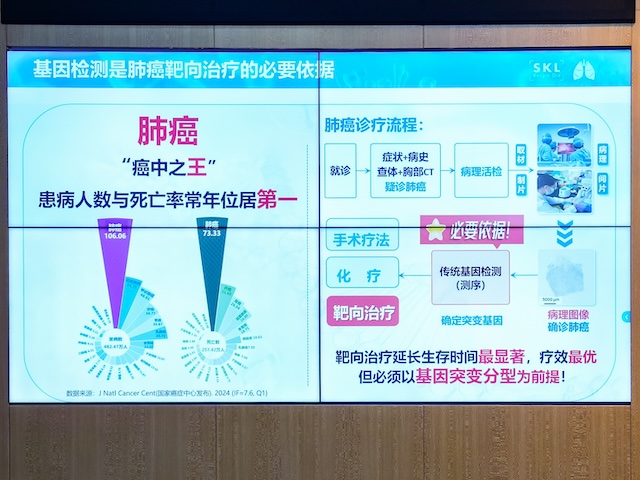
传统肿瘤基因检测价格过万,大模型能改变多少
Di Yi Cai Jing· 2025-10-12 03:17
Core Insights - AI technology has the potential to transform traditional gene testing diagnostic processes [1] - The collaboration between KingMed Diagnostics, Tencent, and Guangzhou Medical University aims to develop a multi-modal AI model for accurate and accessible gene mutation predictions for cancer patients [2][5] Group 1: Traditional Gene Testing Challenges - Traditional tumor gene testing is expensive, with costs ranging from 15,000 to 20,000 yuan, making it unaffordable for many patients [4] - The waiting time for traditional gene testing can take 7 to 14 days, during which patients' conditions may deteriorate, delaying treatment and reducing survival rates [4] - There is a lack of gene testing capabilities in most hospitals outside of top-tier institutions, limiting access for patients [4] Group 2: AI Model Development and Validation - The AI model "DeepGEM" has been developed to predict lung cancer gene mutations using routine tissue pathology images, achieving a prediction accuracy of 78% to 99% within one minute [5] - A larger-scale validation of the DeepGEM model is planned for 2025 in collaboration with KingMed Diagnostics [5] - The partnership aims to expand the model's application in lung cancer gene identification and explore its capabilities in other cancer types [5] Group 3: Future Directions and Goals - KingMed Diagnostics emphasizes the importance of AI in transforming traditional diagnostic processes, providing timely guidance for urgent cases and affordable diagnostic pathways for patients without access to expensive testing [6] - The collaboration aims to create a new paradigm in smart medical testing, with aspirations to extend beyond cancer diagnostics to rare and complex diseases [6]

金域医学:联合腾讯、广医附一院开发病理基因多模态大模型
Zheng Quan Shi Bao Wang· 2025-10-11 10:39
Core Insights - The collaboration between Kingmed Medical, Tencent, and Guangzhou Medical University First Affiliated Hospital aims to develop the AI model DeepGEM for predicting gene mutations in cancer patients using routine pathological images [1][5][6] - DeepGEM has demonstrated a high accuracy rate of 78% to 99% in predicting common lung cancer driver gene mutations, significantly improving the efficiency and accessibility of genetic diagnostics [2][4] Group 1: Development and Technology - DeepGEM is developed by a collaboration between Guangzhou Medical University First Affiliated Hospital, Guangzhou Respiratory Health Research Institute, and Tencent, marking a significant advancement from traditional pathology to genetic insights [1][3] - The model utilizes innovative techniques such as Multiple Instance Learning (MIL) and an end-to-end architecture that enhances prediction accuracy without the need for manual tumor region annotation [3][4] Group 2: Clinical Application and Validation - Kingmed Medical is providing a large-scale dataset for validating DeepGEM, with over 15,000 NGS tests conducted annually and a sample size of 4,260 lung cancer patients across various medical institutions [4][5] - The model has reached clinical auxiliary diagnostic levels for identifying mutations in genes like EGFR, KRAS, and ALK, showcasing its robustness and compatibility for clinical use [4][6] Group 3: Future Prospects and Expansion - The partnership aims to expand the application of DeepGEM beyond lung cancer to other cancer types, integrating various omics data for a comprehensive diagnostic approach [5][6] - The collaboration is seen as a milestone in the exploration of AI-driven pathology-genetics models, with aspirations to enhance the efficiency of clinical research and diagnostics in both cancer and rare diseases [6]