DishBrain

Search documents
心智观察所:离体脑细胞学会打游戏,智能从何而来?
Guan Cha Zhe Wang· 2026-02-07 01:14
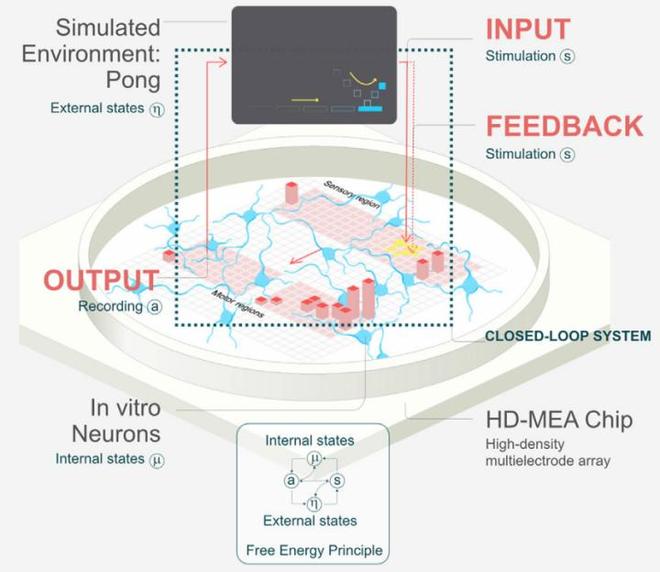
神经元如何"看见"和"移动"? 要理解这项实验的精妙之处,首先需要了解科学家是如何让这些"无眼无手"的神经元与游戏世界互动 的。 实验的核心是一个高密度微电极阵列(HD-MEA)——一块布满数千个微型电极的硅芯片。研究人员将 从小鼠胚胎皮层或人类诱导多能干细胞(hiPSCs)分化而来的神经元接种在这块芯片上。几天后,这些 神经元彼此连接,形成一个自发放电、具有基本网络结构的微型"脑组织"。 【文/观察者网专栏作者 心智观察所】 近年来,随着大语言模型的爆发式发展和生成式人工智能的广泛应用,人们一度认为硅基计算——即由 晶体管、芯片和算法构成的传统人工智能——已经牢牢锁定了通往未来的道路。然而,就在AI系统变 得越来越庞大、能耗越来越高、对数据依赖越来越强的同时,一个曾被边缘化的疑问重新浮出水面:智 能是否必须建立在硅片之上?有没有可能,真正的下一代智能,其根基不在金属与电流,而在活生生的 细胞与突触之中? 这一问题并非空想。在全球多个前沿实验室里,科学家正尝试将活体神经元与电子设备深度融合,构建 一种被称为"合成生物智能"(Synthetic Biological Intelligence)的新范式。它不依赖 ...

离体脑细胞学会打游戏,智能从何而来?
Guan Cha Zhe Wang· 2026-01-29 00:43
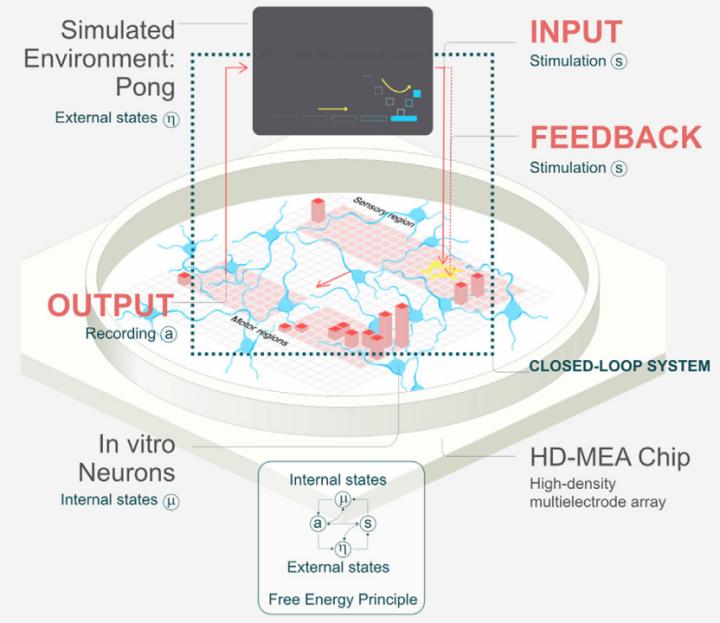
Core Insights - The article discusses the emergence of "Synthetic Biological Intelligence" (SBI), which integrates living neurons with electronic devices, challenging the traditional silicon-based AI paradigm [1][13]. Group 1: Experiment Overview - The experiment conducted by Cortical Labs demonstrated that living neurons could learn to play the video game "Pong" without a physical body, showcasing their ability to perceive and react in a virtual environment [2][4]. - The system, named "DishBrain," consists of neurons from mouse embryos or human stem cells placed on a microchip, forming a mini brain that can interact with a simplified game [2][4]. Group 2: Mechanism of Interaction - The interaction between neurons and the game is facilitated by a high-density microelectrode array that sends electrical signals to the neurons based on the ball's position on the screen [4][5]. - Neurons control the paddle's movement by adjusting their firing rates in response to the game's feedback, creating a closed-loop system of learning [5][7]. Group 3: Learning Process - The neurons improved their gameplay by extending the duration of each game round, indicating enhanced accuracy in hitting the ball, achieved through a feedback mechanism based on the Free Energy Principle [7][8]. - The experiment confirmed that only neurons in a closed-loop feedback system exhibited learning capabilities, ruling out random fluctuations as a source of learning [8]. Group 4: Comparison of Neurons - Human-derived neurons outperformed mouse-derived neurons in the later stages of the game, suggesting differences in synaptic plasticity and information processing efficiency between species [9][11]. - The term "sentience" used in the study refers to the neurons' ability to respond adaptively to sensory inputs, not implying consciousness or emotional awareness [12]. Group 5: Implications for Synthetic Biological Intelligence - The findings of DishBrain suggest a new direction for technology, where living neurons could serve as computational units, potentially leading to more efficient and adaptive systems compared to traditional AI [13]. - Applications for DishBrain include drug testing and studying neurodegenerative diseases, highlighting its potential in real-world scenarios [13]. Group 6: Ethical Considerations - The advancement of systems like DishBrain raises ethical questions regarding the treatment of increasingly complex neural networks, prompting discussions on their moral status [14]. - The article emphasizes the need for ethical frameworks to address the implications of creating entities with adaptive capabilities [14]. Group 7: Conclusion - The DishBrain experiment illustrates that intelligence can emerge from simple rules of minimizing unpredictability, prompting a reevaluation of the nature of intelligence and its origins [15][16].