自由能原理

Search documents
离体脑细胞学会打游戏,智能从何而来?
Guan Cha Zhe Wang· 2026-01-29 00:43
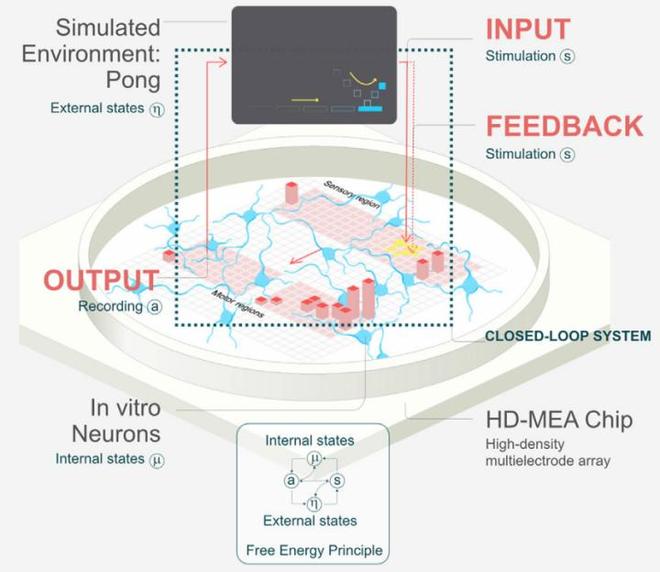
Core Insights - The article discusses the emergence of "Synthetic Biological Intelligence" (SBI), which integrates living neurons with electronic devices, challenging the traditional silicon-based AI paradigm [1][13]. Group 1: Experiment Overview - The experiment conducted by Cortical Labs demonstrated that living neurons could learn to play the video game "Pong" without a physical body, showcasing their ability to perceive and react in a virtual environment [2][4]. - The system, named "DishBrain," consists of neurons from mouse embryos or human stem cells placed on a microchip, forming a mini brain that can interact with a simplified game [2][4]. Group 2: Mechanism of Interaction - The interaction between neurons and the game is facilitated by a high-density microelectrode array that sends electrical signals to the neurons based on the ball's position on the screen [4][5]. - Neurons control the paddle's movement by adjusting their firing rates in response to the game's feedback, creating a closed-loop system of learning [5][7]. Group 3: Learning Process - The neurons improved their gameplay by extending the duration of each game round, indicating enhanced accuracy in hitting the ball, achieved through a feedback mechanism based on the Free Energy Principle [7][8]. - The experiment confirmed that only neurons in a closed-loop feedback system exhibited learning capabilities, ruling out random fluctuations as a source of learning [8]. Group 4: Comparison of Neurons - Human-derived neurons outperformed mouse-derived neurons in the later stages of the game, suggesting differences in synaptic plasticity and information processing efficiency between species [9][11]. - The term "sentience" used in the study refers to the neurons' ability to respond adaptively to sensory inputs, not implying consciousness or emotional awareness [12]. Group 5: Implications for Synthetic Biological Intelligence - The findings of DishBrain suggest a new direction for technology, where living neurons could serve as computational units, potentially leading to more efficient and adaptive systems compared to traditional AI [13]. - Applications for DishBrain include drug testing and studying neurodegenerative diseases, highlighting its potential in real-world scenarios [13]. Group 6: Ethical Considerations - The advancement of systems like DishBrain raises ethical questions regarding the treatment of increasingly complex neural networks, prompting discussions on their moral status [14]. - The article emphasizes the need for ethical frameworks to address the implications of creating entities with adaptive capabilities [14]. Group 7: Conclusion - The DishBrain experiment illustrates that intelligence can emerge from simple rules of minimizing unpredictability, prompting a reevaluation of the nature of intelligence and its origins [15][16].

AI 让企业更快,也更乱?问题不在算法,而在组织本身
3 6 Ke· 2026-01-06 05:03
Core Insights - The core argument is that the next wave of artificial intelligence (AI) will not depend on larger models or more data, but rather on the ability to minimize errors and quickly correct them, highlighting the need for organizations to evolve beyond traditional industrial logic [1] Group 1: AI's Role in Organizations - AI is transforming from a mere tool to a magnifying glass that amplifies existing order and chaos within organizations [1] - The real challenge for companies is not just how to use AI, but whether they possess the ability to self-perceive, self-regulate, and self-evolve like living systems [1] Group 2: Diverging Paths in AI Development - The current AI landscape is splitting into two paths: one focused on scaling through larger models and more data, and another advocating for a shift in approach beyond mere computational power [2] - Prominent figures in AI, such as OpenAI's co-founder Ilya Sutskever and Turing Award winner Yann LeCun, warn that relying solely on scale is nearing its limits and that a new paradigm is needed [2][3][5] Group 3: Free Energy Principle (FEP) - The Free Energy Principle (FEP) posits that all living systems aim to minimize unexpected occurrences, which can be applied to organizational behavior [6][12] - Organizations must continuously predict, monitor, and correct deviations from expected outcomes to maintain stability and reduce operational costs [13][15] Group 4: Organizational Design and Efficiency - Effective organizations should create a clear internal cognitive map to ensure all members have a unified understanding of the current state [16] - Monitoring energy flow and minimizing wasteful consumption are crucial for maintaining efficiency in complex systems [16] - Organizations should align their strategic elements to create a "momentum advantage," reducing internal friction and unexpected outcomes [16] Group 5: Transition to Efficient Reasoning - The shift from brute-force computation to efficient reasoning in AI indicates that future competitive advantages will come from generating accurate judgments with fewer resources [17] - Organizations that can continuously sense, adjust, and respond effectively to changes will likely maintain competitiveness in the evolving AI landscape [17]
谷歌Dreamer大神离职,自曝错过Transformer
3 6 Ke· 2025-11-05 02:20
Core Insights - Danijar Hafner, a prominent researcher at Google DeepMind, has announced his departure after nearly ten years, marking the end of a significant chapter in his career [1][4]. Group 1: Career Overview - Danijar served as a Staff Research Scientist at Google DeepMind's San Francisco branch, focusing on developing general intelligent agents capable of understanding and interacting with the world [1]. - His notable contributions include leading the development of the Dreamer series, which encompasses Dreamer, DreamerV3, and Dreamer4 [1][21]. - He began his career with an internship at Google Brain in Mountain View in 2016, collaborating with notable figures in the field [7]. Group 2: Educational Background - Danijar's educational journey includes a PhD at the University of Toronto from 2018 to 2023, where he worked extensively with the Brain Team [6][17]. - He also pursued a Master's degree at University College London while working at DeepMind in London [6][14]. - His academic path reflects a strong foundation in deep learning and reinforcement learning, with mentorship from influential figures like Geoffrey Hinton [17][21]. Group 3: Research Contributions - Danijar's research has significantly advanced the field of world models, particularly through the development of the Dreamer series, which allows for complex task completion in offline environments [21]. - He collaborated with Mohammad Norouzi on various versions of Dreamer, contributing to the understanding of intelligent systems [19]. - His work has been supported by top-tier resources and collaborations, enhancing the exploration of cutting-edge AI technologies [21].