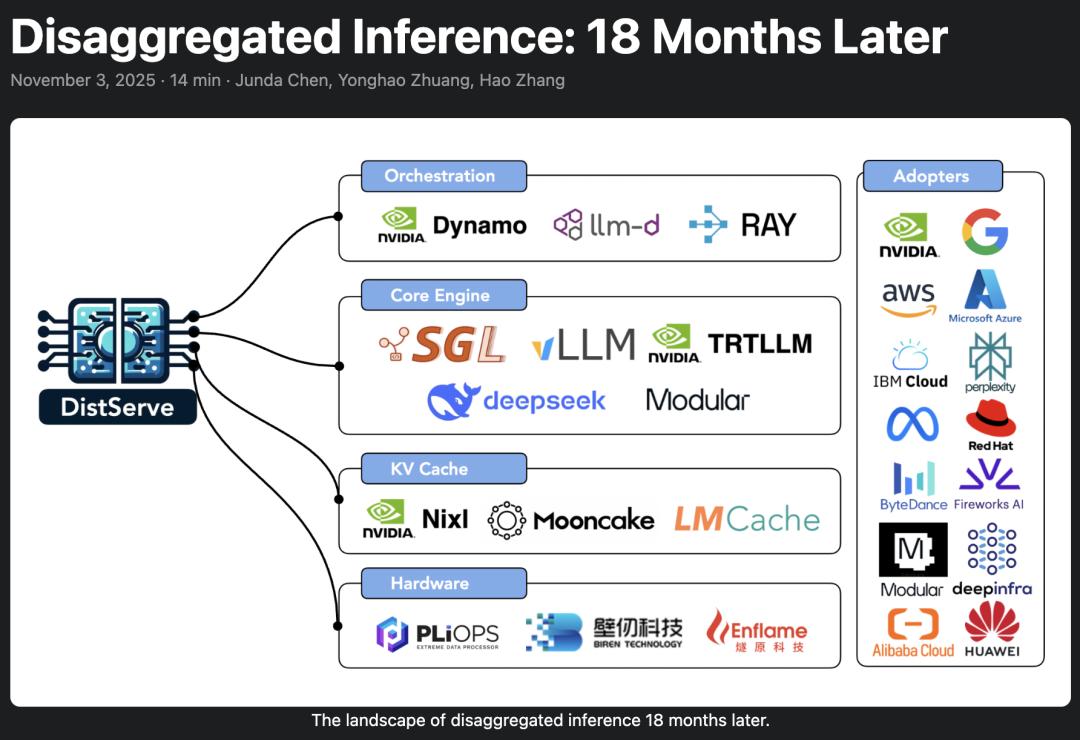
DistServe系统

Search documents
英伟达、DeepSeek集体跟进,18个月前被忽视,如今统治AI推理
3 6 Ke· 2025-11-10 04:11
Core Insights - The article discusses the emergence of the "Decoupled Inference" concept introduced by the Peking University and UCSD teams, which has rapidly evolved from a laboratory idea to an industry standard adopted by major frameworks like NVIDIA and vLLM, indicating a shift towards "modular intelligence" in AI [1] Group 1: Decoupled Inference Concept - The DistServe system, launched in March 2024, proposes a bold idea of splitting the inference process of large models into two stages: "prefill" and "decode," allowing them to scale and schedule independently in separate resource pools [1][19] - This decoupled architecture addresses two fundamental limitations of previous inference frameworks: interference and coupled scaling, which hindered efficiency and increased costs in production environments [10][15][18] - By separating prefill and decode, DistServe enables independent scaling to meet latency requirements for both stages, significantly improving overall efficiency [19][22] Group 2: Adoption and Impact - Initially, the decoupled inference concept faced skepticism in the open-source community due to the engineering investment required for deep architectural changes [21] - However, by 2025, it gained widespread acceptance as businesses recognized the critical importance of latency control for their core operations, leading to its adoption as a default solution in major inference stacks [22][23] - The decoupled architecture allows for high resource utilization and flexibility in resource allocation, especially as model sizes and access traffic increase [22][23] Group 3: Current State and Future Directions - The decoupled inference has become a primary design principle in large model inference frameworks, influencing orchestration layers, inference engines, storage systems, and emerging hardware architectures [23][31] - Future research is exploring further disaggregation at the model level, such as "Attention-FFN Disaggregation," which separates different components of the model across various nodes [33][34] - The trend is moving towards a more modular approach in AI systems, where different functional modules can evolve, expand, and optimize independently, marking a significant shift from centralized to decoupled architectures [47][48]