ERNIE 3.0

Search documents
智谱华章上市首日暴涨:中国AI大模型能否挑战OpenAI?
Sou Hu Cai Jing· 2026-01-07 11:54
Core Insights - The core narrative revolves around the significant rise of Zhiyuan Huazhang (智谱华章) in the AI large model sector, marking a pivotal challenge to OpenAI's dominance in the global market [1][5]. Group 1: Market Performance - Zhiyuan Huazhang's stock opened at 210 HKD, soaring 80.7% from its issue price, with a market capitalization exceeding 90 billion HKD, making it the highest-valued non-U.S. listed company in the AI large model sector [1]. - The company's debut was characterized by an oversubscription of over 58 times, with frozen funds exceeding 29 billion HKD, and a first-day increase of 110%, nearing a market cap of 100 billion HKD [1]. Group 2: Technological Advancements - Zhiyuan's GLM-4.7 model has surpassed GPT-5.2 in code generation, achieving a 98.3% pass rate on the HumanEval benchmark, compared to GPT-5.2's 96.1% [2]. - The company has established a robust ecosystem with 2.7 million paying users through a dual approach of "open source + API calls," generating annual revenue exceeding 320 million CNY [2]. Group 3: Industry Context - The rise of Chinese AI large models is supported by national policies and the Hong Kong Stock Exchange's regulations, creating a favorable environment for hard-tech enterprises [2]. - Competing models from Alibaba and Baidu have established technical barriers in specific areas, with Alibaba's Qwen3-Max achieving full marks in mathematical reasoning tests [2]. Group 4: Strategic Approaches - Chinese companies are adopting a "rural encirclement of cities" strategy, with Zhiyuan providing national-level AI infrastructure solutions in Southeast Asia and Alibaba deploying over 100,000 AI agents on its e-commerce platform [4]. - The capital market has shown strong support, with AI sector financing in Hong Kong increasing by 177% year-on-year, and leading firms raising over 20 billion HKD [4]. Group 5: Future Outlook - The competition in global AI is evolving beyond mere parameter comparisons to encompass technology routes, ecosystem building, and geopolitical factors [6][7]. - The strategic positioning of Chinese AI large models aims to create a "second brain" for the digital age, indicating a potential shift in the global AI landscape [5].


首部法律LLM全景综述发布,双重视角分类法、技术进展与伦理治理
3 6 Ke· 2025-07-31 09:13
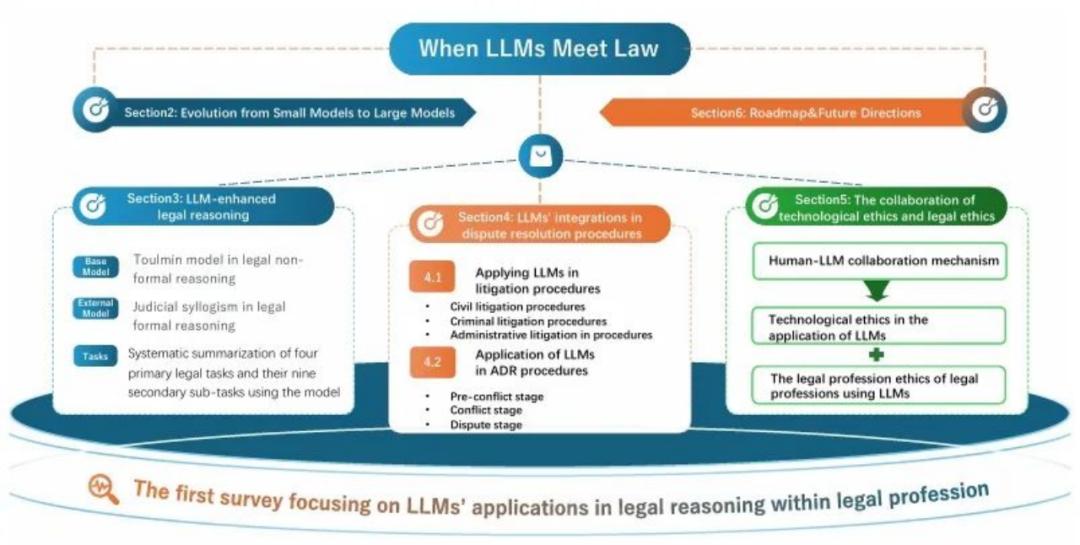
Core Insights - The article presents a comprehensive review of the application of Large Language Models (LLMs) in the legal field, introducing an innovative dual perspective classification method that integrates legal reasoning frameworks with professional ontology [1][3][5] - It highlights the advancements of LLMs in legal text processing, knowledge integration, and formal reasoning, while also addressing core issues such as hallucinations, lack of interpretability, and cross-jurisdictional adaptability [1][5][12] Group 1: Technological Advancements - Traditional legal AI methods are limited by symbolic approaches and small model techniques, facing challenges such as knowledge engineering bottlenecks and insufficient semantic interoperability [6][8] - The emergence of LLMs, powered by Transformer architecture, has successfully overcome the limitations of earlier systems through context reasoning, few-shot adaptation, and generative argumentation capabilities [6][12] - The legal sector's demand for complex text processing, multi-step reasoning, and process automation aligns well with the emerging capabilities of LLMs [8][12] Group 2: Ethical and Governance Challenges - The practical application of technology in the legal field is accompanied by ethical risks, such as the amplification of biases and the weakening of professional authority, necessitating a systematic research framework to integrate technology, tasks, and governance [3][8][11] - The review systematically analyzes ethical challenges faced by legal practitioners, including technical ethics and legal professional responsibilities, expanding user-centered ontology research for LLM deployment [11][12] Group 3: Research Contributions - The study employs an innovative dual perspective framework that combines legal argumentation types with legal professional roles, significantly advancing research in the field [9][12] - It constructs a legal reasoning ontology framework that aligns the Toulmin argument structure with LLM workflows, integrating contemporary LLM advancements with historical evidence research [9][10] - A role-centered deployment framework for LLMs is proposed, merging litigation and non-litigation workflows to meet the demand for smarter tools in legal practice [10][12] Group 4: Future Directions - Future research should prioritize multi-modal evidence integration, dynamic rebuttal handling, and aligning technological innovations with legal principles to create robust and ethically grounded legal AI [13] - The article advocates for a legal profession-centered strategy, positioning LLMs as supportive tools rather than decision-makers, ensuring human oversight at critical junctures [13]