Eagle

Search documents
Got $5,000? 2 Quantum Computing Stocks That Insiders Haven't Stopped Buying
Yahoo Finance· 2026-03-16 10:20
Group 1: Quantum Computing Overview - Quantum computers can process certain tasks much faster than classical computers, but they are larger, more expensive, and consume more power, with a higher percentage of errors. Over the next decade, improvements are expected to make them smaller, cheaper, more power-efficient, and more accurate, leading to broader client adoption for mainstream applications [1] Group 2: IBM - IBM has been expanding its quantum computing business over the past decade, deploying over 85 quantum systems to run more than 3 trillion programs. The company aims to build a fully error-free quantum system by 2029 with several experimental chips [5] - IBM's clients primarily include universities and government research institutions, but it aims to reach a broader market by integrating quantum services into its hybrid cloud and AI ecosystem [6] - Analysts project IBM's revenue and EPS to grow at CAGRs of 5% and 7% respectively from 2025 to 2028, with the stock currently valued at 23 times this year's earnings. Insiders have bought nearly 60% as many shares as they sold in the past three months [7] Group 3: IonQ - IonQ produces its own quantum systems and offers computing power as a cloud-based service. It utilizes tiny lasers to trap ions in a quantum state, allowing for operation at room temperature and generally lower error rates compared to electron-based systems [8] - IonQ plans to increase its quantum computing power from 64 physical qubits in 2025 to over 2 million qubits by 2030, aiming to achieve this through miniaturization of quantum processing units and scaling up its systems [9]


欧洲首台E级超算诞生
Guan Cha Zhe Wang· 2025-11-19 14:54
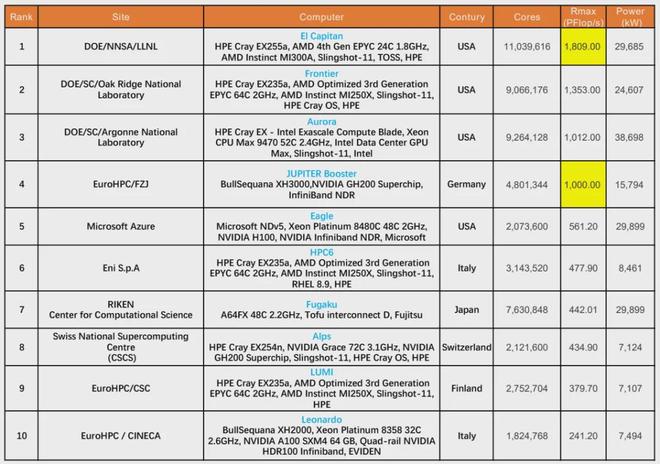
Core Insights - The 66th TOP500 supercomputer ranking was announced at the SC25 conference, highlighting the deployment of Germany's JUPITER Booster, which has achieved exascale performance, marking it as Europe's first exascale supercomputer and the fourth globally [1][8]. Group 1: Supercomputer Rankings - The top three positions in the ranking are held by the U.S. Department of Energy's El Capitan, Frontier, and Aurora, with El Capitan achieving a performance of 1.809 Exaflop/s, an increase from 1.742 Exaflop/s in the previous ranking [3][5]. - Frontier maintains its second position with a performance of 1.353 Exaflop/s, while Aurora remains third at 1.012 Exaflop/s, showing no change compared to previous rankings [5]. Group 2: European Achievements - The JUPITER Booster, based on the BullSequana XH3000 architecture, has successfully crossed the exascale threshold with a performance of 1 Exaflop/s, representing a significant milestone for Europe in the supercomputing domain [8][10]. - The presence of JUPITER, along with Finland's LUMI and Italy's Leonardo, in the TOP10 reflects the success of the EU's EuroHPC initiative, which aims to enhance Europe's competitiveness in supercomputing through collaborative resource integration [10][11]. Group 3: Global Investment Trends - Countries are significantly increasing their investments in supercomputing, with the U.S. planning to invest $1 billion for two new generation supercomputers, the UK launching a £2 billion investment for a world-class computing ecosystem, and the EU enhancing its EuroHPC network to strengthen its AI capabilities [12]. - Despite not having new systems in the TOP500 recently, China continues to advance its supercomputing research and development, indicating a trend towards a multipolar global computing landscape [12]. Group 4: International Collaboration - The competition in the supercomputing field is not a zero-sum game, as demonstrated by Europe's EuroHPC initiative, which promotes cross-national collaboration and resource integration to achieve exascale breakthroughs [13]. - There is a need for an open collaborative system across regions and disciplines to address global challenges such as climate change and energy transition, emphasizing the role of supercomputers in advancing technology for sustainable development [13].