FAST)

Search documents
“中国天眼”如何找到快速射电暴双星起源关键证据?
Ren Min Ri Bao· 2026-01-19 07:00
Core Findings - The research team led by the Purple Mountain Observatory of the Chinese Academy of Sciences announced the first detailed observation of the evolution process of the Faraday rotation of a repeating fast radio burst (FRB), providing key evidence for the hypothesis that FRBs originate from binary star systems [2][3][4] Group 1: Fast Radio Bursts (FRBs) - Fast radio bursts are mysterious cosmic phenomena that release energy equivalent to the total radiation of the Sun over a week in just milliseconds [3] - The team monitored the repeating FRB 20220529 for over two years, utilizing the high sensitivity of the "Chinese Sky Eye" [3][4] - A significant increase in the Faraday rotation measure of FRB 20220529 was observed, reaching 20 times the normal variation, followed by a rapid decline back to normal levels, marking a first in recorded FRB studies [3][4] Group 2: Scientific Contributions of the "Chinese Sky Eye" - Since its acceptance in 2020, the "Chinese Sky Eye" has maintained stable operations, with over 5400 hours of observation and more than 17.5 petabytes of new scientific data generated in the last complete observation year [5][6] - The telescope has produced groundbreaking results in various fields, including gravitational wave detection, pulsar searches, and FRB studies [6][7] - The "Chinese Sky Eye" has also improved radar imaging resolution of the Moon from kilometers to 10 meters, aiding geological studies and resource exploration [7] Group 3: Future Developments and Upgrades - The "Chinese Sky Eye" is advancing its upgrade plans to become a "super probe" of the universe, with ongoing research to replace imported components with domestically produced alternatives [8][9] - The project aims to construct a giant synthetic aperture array around the "Chinese Sky Eye," enhancing observational capabilities and solidifying China's leading position in low-frequency radio astronomy [8][9] - By 2025, the completion of core array antennas and low-noise receivers is expected to significantly enhance the telescope's functionality, supporting deeper investigations into cosmic mysteries [9]

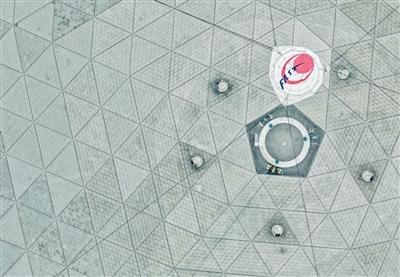
“中国天眼”正稳步推进升级规划 构建全球唯一巨型综合孔径阵列
Zhong Guo Xin Wen Wang· 2026-01-16 04:01
Core Insights - The "China Sky Eye" (FAST) is advancing its upgrade plan to establish a unique giant integrated aperture array centered around the telescope, enhancing its observational capabilities and solidifying China's leadership in the field of radio astronomy [1][3]. Group 1: Upgrade and Innovation - The upgrade will involve the construction of dozens of medium-sized antennas around the 500-meter diameter FAST, addressing the limitations of single-dish telescopes in spatial resolution and significantly improving observational sensitivity [1][3]. - This innovative design aims to achieve a qualitative leap in comprehensive observational performance, reinforcing China's core position in the mid-low frequency radio astronomy sector amidst intense international competition [3]. Group 2: Scientific Contributions - Upon completion of the upgrades, FAST will serve as a more powerful "cosmic super probe," aiding scientists in understanding the origins of fast radio bursts and addressing long-standing astrophysical challenges such as the Hubble constant crisis and the missing baryonic matter problem [3][4]. - The telescope has already produced groundbreaking results in various fields, including gravitational wave detection, pulsar searches, and neutral hydrogen observations, significantly enhancing China's academic influence and international standing in radio astronomy [4]. Group 3: Strategic Importance - The achievements of the "China Sky Eye" reflect China's core capabilities in major scientific infrastructure, showcasing the country's ability to independently control key technologies and continuously lead in scientific output [4].

国际首次!“中国天眼”发现揭示快速射电暴双星起源关键证据
Zhong Guo Xin Wen Wang· 2026-01-16 03:15
Core Insights - The "China Sky Eye" (FAST) has made a significant breakthrough by capturing the detailed evolution of the Faraday rotation of a repeating fast radio burst (FRB), providing crucial observational evidence for the hypothesis that fast radio bursts originate from binary star systems [1][4][7]. Group 1: Research Findings - The research team, led by the Purple Mountain Observatory of the Chinese Academy of Sciences, published their findings in the journal "Science" on January 16, 2023, and held a press conference to explain the results [3]. - The Faraday rotation of FRB 20220529 was monitored for over two years, revealing a sudden spike to 1977±84 radians/m², approximately 20 times the previous fluctuation range, followed by a rapid decline back to normal levels [6][8]. - This unprecedented observation of rapid and reversible magnetic environment changes marks a first in the history of fast radio burst research [6]. Group 2: Implications for Astrophysics - The core physical mechanism behind the observed Faraday rotation change is attributed to a dense magnetized plasma cloud from the fast radio burst's source, which passed through the line of sight between Earth and the burst [7]. - The findings suggest that if FRB 20220529 originated from a solitary neutron star, existing theories cannot explain such a drastic and rapid magnetic environment change. However, if it is part of a binary system, the intense activity from a companion star could naturally produce the observed Faraday rotation event [7]. - This discovery provides strong observational support for the binary star origin model of fast radio bursts, enhancing the understanding of their mechanisms [7].