法拉第旋转量

Search documents
“中国天眼”如何找到快速射电暴双星起源关键证据?
Ren Min Ri Bao· 2026-01-19 07:00
Core Findings - The research team led by the Purple Mountain Observatory of the Chinese Academy of Sciences announced the first detailed observation of the evolution process of the Faraday rotation of a repeating fast radio burst (FRB), providing key evidence for the hypothesis that FRBs originate from binary star systems [2][3][4] Group 1: Fast Radio Bursts (FRBs) - Fast radio bursts are mysterious cosmic phenomena that release energy equivalent to the total radiation of the Sun over a week in just milliseconds [3] - The team monitored the repeating FRB 20220529 for over two years, utilizing the high sensitivity of the "Chinese Sky Eye" [3][4] - A significant increase in the Faraday rotation measure of FRB 20220529 was observed, reaching 20 times the normal variation, followed by a rapid decline back to normal levels, marking a first in recorded FRB studies [3][4] Group 2: Scientific Contributions of the "Chinese Sky Eye" - Since its acceptance in 2020, the "Chinese Sky Eye" has maintained stable operations, with over 5400 hours of observation and more than 17.5 petabytes of new scientific data generated in the last complete observation year [5][6] - The telescope has produced groundbreaking results in various fields, including gravitational wave detection, pulsar searches, and FRB studies [6][7] - The "Chinese Sky Eye" has also improved radar imaging resolution of the Moon from kilometers to 10 meters, aiding geological studies and resource exploration [7] Group 3: Future Developments and Upgrades - The "Chinese Sky Eye" is advancing its upgrade plans to become a "super probe" of the universe, with ongoing research to replace imported components with domestically produced alternatives [8][9] - The project aims to construct a giant synthetic aperture array around the "Chinese Sky Eye," enhancing observational capabilities and solidifying China's leading position in low-frequency radio astronomy [8][9] - By 2025, the completion of core array antennas and low-noise receivers is expected to significantly enhance the telescope's functionality, supporting deeper investigations into cosmic mysteries [9]

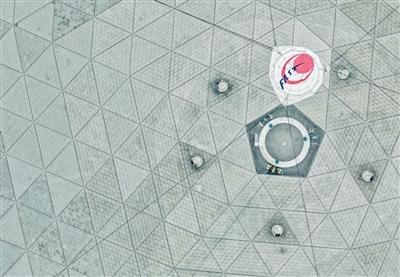
“中国天眼”揭示快速射电暴双星起源关键证据 极目星河深处 求索未解之谜(科技自立自强)
Ren Min Ri Bao· 2026-01-18 22:05
Core Viewpoint - The research team led by the Chinese Academy of Sciences has found key evidence regarding the origin of fast radio bursts (FRBs), suggesting they may originate from binary star systems, as reported in the journal "Science" [1][2]. Group 1: Fast Radio Bursts Research - Fast radio bursts are mysterious cosmic phenomena that release energy equivalent to the total radiation of the Sun over a week in just milliseconds [2]. - The team monitored the repeating fast radio burst FRB 20220529 for over two years, utilizing the high sensitivity of the "Chinese Sky Eye" [2][3]. - A significant observation was made when the Faraday rotation measure of FRB 20220529 surged to 20 times its normal level before returning to typical fluctuations, marking a first in recorded FRB studies [2][3]. Group 2: Scientific Contributions of the "Chinese Sky Eye" - Since its operation began in 2020, the "Chinese Sky Eye" has maintained high efficiency, with over 5400 hours of observation and more than 17.5 petabytes of new scientific data generated in the last complete observation year [4]. - The telescope has produced groundbreaking results in various fields, including the detection of gravitational waves, pulsar searches, and studies of neutral hydrogen [5]. - The "Chinese Sky Eye" has also improved radar imaging resolution of the Moon from kilometers to 10 meters, aiding geological studies and resource exploration [6]. Group 3: Future Developments and Upgrades - The "Chinese Sky Eye" is advancing its upgrade plans to become a "super probe" of the universe, with ongoing research to replace imported components with domestically produced alternatives [7][8]. - By 2025, two core array antennas will be completed, enhancing observational capabilities and addressing long-standing astrophysical questions [8].
“中国天眼”新发现:宇宙神秘“闪光”来自双星系统
Xin Lang Cai Jing· 2026-01-16 19:06
Core Viewpoint - The Chinese 500-meter Aperture Spherical Telescope (FAST) has made a significant breakthrough in understanding the origin of fast radio bursts (FRBs), providing key evidence that supports the theory of their origin in binary star systems [1][2]. Group 1: Research Findings - The research team, led by the Purple Mountain Observatory of the Chinese Academy of Sciences, monitored a repeating fast radio burst named FRB 20220529 for over two years, focusing on a metric called the "Faraday rotation measure," which reflects the magnetic environment along the signal's path [2]. - In December 2023, the team observed a significant spike in the Faraday rotation measure, reaching approximately 20 times its normal fluctuation level, followed by a gradual return to normal within two weeks, marking the first detailed record of such a rapid and reversible change in FRB research [2]. - The observed magnetic environment change is believed to be caused by a cloud of magnetized charged material briefly passing through the line of sight, supporting the binary star system origin theory rather than a solitary neutron star [2]. Group 2: Technological and Collaborative Aspects - The successful detection and recording of the faint target signal demonstrate the advanced sensitivity of FAST, showcasing the strength of China's major scientific infrastructure and the collaborative capabilities of its research teams [3]. - The research was a collaborative effort involving multiple institutions, and the findings were published online in the international journal "Science" [3]. - Future upgrades to FAST will include the construction of an array system to further enhance observational capabilities, aiding in the exploration of cosmic mysteries [3].

【新华社】“中国天眼”找到快速射电暴起源关键证据
Xin Hua She· 2026-01-16 07:08
Core Viewpoint - The research team led by the Purple Mountain Observatory of the Chinese Academy of Sciences has captured the detailed evolution process of the Faraday rotation measure (RM) of a repeating fast radio burst (FRB), providing key observational evidence for the hypothesis that fast radio bursts originate from binary star systems [3][4]. Group 1: Research Findings - The team utilized the 500-meter Aperture Spherical Telescope (FAST) to monitor the repeating fast radio burst FRB 20220529 for over two years, concluding that it likely originates from a binary star system [3]. - The observed Faraday rotation measure exhibited a 20-fold increase followed by a rapid decrease, indicating the passage of a dense magnetized plasma cloud through the observational line, consistent with the intense activity of a companion star in a binary system [4]. Group 2: Technological Advancements - FAST, the world's largest single-dish radio telescope, has produced significant results in various fields, including gravitational wave detection, pulsar searches, and fast radio burst studies since its inception [4]. - The FAST operation and development center plans to upgrade the telescope by constructing dozens of medium-sized antennas around it, creating a giant integrated aperture array to enhance observational sensitivity and overcome the limitations of single-dish telescopes [4].

中国天眼,新成果发布
财联社· 2026-01-16 04:58
Core Insights - The article discusses a significant breakthrough in astrophysics achieved by a research team led by the Purple Mountain Observatory, which captured the detailed evolution of the Faraday rotation measure (RM) of a repeating fast radio burst (FRB) for the first time internationally, providing strong observational evidence for the hypothesis that fast radio bursts originate from binary star systems [1][4]. Group 1: Fast Radio Bursts (FRBs) - Fast radio bursts are one of the most mysterious radio explosion phenomena in the universe, lasting only a few milliseconds but releasing energy equivalent to the total radiation of the Sun over a week [2][3]. - Since their first discovery in 2007, the origin mechanisms of fast radio bursts have remained a significant mystery in astrophysics, with speculation linking them to compact objects like neutron stars [2][3]. Group 2: Research Methodology - The research team utilized the high sensitivity of the Chinese Tianyan FAST to conduct over two years of continuous monitoring of the repeating fast radio burst FRB 20220529 [4]. - A crucial parameter monitored was the Faraday rotation measure, which reflects the density of plasma and magnetic field strength along the signal's propagation path, acting as a precise "cosmic magnetic environment probe" [4]. Group 3: Key Findings - The Faraday rotation measure of FRB 20220529 exhibited a dramatic increase, reaching 20 times its normal variation level, followed by a rapid decline back to normal within two weeks, marking a first in recorded fast radio burst research [4][5]. - The observed phenomenon is attributed to a dense magnetized plasma cloud from the vicinity of the fast radio burst source passing through the line of sight to Earth, similar to solar activity causing coronal mass ejections [5]. - Further analysis indicates that if FRB 20220529 originated from an isolated neutron star, existing theories could not explain the rapid magnetic environment changes; however, if it is part of a binary system, the intense activity from a companion star could naturally account for the observed fluctuations in the Faraday rotation measure [5].

新华鲜报丨再立新功!“中国天眼”找到快速射电暴起源关键证据
Xin Hua She· 2026-01-16 03:32
Core Insights - A research team led by the Purple Mountain Observatory of the Chinese Academy of Sciences has captured the detailed evolution of the Faraday rotation measure (RM) of a repeating fast radio burst (FRB), providing key observational evidence for the hypothesis that FRBs originate from binary star systems [1][3] Group 1: Research Findings - The team monitored the repeating fast radio burst FRB 20220529 for over two years, concluding that it likely originates from a binary star system [3] - The observed Faraday rotation measure increased by 20 times and then rapidly decreased, indicating the passage of a dense magnetized plasma cloud through the line of sight, consistent with the activity of a companion star in a binary system [3] Group 2: Technological Advancements - The Five-hundred-meter Aperture Spherical Telescope (FAST) is the world's largest single-dish radio telescope, contributing to various fields such as gravitational wave detection and pulsar searches since its operation [5] - FAST is set to undergo upgrades, including the construction of several medium-sized antennas to form a giant aperture array, enhancing observational sensitivity and addressing the limitations of single-dish telescopes [5]

打开探测宇宙深处的窗口!“中国天眼”揭示快速射电暴“双星起源之谜”
Xin Hua She· 2026-01-16 03:32
Core Insights - The research team utilizing the "China Sky Eye" has made a significant breakthrough in understanding the origin of fast radio bursts (FRBs), specifically revealing that they originate from binary star systems, providing crucial evidence for understanding extreme cosmic phenomena [2][3] Group 1: Research Findings - The discovery was published in the international academic journal "Science" on January 16, 2026, and is a result of collaboration among multiple research institutions led by the Purple Mountain Observatory of the Chinese Academy of Sciences [2] - Fast radio bursts are one of the most mysterious phenomena in the universe, lasting only milliseconds but releasing energy equivalent to the total radiation of the Sun over a week [2] - The research team conducted over two years of continuous monitoring of the repeating fast radio burst FRB 20220529 using the "China Sky Eye," the world's largest single-dish radio telescope [2] Group 2: Observational Breakthroughs - The "China Sky Eye" demonstrated unparalleled sensitivity, allowing it to detect weak signals that other telescopes could not, which was crucial for observing FRB 20220529 [3] - During the observations, the Faraday rotation measure of FRB 20220529 suddenly surged to 1977±84 radians/m², approximately 20 times the previous fluctuation range, before quickly declining back to normal levels [3] - This unique observation process provides a new window for exploring the depths of the universe and offers key evidence for understanding extreme cosmic explosion phenomena [3] Group 3: Contributions to Astronomy - Since its inception, the "China Sky Eye" has produced groundbreaking results in various fields, including gravitational wave detection, pulsar searches, fast radio burst research, and neutral hydrogen observations, contributing to humanity's exploration of the unknown universe [3]

中国天眼揭示快速射电暴双星起源关键证据
Ren Min Ri Bao· 2026-01-16 03:07
Core Insights - A research team led by the Chinese Academy of Sciences' Purple Mountain Observatory has made a significant breakthrough by capturing the detailed evolution of the Faraday rotation measure (RM) of a repeating fast radio burst (FRB) for the first time internationally, providing key observational evidence for the hypothesis that fast radio bursts originate from binary star systems [2][3][5]. Group 1: Research Findings - The team monitored the repeating fast radio burst FRB20220529 for 2.2 years using China's 500-meter Aperture Spherical Telescope (FAST), which has ultra-high sensitivity [3][6]. - The Faraday rotation measure of FRB20220529 fluctuated between -300 to +300 rad/m² with a median of 17 rad/m² during regular monitoring, but in December 2023, it surged to 1977±84 rad/m², approximately 20 times the previous levels, before rapidly declining back to normal [4][5]. - This rapid and reversible change in the magnetic environment is unprecedented in the history of fast radio burst research, indicating a dense magnetized plasma cloud passing between the Earth and the burst source [4][5]. Group 2: Implications for Astrophysics - The observed rapid change in the Faraday rotation measure cannot be explained by existing theories if FRB20220529 originated from an isolated neutron star; however, it can be reasonably explained if it is part of a binary star system, where the companion star's activity could cause such fluctuations [5]. - This discovery provides strong observational support for the binary star origin model of fast radio bursts, which has been a significant mystery in astrophysics [5]. Group 3: Technological Advancements - The breakthrough highlights the unmatched sensitivity of FAST, which can detect extremely weak radio signals, and the innovative data processing methods employed by the research team to extract key polarization information from vast observational data [6]. - The collaboration involved multiple institutions, including the University of Science and Technology of China and the Australian Commonwealth Scientific and Industrial Research Organisation, showcasing the strength of China's scientific infrastructure [6]. Group 4: Future Developments - To maintain its leading position in the field of low-frequency radio astronomy, FAST is advancing upgrade plans, which include constructing dozens of medium-sized antennas around the telescope to form a giant array [8]. - This upgrade aims to overcome the spatial resolution limitations of single-dish telescopes and enhance observational sensitivity, positioning FAST as a more powerful "cosmic super probe" for understanding fast radio bursts and other astrophysical mysteries [8].

中国天眼新成果发布 揭示快速射电暴双星起源关键证据
Yang Shi Xin Wen· 2026-01-16 03:06
Core Insights - A research team led by the Purple Mountain Observatory has made a significant breakthrough by capturing the detailed evolution of the Faraday rotation measure (RM) of a repeating fast radio burst (FRB) for the first time internationally, providing strong observational evidence for the hypothesis that FRBs originate from binary star systems [1][4]. Group 1: Discovery and Research Methodology - The research utilized China's 500-meter aperture spherical radio telescope, FAST, to monitor the repeating FRB 20220529 for over two years, leveraging its high sensitivity to detect subtle changes in the Faraday rotation measure [1][3]. - The Faraday rotation measure is a crucial parameter that reflects the density of plasma and magnetic field strength along the signal's propagation path, acting as a precise "cosmic magnetic environment probe" [3][4]. Group 2: Observational Findings - The Faraday rotation measure of FRB 20220529 exhibited small fluctuations within a certain range for 18 months, until December 2023, when it experienced a dramatic surge to 20 times its normal variation level, followed by a rapid decline back to normal [4][5]. - This phenomenon is unprecedented in the recorded history of FRB research, indicating a significant event in the cosmic environment [4]. Group 3: Theoretical Implications - The observed rapid and large-scale changes in the magnetic environment cannot be explained by existing theories if FRB 20220529 were to originate from an isolated neutron star; however, if it is part of a binary star system, the intense activity from a companion star could naturally explain the observed fluctuations in the Faraday rotation measure [5].