快速射电暴

Search documents
“中国天眼”揭开重复快速射电暴神秘“身世”
Xin Lang Cai Jing· 2026-02-01 23:26
Core Insights - The research team from Huazhong Normal University, Tsinghua University, Yunnan University, and the National Astronomical Observatories of China has made significant progress in understanding the origins of fast radio bursts (FRBs) through the "China Sky Eye" telescope, revealing that these bursts originate from young supernova remnants [1][2] Group 1: Research Findings - The study identified the first continuously active FRB, designated "FRB 20190520B," which has provided a unique opportunity to study the evolution and origins of FRBs [1] - Over 400 bursts from "FRB 20190520B" were analyzed, indicating that its central engine is a young magnetar embedded within a supernova remnant, which is considered a crucial candidate for the origin of FRBs [2] - The research confirms that "FRB 20190520B" is a very young remnant, approximately 10 to 100 years old, providing direct observational evidence linking FRBs to supernova events [2] Group 2: Implications and Contributions - This study opens new pathways for understanding the environments from which FRBs originate by enabling long-term monitoring and "time-reversal" analysis of these bursts [2] - The findings enhance the scientific community's understanding of the physical origins of FRBs and demonstrate China's leading capabilities in radio astronomy and time-domain astronomy research [2] - The research provides compelling evidence that some FRBs originate from the death sites of their massive progenitor stars, marking a significant advancement in the field [2]
寻找“星际旅行者”出发的地方
Zhong Guo Qing Nian Bao· 2026-01-22 22:41
Core Insights - The article discusses the discovery and significance of Fast Radio Burst (FRB) 20220529, which traveled 2.9 billion years to reach Earth, highlighting its immense energy comparable to that of the Sun over several days or even a year [1] - The research team, utilizing China's Five-hundred-meter Aperture Spherical Telescope (FAST), has been studying this repeating FRB for over two years, aiming to uncover its origins and characteristics [1][6] Group 1: Discovery and Characteristics of FRB - FRB 20220529 is characterized as a "repeating burst," being the fourth such case observed by FAST, indicating its rarity despite the increasing detection of FRBs [6] - The FRB's signal was captured amidst significant electromagnetic interference, requiring highly sensitive telescopes like FAST to detect it [4][6] - The research team identified unusual "Faraday rotation" in the FRB's polarization, suggesting a unique interaction possibly involving a binary star system [7][8] Group 2: Research and Collaboration - The research team, led by scientists from the Purple Mountain Observatory, has adopted a collaborative approach, inviting researchers from various countries to join in the study of FRBs [10][12] - The team has produced significant findings, including the first detection of a continuously active FRB and the largest sample of FRB polarization observations [12] - The open research model encourages young scholars to contribute ideas and collaborate, fostering a dynamic research environment [12] Group 3: Theoretical Implications and Future Research - The findings suggest that the FRB may originate from interactions between two celestial bodies, providing critical observational evidence for the theory of FRBs arising from binary systems [8] - Despite advancements, many questions remain regarding the exact nature of the dense celestial objects responsible for FRBs and their radiation mechanisms [13] - The research team expresses a strong curiosity and imagination about the potential applications of FRBs in understanding cosmic phenomena and navigation in space [14]

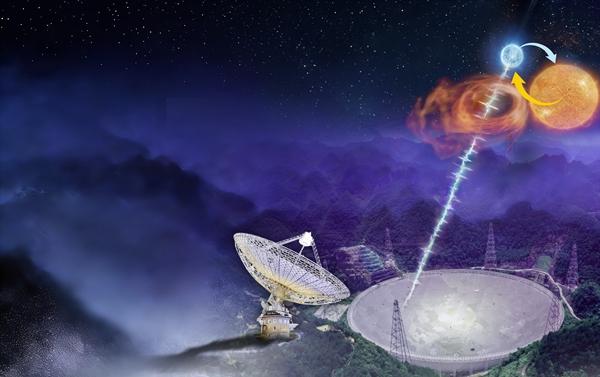
“中国天眼”如何找到快速射电暴双星起源关键证据?
Ren Min Ri Bao· 2026-01-19 07:00
Core Findings - The research team led by the Purple Mountain Observatory of the Chinese Academy of Sciences announced the first detailed observation of the evolution process of the Faraday rotation of a repeating fast radio burst (FRB), providing key evidence for the hypothesis that FRBs originate from binary star systems [2][3][4] Group 1: Fast Radio Bursts (FRBs) - Fast radio bursts are mysterious cosmic phenomena that release energy equivalent to the total radiation of the Sun over a week in just milliseconds [3] - The team monitored the repeating FRB 20220529 for over two years, utilizing the high sensitivity of the "Chinese Sky Eye" [3][4] - A significant increase in the Faraday rotation measure of FRB 20220529 was observed, reaching 20 times the normal variation, followed by a rapid decline back to normal levels, marking a first in recorded FRB studies [3][4] Group 2: Scientific Contributions of the "Chinese Sky Eye" - Since its acceptance in 2020, the "Chinese Sky Eye" has maintained stable operations, with over 5400 hours of observation and more than 17.5 petabytes of new scientific data generated in the last complete observation year [5][6] - The telescope has produced groundbreaking results in various fields, including gravitational wave detection, pulsar searches, and FRB studies [6][7] - The "Chinese Sky Eye" has also improved radar imaging resolution of the Moon from kilometers to 10 meters, aiding geological studies and resource exploration [7] Group 3: Future Developments and Upgrades - The "Chinese Sky Eye" is advancing its upgrade plans to become a "super probe" of the universe, with ongoing research to replace imported components with domestically produced alternatives [8][9] - The project aims to construct a giant synthetic aperture array around the "Chinese Sky Eye," enhancing observational capabilities and solidifying China's leading position in low-frequency radio astronomy [8][9] - By 2025, the completion of core array antennas and low-noise receivers is expected to significantly enhance the telescope's functionality, supporting deeper investigations into cosmic mysteries [9]
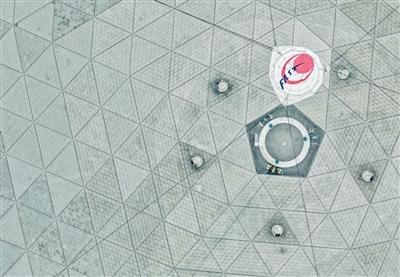
“中国天眼”揭示快速射电暴双星起源关键证据 极目星河深处 求索未解之谜(科技自立自强)
Ren Min Ri Bao· 2026-01-18 22:05
Core Viewpoint - The research team led by the Chinese Academy of Sciences has found key evidence regarding the origin of fast radio bursts (FRBs), suggesting they may originate from binary star systems, as reported in the journal "Science" [1][2]. Group 1: Fast Radio Bursts Research - Fast radio bursts are mysterious cosmic phenomena that release energy equivalent to the total radiation of the Sun over a week in just milliseconds [2]. - The team monitored the repeating fast radio burst FRB 20220529 for over two years, utilizing the high sensitivity of the "Chinese Sky Eye" [2][3]. - A significant observation was made when the Faraday rotation measure of FRB 20220529 surged to 20 times its normal level before returning to typical fluctuations, marking a first in recorded FRB studies [2][3]. Group 2: Scientific Contributions of the "Chinese Sky Eye" - Since its operation began in 2020, the "Chinese Sky Eye" has maintained high efficiency, with over 5400 hours of observation and more than 17.5 petabytes of new scientific data generated in the last complete observation year [4]. - The telescope has produced groundbreaking results in various fields, including the detection of gravitational waves, pulsar searches, and studies of neutral hydrogen [5]. - The "Chinese Sky Eye" has also improved radar imaging resolution of the Moon from kilometers to 10 meters, aiding geological studies and resource exploration [6]. Group 3: Future Developments and Upgrades - The "Chinese Sky Eye" is advancing its upgrade plans to become a "super probe" of the universe, with ongoing research to replace imported components with domestically produced alternatives [7][8]. - By 2025, two core array antennas will be completed, enhancing observational capabilities and addressing long-standing astrophysical questions [8].
中国天眼又立功了
Xin Lang Cai Jing· 2026-01-17 22:51
Group 1 - The Chinese Academy of Sciences and the Purple Mountain Observatory announced a significant astronomical discovery regarding fast radio bursts (FRBs), providing key observational evidence for the hypothesis that FRBs originate from binary star systems [1] - The research team monitored the repeating fast radio burst FRB 20220529 for over two years, observing a sudden increase in the Faraday rotation measure, which spiked to 20 times its previous level in December 2023, marking a first in the history of FRB research [1] - The observed phenomenon is attributed to a magnetized plasma cloud near the source of the FRB, which passed through the line of sight between Earth and the burst source, similar to solar coronal mass ejections [1] Group 2 - The breakthrough was made possible by the unparalleled sensitivity of the Five-hundred-meter Aperture Spherical Telescope (FAST) and the innovative data processing methods of the research team, showcasing China's technological advantages in large scientific installations [2] - FAST, the world's largest single-dish radio telescope, has produced groundbreaking results in various frontier fields since its operation, enhancing China's influence in the global radio astronomy sector [2] - An upgrade plan for FAST is underway, which includes the construction of dozens of medium-sized antennas around FAST to create a unique giant aperture array centered on FAST [2]
中国天眼在国际上首次揭示快速射电暴双星起源关键证据
Yang Guang Wang· 2026-01-17 02:11
Core Insights - Chinese scientists have captured a unique phenomenon of a repeating fast radio burst (FRB) using the FAST telescope, providing the strongest observational evidence to date for the hypothesis that FRBs originate from binary star systems [1][3] Group 1: Observational Evidence - The research team from the Purple Mountain Observatory monitored the repeating FRB 20220529 for over two years, utilizing the high sensitivity of the FAST telescope to capture detailed bursts [1] - In December 2023, the team observed a groundbreaking phenomenon where the Faraday rotation measure of the source surged to approximately 20 times its previous levels before monotonically decreasing back to normal fluctuations within two weeks [1] Group 2: Theoretical Implications - The sudden and reversible changes in the magnetic environment are unprecedented in the history of FRB research, suggesting that a cloud of magnetized charged particles briefly passed through the line of sight [1] - The binary star system involved has a star that, similar to the Sun, continuously emits solar wind and periodically ejects magnetized plasma, which alters the Faraday rotation of the radio signals when it passes through the observation line [2]
“中国天眼”找到快速射电暴起源关键证据
Ren Min Ri Bao Hai Wai Ban· 2026-01-17 01:51
Core Insights - The research team led by the Chinese Academy of Sciences has captured the detailed evolution of the Faraday rotation measure (RM) of a repeating fast radio burst (FRB), providing key observational evidence for the hypothesis that FRBs originate from binary star systems [1][2] Group 1: Research Findings - The team monitored the repeating fast radio burst FRB 20220529 for over two years, concluding that it likely originates from a binary star system [2] - The observed Faraday rotation measure increased by 20 times and then rapidly decreased, indicating the passage of a dense magnetized plasma cloud, which aligns with the intense activity expected in a binary star system [2] Group 2: Technological Advancements - The Five-hundred-meter Aperture Spherical Telescope (FAST) is the world's largest single-dish radio telescope, contributing significantly to various fields including gravitational wave detection and pulsar searches since its operation began [2] - FAST is set to undergo upgrades, including the construction of several medium-sized antennas to form a giant aperture array, enhancing spatial resolution and observational sensitivity [2][3] Group 3: Broader Implications - The advancements in FAST and its research outputs reflect China's commitment to achieving high-level technological self-reliance and strengthening its position in the field of radio astronomy [2]
“中国天眼”新发现:宇宙神秘“闪光”来自双星系统
Xin Lang Cai Jing· 2026-01-16 19:06
Core Viewpoint - The Chinese 500-meter Aperture Spherical Telescope (FAST) has made a significant breakthrough in understanding the origin of fast radio bursts (FRBs), providing key evidence that supports the theory of their origin in binary star systems [1][2]. Group 1: Research Findings - The research team, led by the Purple Mountain Observatory of the Chinese Academy of Sciences, monitored a repeating fast radio burst named FRB 20220529 for over two years, focusing on a metric called the "Faraday rotation measure," which reflects the magnetic environment along the signal's path [2]. - In December 2023, the team observed a significant spike in the Faraday rotation measure, reaching approximately 20 times its normal fluctuation level, followed by a gradual return to normal within two weeks, marking the first detailed record of such a rapid and reversible change in FRB research [2]. - The observed magnetic environment change is believed to be caused by a cloud of magnetized charged material briefly passing through the line of sight, supporting the binary star system origin theory rather than a solitary neutron star [2]. Group 2: Technological and Collaborative Aspects - The successful detection and recording of the faint target signal demonstrate the advanced sensitivity of FAST, showcasing the strength of China's major scientific infrastructure and the collaborative capabilities of its research teams [3]. - The research was a collaborative effort involving multiple institutions, and the findings were published online in the international journal "Science" [3]. - Future upgrades to FAST will include the construction of an array system to further enhance observational capabilities, aiding in the exploration of cosmic mysteries [3].

1.16犀牛财经晚报:小米等四家手机厂商下调全年出货预期
Xi Niu Cai Jing· 2026-01-16 10:32
Group 1: Gold Jewelry Prices - Several gold jewelry brands in China have shown price discrepancies, with some maintaining prices while others have adjusted them down to around 1435 CNY per gram [1] - Specific prices include: Liufu Jewelry at 1434 CNY/gram, Chow Tai Fook and Xie Rui Lin at 1436 CNY/gram, and Chow Sang Sang at 1431 CNY/gram, which decreased by 5 CNY from the previous day [1] Group 2: Battery Industry Growth - In 2025, China's cumulative sales of power and energy storage batteries are projected to reach 1700.5 GWh, marking a year-on-year increase of 63.6% [1] - Power batteries account for 1200.9 GWh, representing 70.6% of total sales, with a year-on-year growth of 51.8%, while energy storage batteries are at 499.6 GWh, showing a 101.3% increase [1] Group 3: Passive Components Price Increase - Yageo Corporation announced a price increase of 15%-20% on certain resistor products due to significant cost rises in chip product lines, particularly for precious metals [2] Group 4: Smartphone Manufacturers Adjusting Forecasts - Major smartphone manufacturers including Xiaomi and OPPO have reduced their annual shipment forecasts by over 20% due to rising storage costs in the supply chain [2] - Vivo has lowered its forecast by nearly 15%, while Transsion has adjusted its target to below 70 million units [2] Group 5: Semiconductor Industry Performance - The semiconductor industry showed resilience with significant stock price increases, particularly in companies like Longji Technology, which reached a five-year high [20] - The storage chip sector also saw historical highs for companies like Baiwei Storage and Jiangbo Long [20] Group 6: New Product Developments - Samsung Display has commenced mass production of its 8.6-generation OLED panel line, indicating advancements in display technology [2] - Apple is expected to launch its AI glasses in the second quarter of this year, with design advantages over existing products [3] Group 7: Regulatory Actions - The China Securities Regulatory Commission has approved the IPO registration of Fuen Co., Ltd. on the Shenzhen Stock Exchange [7] - Several companies, including Haizheng Pharmaceutical and Mengguli, received warnings from regulatory bodies for financial discrepancies in their disclosures [8][9][10]
中国天眼,新成果发布
财联社· 2026-01-16 04:58
Core Insights - The article discusses a significant breakthrough in astrophysics achieved by a research team led by the Purple Mountain Observatory, which captured the detailed evolution of the Faraday rotation measure (RM) of a repeating fast radio burst (FRB) for the first time internationally, providing strong observational evidence for the hypothesis that fast radio bursts originate from binary star systems [1][4]. Group 1: Fast Radio Bursts (FRBs) - Fast radio bursts are one of the most mysterious radio explosion phenomena in the universe, lasting only a few milliseconds but releasing energy equivalent to the total radiation of the Sun over a week [2][3]. - Since their first discovery in 2007, the origin mechanisms of fast radio bursts have remained a significant mystery in astrophysics, with speculation linking them to compact objects like neutron stars [2][3]. Group 2: Research Methodology - The research team utilized the high sensitivity of the Chinese Tianyan FAST to conduct over two years of continuous monitoring of the repeating fast radio burst FRB 20220529 [4]. - A crucial parameter monitored was the Faraday rotation measure, which reflects the density of plasma and magnetic field strength along the signal's propagation path, acting as a precise "cosmic magnetic environment probe" [4]. Group 3: Key Findings - The Faraday rotation measure of FRB 20220529 exhibited a dramatic increase, reaching 20 times its normal variation level, followed by a rapid decline back to normal within two weeks, marking a first in recorded fast radio burst research [4][5]. - The observed phenomenon is attributed to a dense magnetized plasma cloud from the vicinity of the fast radio burst source passing through the line of sight to Earth, similar to solar activity causing coronal mass ejections [5]. - Further analysis indicates that if FRB 20220529 originated from an isolated neutron star, existing theories could not explain the rapid magnetic environment changes; however, if it is part of a binary system, the intense activity from a companion star could naturally account for the observed fluctuations in the Faraday rotation measure [5].