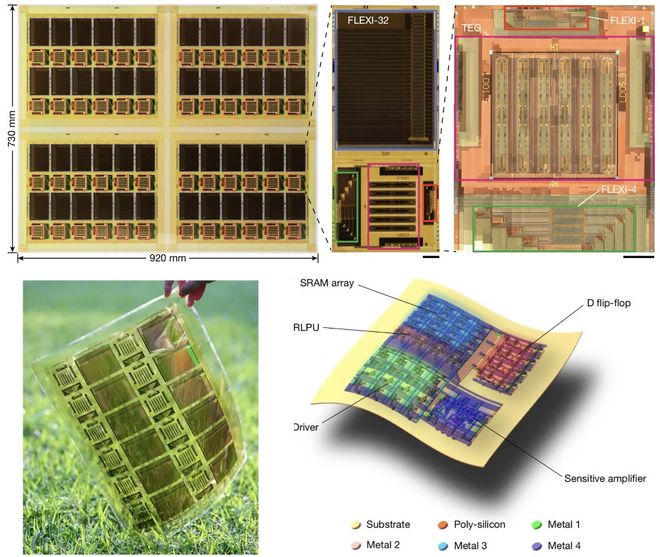
FLEXI柔性数字存算芯片

Search documents
清华研发柔性数字存算芯片取得突破!机器人ETF(562500)低位整理,科瑞技术逆势领涨
Mei Ri Jing Ji Xin Wen· 2026-02-04 06:00
Group 1 - The core viewpoint of the news highlights the current performance and potential of the Robot ETF (562500), which is experiencing a slight decline but remains stable with no extreme weakness observed [1] - The ETF tracks 66 component stocks, with 58 showing a decline, yet the overall drop is moderate, indicating a balanced market response [1] - The trading volume of the Robot ETF reached 636 million yuan, with a turnover rate of 2.56%, suggesting a moderate level of trading activity [1] Group 2 - Longcheng Securities emphasizes that 2026 will be a critical year for mass production in the robotics industry, with major domestic and international manufacturers aligning their production schedules [2] - The Robot ETF (562500) is noted as the only robot-themed ETF in the market with a scale exceeding 20 billion yuan, covering various segments such as humanoid robots, industrial robots, and service robots [2] - Recent adjustments to the ETF's component stocks have increased the humanoid robot content to nearly 70%, successfully removing underperforming stocks and retaining stronger ones [2]

柔性边缘智能AI芯片突破“存储墙”性能限制
Ke Ji Ri Bao· 2026-02-04 00:57
Core Insights - Tsinghua University's research team has developed the "FLEXI flexible digital computing chip," which fills a gap in high-performance flexible AI computing chip technology [1] - The chip is designed for extreme edge devices like wearable sensors and brain implants, addressing the need for local basic computation on flexible substrates with low-cost components [1][2] - The new flexible AI chip features low power consumption, low cost, and high integration, overcoming previous limitations of flexible processors that were slow and energy-intensive [1] Technical Advancements - The research team innovated by increasing the number of metal layers, enabling complex chip interconnections that traditional flexible electronics could not support [1] - The chip employs a digital "in-memory computing" architecture, processing data within the memory to eliminate time and energy costs associated with data transfer, thus surpassing the performance limitations of traditional analog in-memory computing solutions [1] Performance and Applications - The chip has been tested to work stably in folded and rolled states, maintaining its computational capabilities after 40,000 cycles of folding, and exhibits good resistance to temperature, humidity, and light aging [2] - It can be integrated into wearable devices to recognize daily human activities using physiological signals such as heart rate, respiratory rate, and body temperature [2] - A commentary in the journal Nature highlights that the chip's design and manufacturing optimization allows stable operation of neural network tasks under low-cost and low-power conditions, providing new directions for innovation in smart hardware within the Internet of Things (IoT) sector [2]
能承受4万次以上弯折!清华大学获柔性芯片重要突破
Huan Qiu Wang Zi Xun· 2026-02-02 05:16
Core Insights - The research team from Tsinghua University's School of Integrated Circuits has developed the "FLEXI flexible digital storage-computing chip," marking a significant breakthrough in flexible electronics and edge AI hardware in China, filling a technological gap in high-performance flexible AI computing chips [1][3] Group 1: Technology and Innovation - The newly developed flexible AI chip utilizes CMOS low-temperature polycrystalline silicon (LTPS) technology, allowing direct manufacturing on flexible substrates, offering advantages of low power consumption, low cost, and high integration [3] - The research team innovatively increased the number of metal layers, overcoming the traditional bottleneck of complex chip interconnections in flexible electronics [3] - The chip employs a digital "in-memory computing" architecture, processing data within the memory, which eliminates the time and energy costs associated with data transfer and surpasses the performance limitations of the "memory wall," outperforming traditional analog solutions [3] Group 2: Performance and Applications - Test data shows that the chip can operate stably in folded and curled states, maintaining its computational capability after 40,000 cycles of folding, and exhibits good resistance to temperature, humidity, and light aging [3] - The minimum manufacturing cost of the chip is only $0.016, making it suitable for integration into wearable devices to recognize daily human activities using physiological signals such as heart rate, respiratory rate, and body temperature [3] Group 3: Future Prospects - Experts have noted that this technology fills a gap in AI-specific computing hardware within the flexible electronics sector [3] - Future enhancements through the application of new semiconductor materials and power gating technology optimization are expected to further improve performance [3] - Continuous optimization of production yield and chip size could drive industrial upgrades and technological innovations in wearable health devices and IoT terminals [3]