Happy Meals

Search documents
McDonald’s answers a major question for MLK Day 2026
Yahoo Finance· 2026-01-19 13:00
Core Insights - McDonald's remains a leading fast-food chain in American culture, offering a wide range of meal options that cater to diverse tastes and preferences, maintaining customer loyalty for over 85 years [1] Group 1: Holiday Operations - McDonald's has confirmed that all U.S. locations will remain open during Martin Luther King Jr. Day 2026, continuing its reputation for reliability during holidays [5] - While most McDonald's restaurants are independently owned and operated by franchisees, the chain operates over 40,000 locations globally, making it easy for customers to find an open restaurant [6] - Customers are advised to check the McDonald's restaurant locator on the company's website to confirm local store hours during the holiday [6] Group 2: Menu Offerings - McDonald's has introduced its 2026 winter menu, featuring returning seasonal items and new Happy Meals and value deals available for a limited time [7] - Highlights of the winter menu include the popular Holiday Pie and the McRib sandwich, which are fan favorites [7]

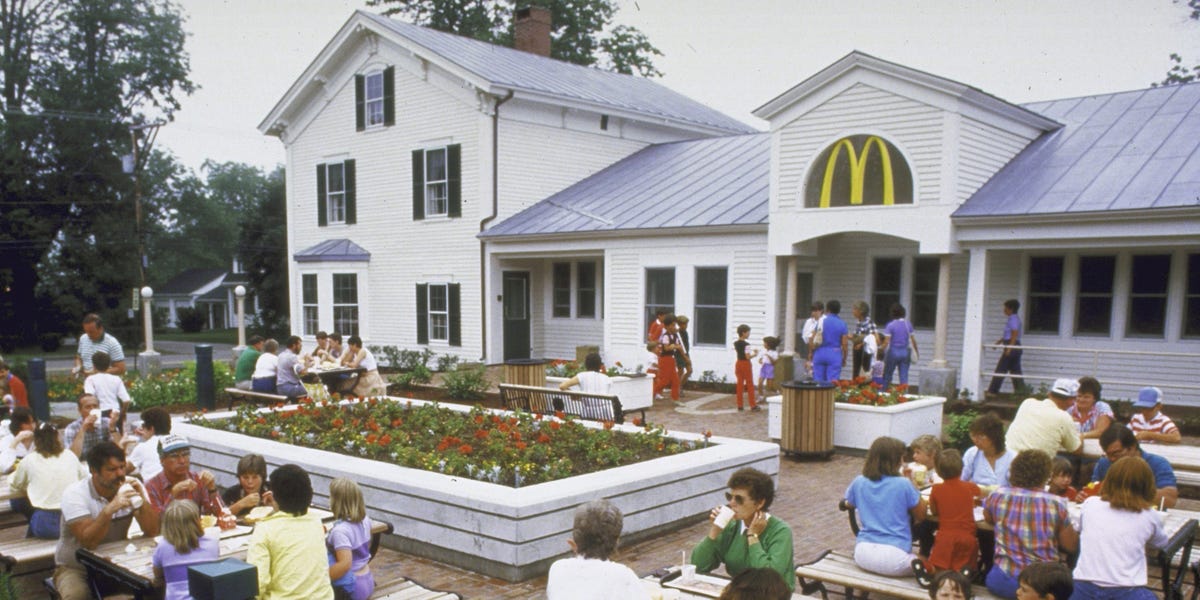
Photos show what it was like to eat at McDonald's in the 1980s
Business Insider· 2025-11-26 15:08
Core Insights - McDonald's has evolved significantly since its inception, becoming a global fast-food leader with over 38,000 locations in more than 100 countries and generating $25.92 billion in revenue in the 2024 fiscal year [2] Historical Growth - The first McDonald's franchise was opened by Ray Kroc in Des Plaines, Illinois, on April 15, 1955, leading to the establishment of McDonald's Corporation [1] - By 1989, systemwide sales reached $17.3 billion, with international sales growing from $900 million in 1979 to $5.3 billion in 1989 [2] Menu Development - The 1980s saw the introduction of several iconic menu items, including Chicken McNuggets in 1983, which became an immediate hit as customers sought leaner protein options [23][28] - The menu had expanded significantly since the 1960s, with the introduction of items like the Filet-O-Fish in 1965, Big Mac in 1968, and Happy Meals in 1979 [21][22] Restaurant Design and Experience - The original McDonald's restaurant design featured a red-and-white color scheme and the now-iconic golden arches, which were added to enhance the building's appearance [6] - By the 1980s, many locations had modernized their designs, while some retained the classic look, showcasing a blend of historical and contemporary architecture [4][10] Cultural Impact - McDonald's became a symbol of American culture in the 1980s, with marketing campaigns linked to events like the 1984 Olympic Games, where customers could win free food based on Olympic outcomes [36][37] - The brand's popularity was further highlighted by notable figures, including President Ronald Reagan, who was photographed enjoying a Big Mac during a campaign stop in 1984 [41][42]

Trump touts steps to make life more affordable, but many struggle to afford fast food
Yahoo Finance· 2025-11-18 15:37
Group 1: Economic Impact on Consumers - Lower-income consumers are experiencing significant financial pressures, leading to a nearly double-digit decline in foot traffic at McDonald's [1] - High levels of inflation are affecting essential expenses such as rent, food, and childcare, which are particularly burdensome for low-income households [2] - The trend of lower-income Americans reducing spending is indicative of a "K-shaped economy," where wealthier individuals continue to thrive while those with fewer resources struggle [3] Group 2: Spending Trends Among Different Income Levels - Visits to McDonald's by affluent consumers have increased by nearly double digits, indicating a shift in spending patterns [4] - The buoyant stock market is a key factor enabling higher-income Americans to spend more, with 87% of households earning over $100,000 owning stocks compared to only 28% of those earning less than $50,000 [5] - Companies like Procter & Gamble are witnessing a widening gap in consumer behavior, where higher-income shoppers opt for larger, more economical product sizes, while lower-income consumers are constrained to smaller sizes [6]
McDonald's is losing its low-income customers. Economists call it a symptom of the stark wealth divide
Yahoo Finance· 2025-11-16 11:00
Core Insights - The earnings report from Delta highlights a disparity in consumer spending, with premium ticket sales increasing by 5% while main cabin revenue fell by 5% [1] - Economists describe a "K-shaped economy," where affluent consumers are thriving while low-income consumers are struggling due to inflation and rising costs [2][3] Consumer Behavior Trends - Low-income consumers are reducing spending, impacting industries like food, automotive, and airlines, while wealthier customers are increasing their purchases [2][3] - Fast food chains, particularly McDonald's, have seen a significant drop in traffic from low-income households, with declines reported in double digits [4] Financial Performance and Pricing - McDonald's has experienced a 40% increase in menu item prices from 2019 to 2024, with specific items like the Big Mac rising from $4.39 to $5.29 [14] - The company attributes price increases to rising costs of labor and ingredients, particularly beef, which has seen a 13% year-over-year increase [15][14] Economic Pressures on Low-Income Households - Consumer credit delinquency rates for households earning less than $45,000 have significantly increased, indicating financial strain [8][9] - A Harvard study found that 50% of renters are cost-burdened, spending over 30% of their income on housing, a rise of 3.2 percentage points since 2019 [10][11] Industry Responses - McDonald's has attempted to attract cash-strapped customers with promotional deals, but initial marketing efforts did not yield immediate results [23][24] - The fast food industry is cautious about passing on higher costs to consumers, reflecting a broader concern about consumer tolerance for price increases [25]
Lovin’ It: Snack Wraps Bring Smiles Back to McDonald’s Investors (and Customers)
Yahoo Finance· 2025-11-06 11:30
Core Insights - McDonald's experienced strong third-quarter sales, driven by the successful relaunch of chicken Snack Wraps, with 20% of customers adding the item to their orders in its first month [1] - Same-store sales increased by 3.6%, recovering from a 1.5% decline in the same period last year, although overall earnings missed analysts' expectations [2] - The company is facing challenges in attracting lower-income consumers, who are increasingly cooking at home due to economic pressures, impacting sales [5] Financial Performance - Net income for McDonald's grew by only 1% in the third quarter, indicating that while sales are up, profitability is under pressure [3] - The company is subsidizing its value-driven efforts, with $15 million spent on price reductions in September and an expected $75 million for the fourth quarter [3] - McDonald's allocated $40 million towards marketing its Extra Value Meals to attract budget-conscious customers [3] Market Strategy - Promotions like the $2.99 Snack Wrap and Extra Value Meals are part of McDonald's strategy to attract customers amid economic challenges [5] - The company is losing patronage from lower-income consumers, who are avoiding dining out, while higher-income consumers are also seeking value options [5]
McDonald's Marketing Engine Revs Up: Can It Drive a Traffic Rebound?
ZACKS· 2025-07-10 14:06
Core Insights - McDonald's Corporation is implementing a bold marketing strategy to address declining traffic and macroeconomic challenges, launching a campaign in partnership with The Minecraft Movie to enhance brand excitement and visit frequency [1][2][4] Marketing Strategy - The campaign exceeded expectations, with collectibles selling out in 10 to 14 days, leading to improved traffic trends in April and supporting other marketing efforts like the $5 Meal Deal [2][8] - The company is focusing on storytelling, digital integration, and product innovation to engage diverse demographics [2][4] - Upcoming product launches, including McCrispy Chicken Strips and snack wraps, will be supported by national campaigns to deepen emotional connections with the brand [3][4] Operational Enhancements - McDonald's has established a Restaurant Experience Team to streamline campaign execution and accelerate new initiatives [3][4] - The marketing strategy aims to balance cultural relevance with operational feasibility, enhancing baseline performance while protecting franchisee economics [4] Competitive Landscape - Competitors like Chipotle and BJ's Restaurants are also leveraging innovative marketing strategies, with Chipotle focusing on menu innovation and digital targeting, and BJ's utilizing social media virality to drive demand [5][6] Financial Performance - McDonald's shares have decreased by 5.5% over the past three months, contrasting with a 4.5% rise in the industry [7] - The Zacks Consensus Estimate indicates a year-over-year earnings increase of 4.5% for 2025 and 7.8% for 2026, with recent upward revisions in estimates [11]