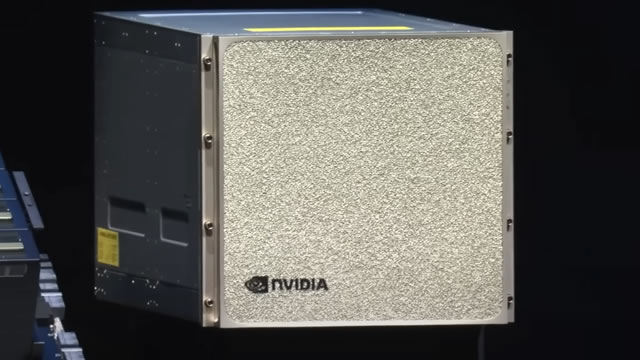
Hopper (H100) graphics processing units

Search documents
One of Jensen Huang's Ambitious Goals Might Make Nvidia Its Own Worst Enemy
The Motley Fool· 2025-06-09 07:51
Core Insights - The evolution of artificial intelligence (AI) is seen as the next major leap for the tech industry, with PwC estimating that AI will contribute $15.7 trillion to the global economy by 2030 [2] - Nvidia has emerged as a significant beneficiary of the AI revolution, with its market cap increasing by over $3 trillion and shares rising more than 870% since the end of 2022 [5][4] - Nvidia's competitive advantage lies in its innovation and leadership in AI-accelerated data centers, particularly with its Hopper and Blackwell GPUs [6][9] Nvidia's Market Position - Nvidia's GPUs are in high demand, allowing the company to charge premium prices, with Hopper chips priced over $40,000 compared to competitors like AMD, which sell their chips for $10,000 to $15,000 [8] - The company's gross margin has significantly increased, reaching as high as 78.4% in the fiscal first quarter a year ago, compared to the low-to-mid 60% range prior to the AI boom [9] Innovation Strategy - CEO Jensen Huang aims to release next-generation AI chips annually, with upcoming products like Blackwell Ultra and Vera Rubin expected to enhance performance and memory capacity [10][11] - While innovation is crucial for success, there are concerns that Nvidia's accelerated innovation timeline may lead to rapid depreciation of its hardware, impacting customer purchasing decisions [15][20] Customer Dynamics - Major customers, referred to as the "Magnificent Seven," are developing their own AI-GPUs, which could lead to delayed upgrade cycles for Nvidia's products as these alternatives are cheaper and more accessible [18][20] - The potential for customers to opt for older Nvidia chips as they depreciate raises questions about the sustainability of Nvidia's pricing power in the face of its own innovation strategy [20][22] Impact on Business Models - Nvidia's aggressive innovation could negatively affect data-center leasing models, as companies may choose to bypass leasing in favor of developing their own solutions [21] - The rapid introduction of new GPUs may lead to a decline in the perceived value of existing Nvidia hardware, impacting both sales and gross margins [20][22]


Is Artificial Intelligence (AI) Stock Palantir Technologies in a Bubble? We Just Got Our Answer
The Motley Fool· 2025-05-08 07:51
Core Viewpoint - Palantir Technologies has emerged as a significant player in the AI revolution, experiencing substantial growth and valuation increases, but is also labeled as Wall Street's biggest bubble stock due to its high price-to-sales ratio [5][21]. Company Overview - Palantir's market capitalization reached $293 billion, with shares rising approximately 1,840% since the beginning of 2023 [5]. - The company has added $278 billion in market value over the past 29 months, showcasing its impressive growth trajectory [6]. AI Market Potential - The global market potential for AI is estimated at $15.7 trillion by the end of the decade, highlighting the vast opportunities within this sector [2]. Product Offerings - Palantir's AI-driven software-as-a-service (SaaS) solutions, particularly the Gotham and Foundry platforms, are noted for their unique capabilities and lack of direct competition at scale [7]. - Gotham is crucial for U.S. government contracts, with a 45% increase in government revenue year-over-year in the latest quarter [8]. - Foundry, which leverages AI and machine learning, saw a 71% surge in U.S. commercial revenue during the first quarter, indicating strong growth potential [9]. Financial Performance - Palantir reported a cash position of $5.43 billion, reflecting a $200 million increase from the previous year, allowing for aggressive reinvestment and shareholder-friendly actions [11]. - The company raised its 2025 sales guidance to a range of $3.89 billion to $3.902 billion, an increase of $147 million at the midpoint, and adjusted free cash flow guidance to $1.6 billion to $1.8 billion [14]. Valuation Concerns - Despite the positive sales guidance, Palantir's stock was valued at over 100 times trailing-12-month sales, raising concerns about its sustainability [15]. - The projected price-to-sales (P/S) ratio for Palantir is expected to be around 75.2 based on the new guidance, which is significantly higher than historical norms for market-leading companies [16][19]. - Historical comparisons indicate that leading companies rarely sustain P/S ratios above 40 for extended periods, suggesting that Palantir's current valuation may not be justifiable [19][21].


Prediction: 8 Wall Street Analysts Lowered Nvidia's Price Target Last Week -- and This Is Just the Beginning
The Motley Fool· 2025-04-22 07:36
Core Viewpoint - Wall Street's optimism for Nvidia, a leader in AI technology, is beginning to decline as analysts cut price targets amid concerns over potential revenue impacts from export restrictions to China and declining gross margins [1][4][7]. Group 1: Market Potential and Company Performance - AI is projected to contribute $15.7 trillion to the global economy by 2030, with Nvidia being a primary beneficiary due to its dominance in AI-GPUs [2]. - Nvidia's H100 GPUs have captured a significant market share in high-compute data centers, leading to a gross margin of 78.4% in Q1 2025 [3][13]. Group 2: Analyst Sentiment and Price Target Adjustments - Eight Wall Street analysts recently lowered their price targets for Nvidia, reflecting a shift in sentiment [6]. - The price target reductions followed Nvidia's disclosure of a potential $5.5 billion revenue impact due to export restrictions on its H20 chips to China [7]. Group 3: Gross Margin Trends - Nvidia's gross margin has been declining from 78.4% in Q1 2025 to an estimated 70.6% in Q1 2026, indicating increased competition and reduced AI-GPU scarcity [13][14]. Group 4: Competitive Landscape - Competitors within the "Magnificent Seven" are developing their own AI-GPUs, which could reduce Nvidia's market share and pricing power [15][16]. - The internal development of cheaper AI-GPUs by major customers poses a significant threat to Nvidia's data center dominance [16]. Group 5: Product Cycle Challenges - Nvidia's rapid product replacement cycle may lead to depreciation of existing hardware investments, reducing incentives for customers to upgrade [19][20]. - The introduction of new architectures like Vera Rubin may not align with customer needs, potentially impacting sales [19]. Group 6: Historical Context and Future Outlook - Historical trends suggest that technology stocks often experience bubble bursts, and Nvidia may be particularly vulnerable given its significant reliance on AI market growth [22][25]. - Despite current demand, many businesses investing in AI have yet to see positive returns, indicating potential overestimation of AI's early adoption [24][25].