
Humanoids

Search documents
RBC's Narayan: Mathematically, Tesla Not An Auto Company
Bloomberg Television· 2026-01-30 13:36
As somebody who's followed the company for quite a while, we are all surprised about the Model S and Model X, essentially, in the words of Craig Trudell being put out to pasture. Ouch. No, not at all.I think that was pretty much expected, right. I mean, this company is moving to more towards autonomy. It's more of an A.I. investment, right. Robotaxi Humanoids.Right. The car business is is is in the past. Really.We've known about this for a while now. Maybe it's the final nail in the coffin, so to speak. Whe ...


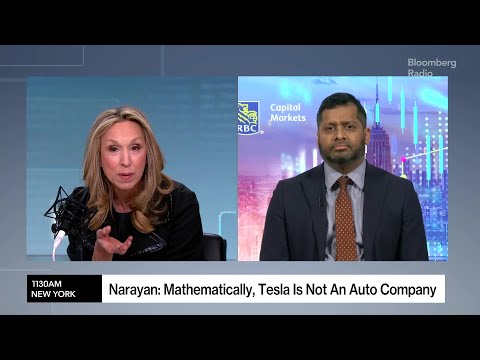
RBC's Narayan: Mathematically, Tesla Not An Auto Company
Youtube· 2026-01-30 13:36
Core Viewpoint - The company is transitioning from being perceived as a traditional car manufacturer to focusing on autonomy and robotics, indicating a shift in its business model towards robotaxis and humanoids [1][3][10]. Market Valuation - The company's market capitalization is currently $1.4 trillion, while the total addressable market for new car sales is estimated at $2.7 trillion, suggesting that the company is not primarily a car manufacturer [3][4]. - The automotive segment is projected to generate $86 billion in revenue by 2026, with energy generation and storage contributing over $17 billion [4]. Future Growth Potential - The potential market for robotaxis and humanoids is in the multiple trillions, and capturing even a small percentage of these markets could justify the company's current valuation [6][7]. - The company is expected to evolve significantly by 2035 with robotaxis and by 2040 with humanoids, although it may take until 2050 for these innovations to substantially impact earnings [12]. Business Model Transition - The company is encouraged to focus on developing fleets of robotaxis and advancing autonomy, rather than solely selling cars to consumers [9][10]. - The data collected from current vehicles is essential for developing the software that powers robotaxis, creating a feedback loop that supports both car sales and autonomous vehicle development [9]. Investment Perspective - The current price-to-earnings ratio is extremely high at 345 times current earnings and nearly 200 times future earnings, indicating that the market has high expectations for future growth [11]. - Analysts suggest that the company needs to align its reality with its valuation over time, emphasizing the importance of market penetration in the robotaxi and humanoid sectors [13].

机器人年鉴第 3 卷:人形与工业机器人 摩根士丹利全球实体 AI 团队 2025 年 12 月-The Robot Amanac Vol.3 Humanoids & Industrial Robots Morgan Stanley Global Embodied Al Team December 2025
摩根· 2025-12-17 03:01
Investment Rating - The report does not explicitly provide an investment rating for the industry [1]. Core Insights - The global labor market is estimated to be valued at $40 trillion, with approximately 4 billion workers worldwide, suggesting a significant total addressable market for humanoid and industrial robots [42][43]. - The report anticipates that by 2050, there will be an estimated 1 billion humanoids globally, indicating a substantial growth potential in the humanoid robotics sector [48]. - The report highlights that China currently dominates the humanoid landscape, with significant government support and numerous publicized events showcasing humanoid technology [73][86][89]. Summary by Sections Humanoids - Humanoids are capable of performing complex tasks that require advanced dexterity and intelligence, but they are still in development and require significant training and data [59]. - The primary barrier to scaling humanoids is the availability of data for training [61]. - The report notes that the cost of building a humanoid robot is significantly lower in China, estimated at around $50,000 compared to $130,000 in the US, highlighting the impact of supply chain efficiencies [150][152]. Industrial Robots - Industrial robots are effective at performing simple, repetitive tasks but may require modifications to existing workplaces [60]. - The report identifies that the most relevant job replacements for industrial robots are in boring, dangerous, and repetitive tasks, particularly in warehouses and heavy manufacturing [45]. - The report emphasizes that the integration of AI and robotics is accelerating, driven by labor shortages and technological advancements [36]. Market Dynamics - The report discusses the competitive landscape, noting that major US tech firms are beginning to test humanoids in various applications, including delivery operations [114]. - It highlights a significant public support gap for humanoids between the US and China, with higher acceptance and interest in China [102][107]. - The report also mentions that every major auto company in China is involved in humanoid development, indicating a strong industry push [98].

X @TechCrunch
TechCrunch· 2025-12-11 22:07
1X struck a deal to send its ‘home’ humanoids to factories and warehouses https://t.co/oHdQ1eJJ86 ...
实体 AI- 摩根士丹利机器人年鉴-Physical AI-The Morgan Stanley Robot Almanac
摩根· 2025-12-08 02:30
Investment Rating - The report indicates a bullish outlook on the robotics industry, projecting significant growth in revenues and unit sales through 2050, with a total of $25 trillion in combined robot revenues anticipated by that year [2][38]. Core Insights - The Morgan Stanley Robot Almanac serves as a comprehensive guide to the physical AI sector, detailing the expected adoption of robotics and its impact on the global economy, potentially multiplying the $115 trillion global GDP over time [2][11]. - The report introduces the Global Robot Model (GROM), which forecasts the total addressable market (TAM) for robotics, including unit sales and revenue across various form factors such as autonomous vehicles, industrial robots, and drones [11][37]. - The report emphasizes the importance of AI-enabled robotics in driving the 3rd Industrial Revolution, with projections of 1.4 billion annual robot unit sales by 2050 [35][38]. Summary by Sections Overview of Robotics - The report outlines the dynamic nature of physical AI and its integration into various sectors, highlighting the potential for transformative impacts across industries [2][4]. Market Projections - By 2050, the report estimates that there will be 6.5 billion robots in operation globally, with significant contributions from home robotics, industrial robots, and autonomous vehicles [12][39]. - Revenue estimates indicate a steady increase, with projections of $91 billion in 2024 growing to $25 trillion by 2050, reflecting the expanding market for robotics [41][42]. Robotics Adoption and Demand - The GROM model provides detailed projections for robotics demand across key components, including cameras, lidar, and semiconductors, essential for the development of various robotic applications [11][37]. - The report categorizes robotics into several verticals, including autonomous cars, drones, humanoids, and industrial robots, each with distinct growth trajectories and market dynamics [7][13]. Regional Insights - The report highlights regional differences in robotics adoption, with the USA, China, and the Rest-of-World showing varying growth patterns and market sizes [42][43]. - Specific revenue and unit sales forecasts are provided for each region, indicating a robust growth outlook particularly in China and the USA [42][43].
投资者演示文稿 - 全会后的政策与经济展望-Investor Presentation-Policy and economic outlook post Plenum
2025-10-27 00:52
Summary of Key Points from the Conference Call Industry Overview - **Focus on Technological Self-Sufficiency and Innovation**: The top priority post-Plenum is on achieving technological self-sufficiency and fostering innovation within China [3][5][12] - **Economic Outlook**: The economic targets for 2026 are projected to include a real GDP growth rate of approximately 5% [3][4] Core Insights and Arguments - **Five-Year Plan (FYP)**: The upcoming FYP will outline medium-term goals for GDP growth, R&D intensity, urbanization, carbon emissions, social welfare coverage, and development targets for key industries [3][4] - **Incremental Policy Changes**: The policy suggestions document expected in late October will likely emphasize supply-centric policies with a gradual approach to social welfare reform [3][4] - **Fiscal Policy**: The fiscal policy for 2026 is expected to align broadly with 2025, with additional stimulus measures dependent on external demand conditions [3][4] Technological Developments - **Investment in Technology**: A new tech board for the bond market is being established to facilitate direct debt financing for tech companies, with a state startup fund potentially reaching RMB 1 trillion [12][13] - **Increased Tech Spending**: On-budget tech spending is projected to reach RMB 1.2 trillion, representing an 8.3% year-on-year increase compared to 4.4% for overall fiscal spending [12][13] AI and Labor Market Dynamics - **AI's Impact on Labor**: The introduction of generative AI is expected to create significant labor-equivalent value, but there may be a dominant labor displacement effect during the transition [33][34] - **Job Creation and Education**: There is a need for more support in AI-oriented education and career training to mitigate the impact of AI on employment [34][35] Social Welfare Reform - **Rising Social Welfare Spending**: Increased social welfare spending is associated with a higher consumption share in GDP, indicating a need for reform in this area [36][37] - **Financial Sustainability of Reforms**: The proposed increase in rural pension benefits is expected to incur a modest additional fiscal burden, estimated at around 1% of GDP per year [40][41] Housing Market Insights - **Housing Investment Trends**: The housing market is undergoing deleveraging, with significant uncertainty regarding future housing prices [45][47] - **Inventory Management**: Approximately RMB 3 trillion in funding is needed to bring housing inventory in tier 1 and tier 2 cities to healthier levels [52][53] Policy Measures and Economic Strategies - **"5R" Reflation Strategy**: A comprehensive strategy is proposed to widen the fiscal deficit and implement consumption-focused fiscal packages, alongside social welfare reforms [54][55] - **Interest Subsidies and Education Initiatives**: Potential subsidies for consumer loans and free preschool education are part of the government's strategy to stimulate the economy [56][57] Conclusion - The conference call highlighted the critical focus on technological innovation, social welfare reform, and housing market stabilization as key areas for China's economic strategy moving forward. The emphasis on AI and its implications for the labor market also underscores the need for proactive measures in education and job creation.
X @Bloomberg
Bloomberg· 2025-08-23 05:01
Market Trends - Dozens of startups are competing to dominate the humanoids market in China [1] - A development frenzy in the humanoids market in China may be hindering innovation [1]
人形机器人 - 北京为智能机器人扶持政策树立典范-Humanoids-Beijing Sets Model for Intelligent Robot Supporting Policies
2025-08-12 02:34
Summary of Key Points from the Conference Call Industry Overview - The conference call focuses on the **intelligent robotics industry** in **China**, particularly the policies set by **Beijing** to support humanoid robots and their production capacity [6][2][1]. Core Insights and Arguments - **Production Capacity Goals**: Beijing aims to achieve an annual production capacity of **10,000 units** of humanoid robots by **2027** [6][1]. - **Government Support**: Comprehensive subsidies will be provided across the entire value chain, including: - Up to **RMB 5 million** for R&D labs - **RMB 100,000** for training sites - Up to **RMB 2 million** for datasets - Up to **RMB 30 million** for secondary development - Adoption subsidies of **20%** for robot companies and **30%** for buyers, capped at **RMB 5 million** [6][2]. - **Data Accumulation Initiatives**: The government plans to open approximately **1,000 locations** for robot data accumulation in sectors like retail, healthcare, and logistics, targeting a **petabyte-level data pool** [6][2]. - **Public Engagement**: The opening of the **Robomall** and **Robot Restaurant** in Beijing serves to establish sales channels and allow public interaction with robots, enhancing consumer familiarity and acceptance [2][6]. Additional Important Information - **Long-term Vision**: Continuous government support is deemed crucial for ramping up adoption and establishing China's leadership in the global intelligent robotics market [6][1]. - **Exhibits**: The Robomall features various robot displays and interactive experiences, while the Robot Restaurant showcases autonomous service robots, indicating a push towards integrating robotics into everyday life [10][8]. Analyst and Company Information - The report is prepared by **Morgan Stanley Asia Limited**, with analysts including **Sheng Zhong**, **Carlos Chai**, **Serena Chen**, and **Chelsea Wang** [3][4]. Conclusion - The conference highlights significant government initiatives aimed at fostering the intelligent robotics sector in China, with a focus on production capacity, subsidies, and public engagement strategies to drive adoption and innovation in the industry [6][1][2].
Timken(TKR) - 2025 Q2 - Earnings Call Transcript
2025-07-30 16:02
Financial Data and Key Metrics Changes - Total sales for the quarter were $1.17 billion, down less than 1% from last year, with organic sales down 2.5% due to lower demand in both segments, partially offset by higher pricing [6][15] - Adjusted EBITDA margins were 17.7%, and adjusted EPS was $1.42, both below prior year levels due to lower volumes, higher tariff costs, and unfavorable currency [7][15] - Free cash flow generated was $78 million, with a quarterly dividend raised by 3% and 340,000 shares repurchased [8][27] Business Segment Data and Key Metrics Changes - Engineered Bearings sales were $777 million, down 0.8% from last year, with lower end market demand in Europe and The Americas, offset by higher revenue in Asia [22] - Industrial Motion sales were $396 million, down 0.7%, with organic decline of 5.9% due to lower demand, although linear motion platform saw growth driven by new business wins [23][25] Market Data and Key Metrics Changes - In Asia Pacific, sales were up 2%, led by growth in China, while The Americas saw a decline of 3% and EMEA was down 5% [16][17] - The overall market environment remains stable, but there are signs of softness in industrial sectors, particularly in Europe and North America [9][17] Company Strategy and Development Direction - The company is focused on managing costs and driving structural cost actions to contribute to margin expansion over time, with plans to complete three plant closures in the second half of the year [10][12] - Timken is investing in high-growth applications within the automation sector, including industrial robotics and factory automation, to capitalize on market trends [13][14] Management's Comments on Operating Environment and Future Outlook - Management expressed a cautious outlook for the second half of the year due to trade uncertainties, but remains optimistic about 2026, expecting industrial markets to expand as trade stabilizes [9][11] - The company is confident in its ability to mitigate tariff impacts and anticipates positive contributions from backlog growth and pricing actions [10][12] Other Important Information - The CEO search is ongoing, with strong interest in the role, and the board is confident in identifying a new leader soon [13][14] - The company continues to pursue M&A opportunities, particularly bolt-on acquisitions, even during the CEO transition [78] Q&A Session Summary Question: Can you unpack the trend to the organic volume guide? - Management indicated a cautious approach for the second half due to trade uncertainties, despite stable market conditions [36][38] Question: What are your thoughts on humanoid robots and their potential? - The company is working on applications for humanoid robots, but expects it to be a long-term play with modest revenue growth in the near term [39][41] Question: What were month-by-month orders through Q2? - Orders have been improving, and July sales rates are in line with the midpoint of guidance, indicating a cautious but positive outlook [47][48] Question: Can you provide an update on discussions with auto OEMs? - Discussions are ongoing, with expectations for some margin uplift in 2026, but no immediate impact anticipated [52][53] Question: How are inventory levels affecting distribution? - Inventory levels are currently good, but there is caution due to potential market weakness, particularly in discretionary spending areas [63][66] Question: What is the outlook for wind energy demand? - Demand in wind energy has improved, particularly in Asia, but growth may be muted in the second half due to pull-ahead spending [68][69] Question: Are there any market share issues or pricing competition? - Management stated that they are not losing market share and expect pricing to continue to rise, which will help recover costs [106][109]

摩根士丹利:A G.I. 法案_针对机器人技术与制造业
摩根· 2025-06-16 03:16
Investment Rating - The industry investment rating is "In-Line" [6]. Core Insights - The report emphasizes the need for the U.S. to enhance its manufacturing capabilities, particularly in robotics and autonomous vehicles, drawing parallels to the G.I. Bill of 1944 which supported workforce integration for veterans [3][4]. - China's manufacturing dominance, with a 29% share of global manufacturing compared to the U.S.'s 17% as of 2023, serves as both a wake-up call and a model for the U.S. to follow [4]. - The report highlights the importance of attracting and retaining skilled talent in the automotive sector, especially as companies like General Motors and Ford transition towards AI-enabled robotics [11]. Summary by Sections Historical Context - The G.I. Bill provided various benefits to veterans, establishing a foundation for workforce integration that continues to influence employment programs today [3]. - The Lincoln Technical Institute was founded in 1946 to help veterans transition their military skills into civilian careers, including automotive training [4]. Current Manufacturing Landscape - U.S. manufacturing as a percentage of GDP has declined from 28% in 1948 to less than 10% today, indicating a significant shift in the industry [4]. - The report notes that the U.S. must revitalize national policies to develop human talent necessary for the future of manufacturing, particularly in the physical AI economy [12]. Implications for Major Automakers - General Motors and Ford face challenges in attracting new talent as they evolve towards AI and robotics, with competition from tech companies intensifying [11]. - The experience of GM and Ford in China over the past four decades may provide valuable insights as the industry progresses [11]. Industry Ratings - The report includes specific ratings for various companies within the automotive sector, with notable mentions such as: - Ford Motor Company: Equal-weight [75] - General Motors Company: Equal-weight [75] - Tesla Inc: Overweight [75]