Hybrid Funds

Search documents
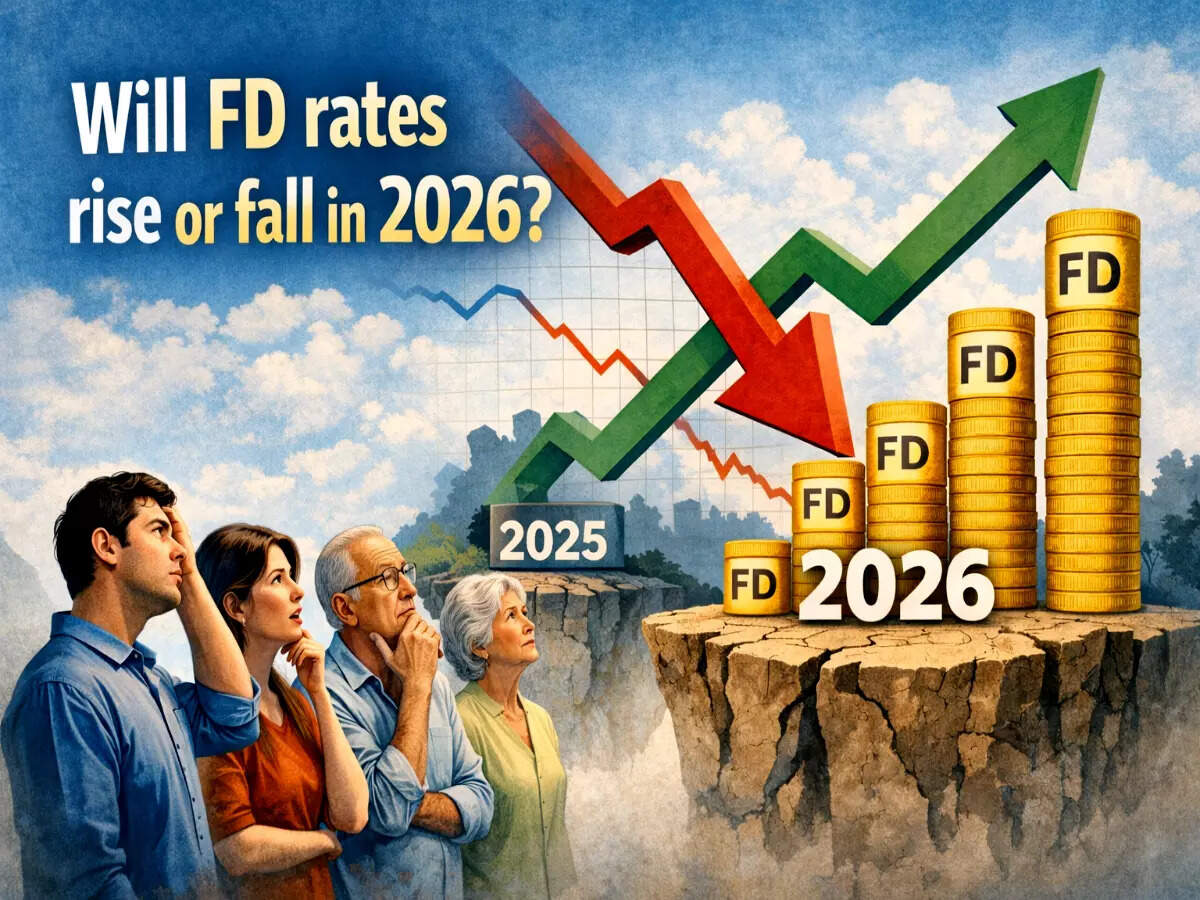
Will FD rates bounce back in 2026 after big fall in 2025? Here’s how you can make the best of FD investment
The Economic Times· 2025-12-31 11:42
Core Viewpoint - The fixed deposit (FD) rates have been reduced significantly due to the Reserve Bank of India's (RBI) repo rate cuts, and the outlook for 2026 suggests that rates may remain stable or trend slightly lower rather than increase sharply [1][5][10] Group 1: FD Rate Changes and Influences - In 2025, banks and small finance banks (SFBs) cut FD interest rates multiple times following a total repo rate cut of 125 basis points by the RBI [9][10] - The last repo rate cut occurred in December 2025, when the RBI reduced the rate by 25 basis points [1][10] - The transmission of these rate cuts into FD rates takes time, and the full impact of previous cuts is still unfolding, which may take months to years [2][10] Group 2: Future Expectations for FD Rates - Swapnil Aggarwal, Director at VSRK Capital, anticipates that FD rates in 2026 are more likely to remain stable or trend slightly lower, contingent on controlled inflation and a more accommodative monetary policy [5][6] - A significant resurgence in inflation or unexpected economic stress is deemed unlikely to lead to a sharp increase in FD rates, suggesting a stable-to-soft outlook for deposit rates [6][10] Group 3: Investment Strategies Amidst Rate Changes - Investors may consider reallocating a portion of their savings to high-quality debt funds if FD rates decline, as these funds can benefit from falling yields [7][8] - Conversely, during rising rate periods, it is advisable to maintain short-term FDs to allow gradual reinvestment at higher rates as they become available [8][9] - Diversification across FDs, debt funds, and hybrid funds is recommended to manage risk while optimizing returns [9][10] Group 4: Current FD Rates at Major Banks - The highest FD rates at major banks include Bandhan Bank at 7.2%, RBL Bank at 7.2%, and IDFC FIRST Bank at 7% for specific tenures [3][4]

中国公募基金总规模逼近37万亿元 连续七个月创新高
Huan Qiu Wang· 2025-11-29 01:20
Core Insights - As of October 2025, the total net asset value of public funds in China reached 36.96 trillion yuan, marking a historical high for the seventh consecutive month [1][2] - The number of public fund management institutions in China stands at 165, including 150 fund management companies and 15 asset management institutions with public qualifications [1][2] Fund Performance - The total number of public funds is 13,381, with a total share of 313.80 billion units, reflecting a month-on-month increase of 1.08% in shares and a 0.59% increase in total scale [2][3] - Year-to-date, the public fund scale has increased by 4.13 trillion yuan, representing a growth rate of over 12% compared to the end of last year [2] Fund Categories - Different fund categories show varying investor preferences, with stock, QDII, and money market funds experiencing growth in shares, while bond, mixed, and closed-end funds faced net redemptions [3] - Money market funds saw a significant inflow of funds post-quarter-end, with an increase of 385.54 billion yuan, reflecting a month-on-month growth of 2.63% [3] - QDII funds also gained popularity, with shares reaching 736.73 billion units, a month-on-month increase of 7.09%, and a scale of 939 billion yuan, up 3.12% [3]

基金研究周报:泛消费板块领涨,中小盘反弹明显(4.21-4.25)
Wind万得· 2025-04-26 22:26
市场概况: 上周(4月21日至4月25日)A 股市场呈现显著的结构性分化特征,A 股市场呈现 "中 小盘成长领涨、大盘价值承压" 的分化格局。上证指数微涨 0.56%,深证成指上行1.38%,创业板 指表现强劲,上涨超过1.5%,万得微盘指数上涨2.52%,涨幅领先其他宽基指数,反映资金加速 向高弹性小盘股聚集。全周上证指数上涨0.56%,深证指数上涨1.38%,创业板指上涨1.74%。 行业板块: 上周Wind一级平均涨幅0.76%,Wind百大概念指数上涨比例78%。板块方面,77% 板块获得正收益,汽车、美容护理、基础化工相对表现良好,分别上涨4.87%、3.80%、2.71%, 而煤炭、房地产、食品饮料相对表现不佳,小幅下跌0.63%、1.31%、1.36%。 基金发行: 上周合计发行27只,其中股票型基金发行17只,混合型基金发行4只,债券型基金发行 5只, FOF型基金发行1只,总发行份额245.79亿份。 基金表现 : 上周万得中国基金总指数上涨0.81%。其中,万得普通股票型基金指数上涨1.66%, 万得偏股混合型基金指数上涨1.90%,万得债券型基金指数上涨0.03%。 数据来源:Wind ...
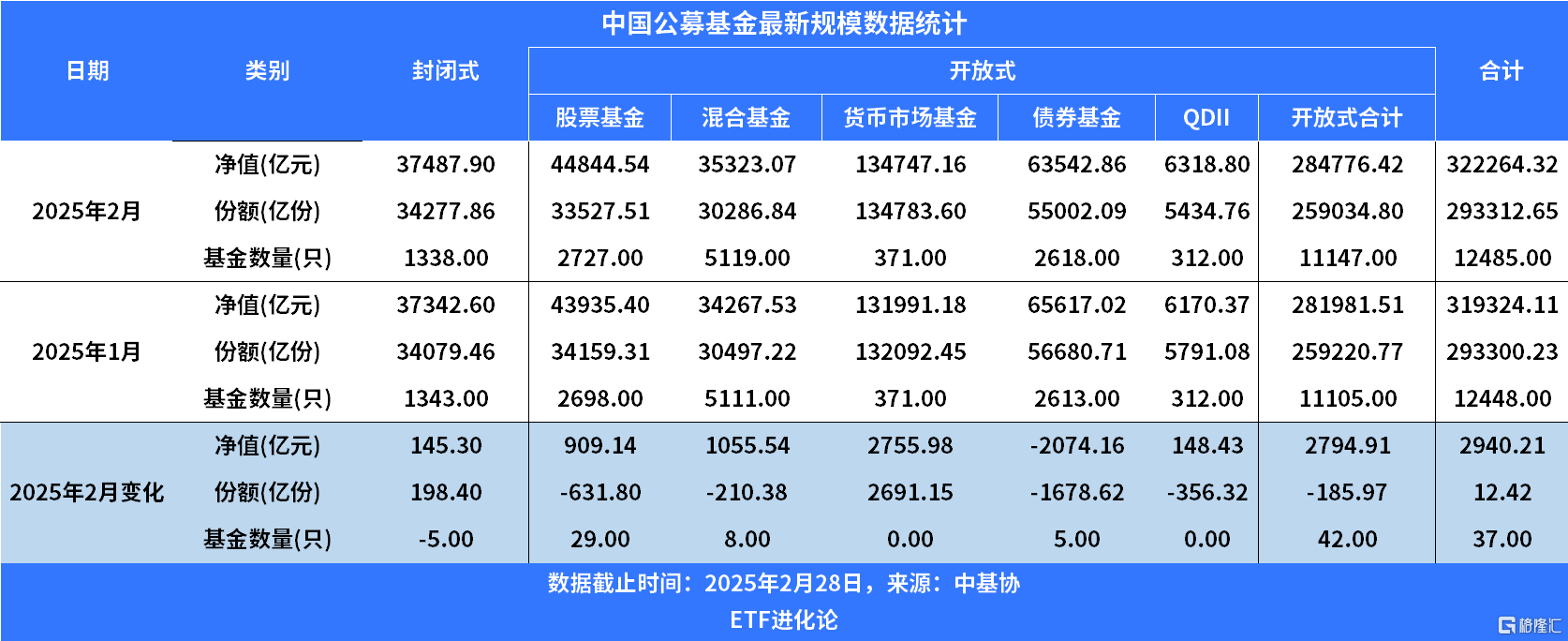
2月公募规模重回32万亿元,除了货基,股票基金、混合基金、债券基金、QDII基金份额全部缩水!
Ge Long Hui· 2025-03-28 04:17
Core Insights - The public fund market in China has shown signs of recovery, with total assets under management exceeding 32 trillion yuan, marking a 0.92% increase from the previous month, primarily driven by a rebound in the equity market [1][16] - Different types of funds have exhibited varied performance, with stock funds, mixed funds, money market funds, and QDII funds all experiencing growth, while bond funds faced a slight decline [1][16] Fund Performance Summary - As of the end of February 2025, the total scale of stock funds reached 4.48 trillion yuan, an increase of 909.14 billion yuan from January, representing a 2.07% month-on-month growth [3] - Mixed funds rebounded with a growth of 1,055.54 billion yuan, reaching a total of 3.53 trillion yuan, marking a 3.08% increase, the highest growth rate in the past 12 months [5] - Money market funds also saw a recovery, with a total scale of 13.47 trillion yuan, up by 2.09% or 2,755.98 billion yuan from January [6] - Conversely, bond funds experienced a decline for the second consecutive month, with a total scale of 6.35 trillion yuan, down by 2,074 billion yuan, reflecting a 3.16% decrease [6] - QDII funds reached a record high of 631.88 billion yuan, increasing by 148.43 billion yuan or 2.41% from January, despite a 6.15% decrease in share volume [6][11] Market Trends - The stock ETF market saw significant contributions from passive index funds, with stock ETFs totaling 2.88 trillion yuan, an increase of 322.23 billion yuan, accounting for 35.44% of the growth in January [3] - Despite the overall growth, some investors opted to take profits, leading to a net redemption of 631.8 billion shares in stock ETFs [5] - The bond market has been under pressure, with the yield curve shifting towards a bear market, as the one-year government bond yield returned to around 1.5% [6] Notable Fund Movements - Several ETFs related to technology and innovation saw substantial gains, with the Hang Seng Technology Index rising by 25% in February, and multiple ETFs achieving over 20% growth [6][8] - However, there were notable outflows from popular ETFs such as the Hang Seng Internet ETF and the China Concept Internet ETF, indicating a trend of profit-taking among investors [11][13]