IDE

Search documents
X @Polkadot
Polkadot· 2026-03-23 05:26
Don't sleep on this thread.A participant in the first Polkadot Solidity Hackathon went in to build a single component but shipped an entire IDE instead.Yogesh Kumar (@itsyogesh18):I went into the @Polkadot Solidity Hackathon planning to add one component.Ended up building an entire IDE.Relaycode was made with modularity in mind - every pallet parameter gets its own input. So Revive pallet just needed a Solidity editor component. Simple, right?Except https://t.co/yDcY3UFENg ...
卡帕西:编程从写文件变成管龙虾!IDE不会凉但得换个用法
量子位· 2026-03-12 07:48
Core Viewpoint - The future of programming tools (IDEs) will not see the disappearance of traditional IDEs but rather an evolution towards larger, more integrated platforms that manage multiple AI agents effectively [3][4][14]. Group 1: Evolution of Programming - The role of programming has shifted from writing individual code files to managing AI agents that execute tasks autonomously [12][13]. - The basic unit of programming has changed from files to agents, leading to new challenges in ensuring efficient collaboration among these agents [13][14]. Group 2: Future IDE Requirements - Future IDEs need to evolve from simple file management tools to comprehensive platforms that can coordinate and manage multiple AI agents [15][27]. - Key features for future IDEs include the ability to display and hide agents, real-time status updates, quick access to tools, detailed usage statistics, and a command center layout for better oversight [27]. Group 3: Organizational Structure and AI - The article discusses how traditional organizational structures cannot be easily replicated, but with AI agents, companies can adopt different management styles by simply "forking" agent teams [21][25]. - This flexibility allows organizations to experiment with various management approaches, enhancing operational efficiency [25][26].


IDE消亡之年?Steve Yegge两句狠话:2026年还用IDE就不行,每天烧500~1000美元Token才合理
程序员的那些事· 2026-01-20 01:07
Core Viewpoint - The traditional IDEs may become obsolete by 2026, as engineers who do not adapt to new AI development methods will fall behind in productivity and competitiveness [1][5]. Group 1: Future of Development Tools - The transition from traditional IDEs to new AI-driven development tools is likened to moving from handheld tools to CNC machines, emphasizing the need for precision and automation in coding [2][11]. - Current AI models are inefficient, akin to sending a single diver into a vast codebase, suggesting a need for multiple specialized roles to enhance productivity [3][19]. - The future of software development will involve task decomposition, gradual refinement, and collaboration among multiple intelligent agents rather than relying on a single AI model [22][24]. Group 2: Productivity Disparities - There is a significant productivity gap among engineers, with those using AI tools like Codex potentially being ten times more productive than their peers who do not [5][27]. - Management is concerned about the implications of this productivity divide, fearing that they may need to reduce their workforce by up to 50% if engineers do not adapt [5][27]. - The situation mirrors the decline of the Swiss watch industry, where traditional craftsmanship was rapidly overtaken by quartz technology [8]. Group 3: New Development Paradigms - The concept of "Vibe coding" is introduced, where coding is driven by dialogue and AI-generated outputs, moving away from traditional manual coding practices [29][35]. - The economic implications of Vibe coding are significant, allowing for more modular and experimental approaches to development, thus increasing the value of options available to teams [38]. - Examples from companies like Travelopia and Capital One illustrate how AI-driven development can drastically reduce the time and resources needed for project completion [41][49]. Group 4: Organizational Transformation - The integration of AI tools is reshaping technical organizations, enabling non-developers to contribute to coding and deployment processes, thus democratizing software development [44][47]. - Trust in AI increases with usage, suggesting that engineers need to practice and engage with these tools to fully leverage their capabilities [42]. - The rapid pace of code submission and the ability to resolve legacy system issues with AI-generated solutions indicate a transformative shift in how teams operate [49].

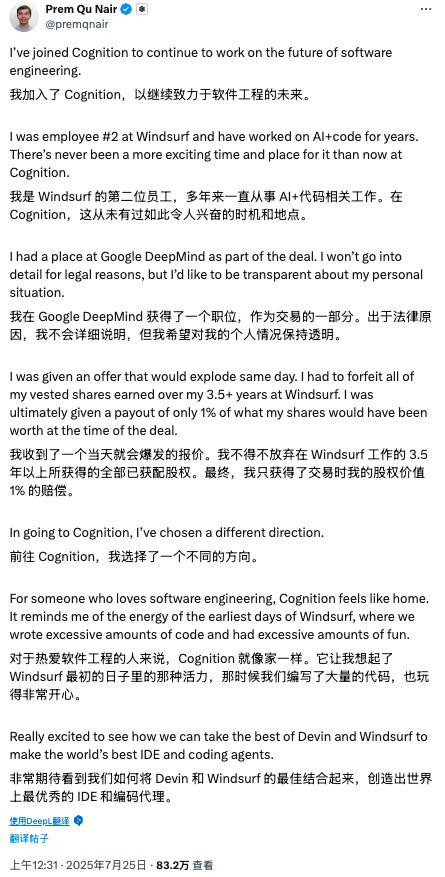
“去Google,我只值原股权的1%!”AI独角兽被瓜分后2号员工怒揭内幕,创始人带头卷走24亿再遭围攻
3 6 Ke· 2025-07-25 11:12
Core Insights - The rise and fall of AI startup Windsurf has garnered significant attention in the tech community, particularly after its CEO and core team joined Google, leaving nearly 200 employees uncertain about their future [1][3] - Cognition, another AI startup, quickly stepped in to acquire the remaining team from Windsurf, providing a temporary resolution to the turmoil [1][11] Group 1: Company Background and Development - Windsurf, originally founded as Exafunction, transitioned to focus on AI programming tools and rebranded as Codeium, achieving rapid growth and attracting over 700,000 developers and thousands of enterprise clients by the end of 2023 [4][5] - The company completed multiple funding rounds, including a $65 million Series B round and a $150 million Series C round, reaching a valuation of $1.25 billion within three years [4][5] - By April 2024, Windsurf's annual recurring revenue (ARR) surpassed $100 million, positioning it as a leading independent AI programming assistant alongside Cursor and GitHub Copilot [5][6] Group 2: Acquisition Attempts and Outcomes - OpenAI initially proposed a $3 billion acquisition of Windsurf to enhance its capabilities in AI coding, but the deal fell through due to regulatory concerns and internal dynamics with Microsoft [6][8] - Google DeepMind later acquired Windsurf's core team for approximately $2.4 billion, but did not take control of the company, leading to uncertainty for the remaining employees [8][10] - Cognition's acquisition of Windsurf's remaining team occurred within 48 hours, reportedly for around $300 million in stock, which was significantly lower than OpenAI's initial offer [11][21] Group 3: Employee Impact and Reactions - The departure of key founders Varun Mohan and Douglas Chen raised concerns about Windsurf's future, as many employees felt abandoned and uncertain about their roles [10][21] - The new CEO of Windsurf, Jeff Wang, expressed gratitude for Cognition's acquisition, which was met with applause from employees, indicating a sense of relief despite the tumultuous circumstances [11][18] - Industry reactions have been mixed, with some criticizing the founders for their departure while others defended their decisions, highlighting the complexities of startup dynamics and employee equity [21][23]