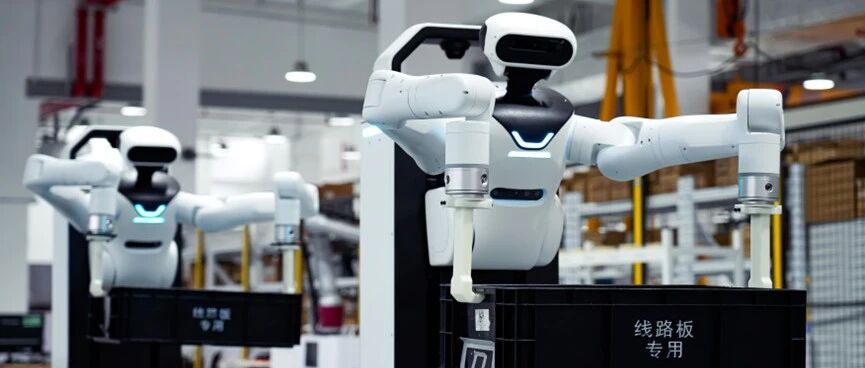
JAKA S³等具身智能机器人及JAKA EVO工业具身智能平台

Search documents
又融一轮!节卡凭什么拿到产业资本的“生态选票”
机器人大讲堂· 2026-03-31 04:00
Core Viewpoint - The capital narrative in the robotics industry is shifting as "embodied intelligence" moves from concept to practical application, leading to stricter evaluation criteria from the capital market, where commercialization validation, core technology barriers, and industrial collaboration capabilities become essential entry tickets [1] Group 1: Investment Logic of Industrial Capital - The recent financing round for JAKA Robotics reflects a trend where capital is increasingly focused on companies with clear commercial scenarios, core technology barriers, and industrial collaboration capabilities [3] - The median amount of single financing in the domestic robotics sector has significantly increased, indicating a concentration of capital towards leading enterprises [3] - The investment from industrial capital, such as Dazero Bay and Guangyu Technology, highlights the importance of JAKA's ability to integrate technology development, industrial cooperation, and scene implementation [5] Group 2: JAKA's Industrial Capability - JAKA Robotics has established a comprehensive capability loop in technology research and development, industrial cooperation, and scene implementation, which is crucial for attracting investment [5] - The company has formed a multi-dimensional cooperation network that connects academic frontiers, computational power, and downstream applications, facilitating a complete loop from technology research to mass application [5] - JAKA's robots have been deployed in various industries, including automotive, 3C, semiconductor, new energy, healthcare, and home care, demonstrating their value in real-world scenarios [5] Group 3: Strategic Partnerships and Collaborations - JAKA has signed strategic cooperation agreements with key players like Xingyu Co. and Intel, focusing on innovation in embodied intelligent robots and smart manufacturing upgrades [6][7] - These partnerships are part of JAKA's strategy to deepen its industrial capabilities and expand its application fields, from automotive manufacturing to smart home solutions [6][7] Group 4: Historical Development and Technological Foundation - JAKA's success is rooted in its V1.0 phase, which established a solid foundation in product and industrial accumulation, leading to its current position as a leader in the robotics industry [11] - The company has developed a comprehensive product library that meets industry-leading performance standards, validated in extreme high-end scenarios [11] - JAKA's innovations in programming and user interaction have lowered the barriers to robot usage, aligning with its mission to "liberate human hands" [12] Group 5: Transition to V2.0 and Future Outlook - The transition from V1.0 to V2.0 represents a strategic leap for JAKA, as it aims to evolve from a manufacturer of industrial collaborative robots to a broader general intelligent robotics platform [14] - The company recognizes the need for robots that can understand tasks and adapt to changes, moving beyond mere tools to intelligent agents capable of solving real problems [14] - JAKA's positioning as a "general intelligent robotics company" reflects its insight into the future competitive landscape, emphasizing the importance of a comprehensive ecosystem that integrates hardware, software, data, and collaboration [14][16]