
LOF(上市开放式基金)

Search documents
多只LOF紧急停牌!警惕“薅羊毛”背后的流动性陷阱
Huan Qiu Wang· 2026-02-02 07:27
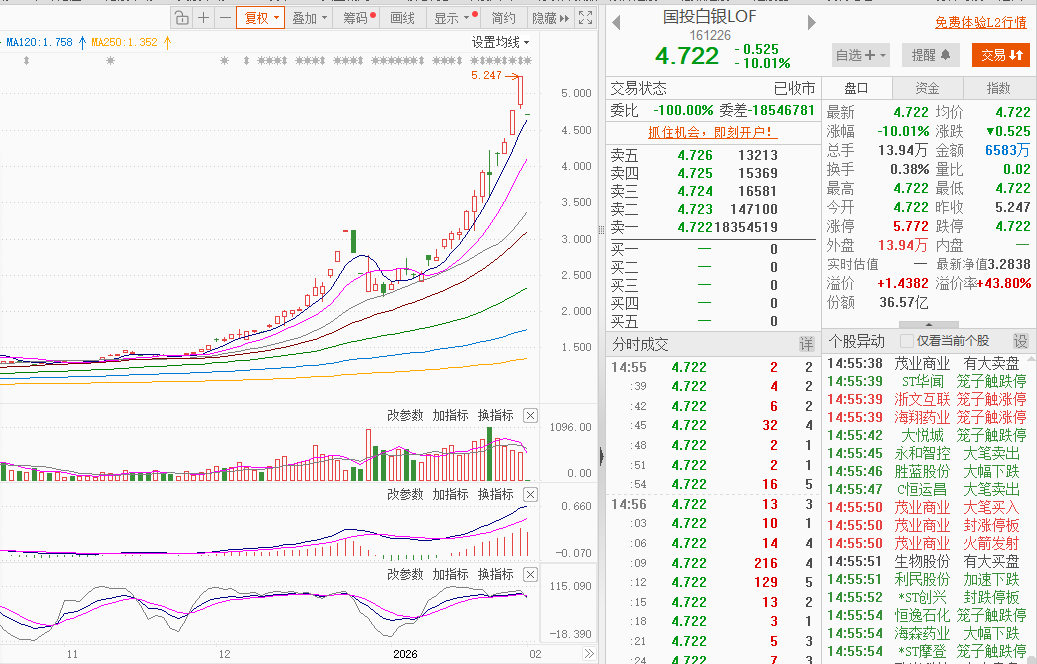
Core Viewpoint - A recent surge in arbitrage opportunities related to Listed Open-Ended Funds (LOFs) has attracted significant attention from investors, leading to a collective price increase in multiple LOFs, prompting regulatory warnings to mitigate high premium risks [1][2]. Group 1: Market Dynamics - The popularity of the Guotou Silver LOF has driven market interest, with its price soaring and premium rates exceeding 60% due to its unique focus on silver futures [2]. - Following the suspension of the Guotou Silver LOF's subscription and arbitrage channels, oil-related LOFs have gained traction, with several experiencing price increases and premium rates surpassing 20% due to rising international oil prices [2]. Group 2: Regulatory Response - In response to the escalating trading sentiment, regulatory authorities have activated risk warning mechanisms, allowing for temporary trading suspensions if premium rates do not decrease effectively [1][5]. - Multiple LOF products announced a one-hour trading suspension to manage risks, emphasizing the need for investor caution regarding high premium rates [1]. Group 3: Risks and Considerations - The LOF arbitrage strategy relies on the price difference between market trading prices and the net asset value of the funds, which can be misleadingly perceived as a guaranteed profit opportunity [4]. - There are significant risks associated with time delays in the arbitrage process, particularly the T+2 settlement period, which can lead to potential losses if market conditions change unfavorably during this time [4]. - Low trading volumes in some LOF products can create liquidity issues, where rapid price changes may prevent investors from selling at desired prices, leading to increased losses [4]. Group 4: Investor Awareness - Analysts stress the importance of recognizing that arbitrage trading is a high-stakes operation requiring expertise in timing and liquidity, contrary to the perception of low-risk opportunities [5]. - Investors are advised to remain rational and not be swayed by social media narratives promoting high returns, as this can obscure the underlying risks of liquidity and price corrections [5].

LOF屡现涨停!火爆背后的真相是什么?
Zhong Guo Zheng Quan Bao· 2026-01-30 14:28
Core Viewpoint - The recent surge in Listed Open-Ended Funds (LOFs) has led to multiple instances of price limits being reached, with significant premium rates observed, raising questions about the underlying reasons and potential risks involved [1]. Group 1: LOF Product Overview - LOF stands for Listed Open-Ended Fund, which allows for both off-market subscription and redemption like traditional open-end funds, as well as real-time trading on stock exchanges like stocks [2]. - LOFs differ from ETFs in that they can be subscribed with cash and have lower investment thresholds, while ETFs typically require a minimum of 1 million shares for subscription [3]. Group 2: Recent Market Activity - The recent batch of LOF price limits is primarily attributed to funds focused on commodities such as silver, gold, and oil, driven by rising prices in these resources and limited off-market subscription options [6]. - The surge in LOF prices is compounded by the small scale of many LOF products, leading to insufficient liquidity, where minimal trading volume can trigger price limits [6]. Group 3: Premium Rates and Constraints - High premium rates for LOFs are difficult to mitigate due to constraints such as QDII quotas for cross-border investment products and limitations on futures positions for resource-based LOFs [7]. - The inability to open subscription channels for high-premium LOFs means that the current pricing dynamics are likely to persist [7]. Group 4: Arbitrage and Risks - While LOF arbitrage has gained attention, it is important to note that high premiums are often unsustainable, and the T+2 or T+3 settlement delays can lead to potential losses if market conditions change [9]. - Risks associated with high premium purchases include volatility of underlying assets, liquidity issues due to potential fund suspensions, and the likelihood of premium corrections if subscription channels reopen [10].