Laser Radar

Search documents
南山南、南山北,或将各有一个“粤海街道”
2 1 Shi Ji Jing Ji Bao Dao· 2026-02-27 09:01
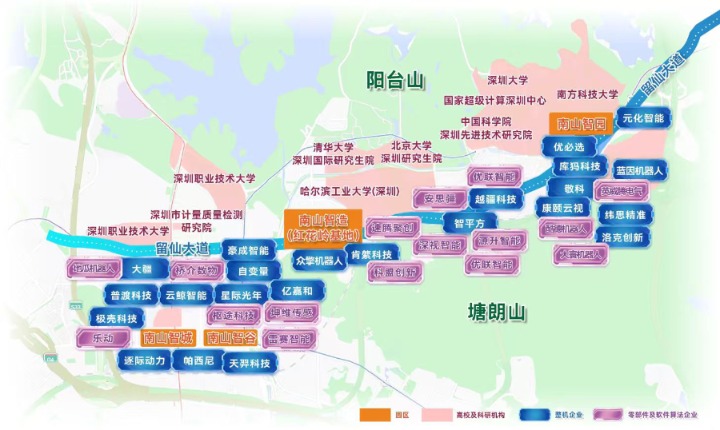
Core Insights - Nanshan District in Shenzhen is emerging as a hub for high-end manufacturing and innovation, with a projected GDP of 1.01 trillion yuan by 2025, making it the first district in China to reach this milestone [1] - The establishment of Nanshan Zhizao and Nanshan Zhicheng parks focuses on the integration of advanced manufacturing and service industries, fostering collaboration among scientists, engineers, and programmers [1][6] - The "vertical factory" concept is being implemented in the Red Flower Ridge base, allowing for high-density industrial development in a space-constrained environment [9] Economic Development - Nanshan District has a GDP exceeding 450 billion yuan, contributing significantly to Shenzhen's overall economic output [1] - The district's industrial structure is evolving, with the second industry accounting for 38.3% of GDP in 2022, marking a recovery after years of decline [5] - By 2025, Shenzhen's industrial output is expected to maintain a leading position nationally, with a stable balance between secondary and tertiary industries [5] Industrial Innovation - The Red Flower Ridge base is home to key enterprises like Zhongqing Robotics and Yuejiang Technology, which are leveraging proximity to R&D centers to enhance production efficiency [8][10] - The base is designed with innovative features such as a spiral ramp for heavy trucks, facilitating efficient logistics and production processes [9] - The integration of various high-tech industries, including robotics and semiconductor manufacturing, is expected to generate a total output value exceeding 183 billion yuan over five years [10] Collaborative Ecosystem - The simultaneous opening of Nanshan Zhizao and Nanshan Zhicheng parks exemplifies the synergy between manufacturing and service sectors, promoting a collaborative ecosystem [11] - The parks provide various platforms for innovation, including AI incubation and biomedicine, enhancing the region's technological capabilities [12] - The development of supportive infrastructure, such as affordable housing for tech talent, aims to create a balanced urban environment that integrates production, living, and ecological spaces [13]

清华系10家硬科技企业年内上市,总市值超2000亿元
Sou Hu Cai Jing· 2025-11-19 13:11
Core Insights - A notable trend in China's capital market is the emergence of ten technology companies founded or led by Tsinghua University alumni, collectively surpassing a market capitalization of 200 billion yuan before the third quarter of 2025, marking a significant "Tsinghua phenomenon" in the IPO market [1] Group 1: Company Performance - The technology companies have their roots deeply embedded in Tsinghua University's research, with notable examples including Haibosichuang, which has seen its stock price increase 12 times since its IPO in January [3] - Other companies such as Xinhenghui in semiconductors and Tianhe Magnetic Materials in new materials also demonstrate Tsinghua's strong foundation in basic research and application development [3] - Hesai Technology, a global leader in LiDAR, went public in September and has become the largest supplier of LiDAR by shipment volume [4] - Geek+ (Jizhi Jia), the first stock of AMR warehouse robots, saw its stock price surge nearly 80% after its IPO in July, reaching a market value of nearly 40 billion HKD [4] Group 2: Innovation Ecosystem - Tsinghua University has established a comprehensive technology transfer system since 2015, creating a unique innovation and entrepreneurship ecosystem that facilitates the conversion of research results into marketable products [3] - The establishment of specialized institutions such as the Technology Transfer Research Institute and the Office of University-Local Cooperation provides institutional support for the transformation of scientific achievements [3] - The "jointly built research institutions" model effectively bridges the gap between research and industry, allowing laboratory innovations to quickly respond to market demands [3] Group 3: Investment Dynamics - Alumni capital has created a strong closed-loop effect, with Haibosichuang receiving 8 million yuan in seed funding from Tsinghua-affiliated investment institutions [5] - Investment firms founded by Tsinghua alumni, such as Dami Venture Capital and Gao Rong Capital, not only provide financial support but also bring valuable industry resources and management experience [5] - The success of Tsinghua alumni in IPOs is not isolated, as six companies founded by Nanjing University alumni also went public during the same period, indicating an overall improvement in the commercialization of scientific achievements across Chinese universities [5] Group 4: Market Recognition - The performance of Tsinghua alumni entrepreneurs illustrates the successful combination of deep academic foundations with keen market insights, showcasing how sustained R&D investment paired with mature capital support can lead to significant market success [5] - The ongoing IPO preparations of more Tsinghua-affiliated technology companies highlight a successful pathway from academia to the market, setting a benchmark for technological innovation and entrepreneurship in China [5]

【行业深度】洞察2025:中国激光测距仪行业竞争格局及市场份额(附市场集中度、企业竞争力评价等)
Qian Zhan Wang· 2025-04-30 05:11
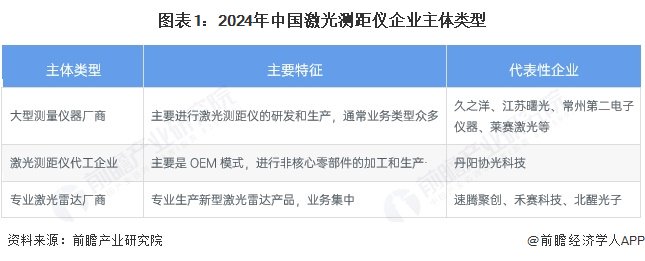
Core Viewpoint - The Chinese laser rangefinder industry is characterized by a diverse competitive landscape, with major players including large measurement instrument manufacturers, OEM companies, and specialized lidar manufacturers, driven by the growing demand for lidar in smart vehicles [1][6][12]. Group 1: Types of Competitors - The Chinese laser rangefinder industry consists of three main types of companies: large measurement instrument manufacturers, OEM companies, and specialized lidar manufacturers [1][3]. - Large measurement instrument manufacturers, such as JiuZhiYang and LaiSai Laser, focus on R&D and production of laser rangefinders and have a diverse business portfolio [3]. - OEM companies primarily engage in the processing and production of non-core components, exemplified by DanYang XieGuang Technology [3]. - Specialized lidar manufacturers, like SuTeng JuChuang and HeSai Technology, concentrate on producing new lidar products [3]. Group 2: Leading Companies - The Chinese laser rangefinder industry can be categorized into three tiers: - The first tier includes listed companies like JiuZhiYang, JuXing Technology, LaiSai Laser, and YouLiDe, which have rich industry experience and strong brand advantages [6]. - The second tier consists of competitive enterprises, including specialized small giants and pre-listed companies, such as MaiCe Technology and LeiShen Intelligent, which possess significant technical accumulation [6]. - The third tier comprises small and medium-sized enterprises and new entrants [6]. Group 3: Market Concentration - As of January 2025, there are over 300 major laser rangefinder-related companies in China, with Guangdong province having the highest number, exceeding 90 [8]. - The market concentration in the laser rangefinder industry is moderate, with a CR3 of 53% and a CR5 of 63% [8]. Group 4: Market Share and Competition - In 2023, leading companies like JuXing Technology, JiuZhiYang, and YouLiDe collectively held a market share of no more than 25%, indicating a relatively fragmented market [10]. - The competitive landscape is intense, with numerous suppliers and established international brands like Bosch and Leica maintaining a leading position in the market [13]. Group 5: Business Strategies - Among listed companies, there is a noticeable divergence in market strategies: JiuZhiYang and LaiSai Laser focus on the domestic market, while JuXing Technology primarily targets international markets [12]. - LaiSai Laser leads in the business layout of laser rangefinders among listed companies, while other firms like JiuZhiYang and JuXing Technology treat laser rangefinder business as a supplementary segment [12].