LoRaWAN

Search documents
LoRaWAN Market to Surpass USD 164.10 Billion by 2035, Driven by Expanding IoT Connectivity and Smart City Deployments | Report by SNS Insider
Globenewswire· 2026-03-10 03:25
Market Overview - The global LoRaWAN market was valued at USD 5.20 Billion in 2025 and is projected to reach USD 164.10 Billion by 2035, growing at a CAGR of 41.24% from 2026 to 2035 [1] - The U.S. LoRaWAN market size was USD 1.6 Billion in 2025 and is expected to grow to USD 39.83 Billion by 2035, with a CAGR of 28.34% during the same period [3] Growth Drivers - The rapid growth of the LoRaWAN market is driven by increasing demand for low-power, long-range IoT connectivity solutions across various industries, including precision agriculture, industrial automation, and smart cities [4] - Smart city and industrial IoT installations account for over 35% of LoRaWAN adoption, highlighting the technology's significance [4] Market Segmentation By Component Type - In 2025, Gateways held a dominant market share of 46%, being essential for connecting devices across various environments [5] By Network Type - Public LoRaWAN Networks led with a 50% market share in 2025, while Private LoRaWAN Networks are the fastest-growing segment from 2026 to 2035 due to increased demand for control and security [7] By Application - Smart Metering & Utilities dominated with a 48% share in 2025, while Smart Agriculture is the fastest-growing segment through 2035 [8] By End-User - Smart Cities accounted for the largest share at 45% in 2025, driven by applications in connected street lighting, traffic monitoring, and environmental sensing [9] Regional Insights - North America represented approximately 35.47% of the LoRaWAN market in 2025, with the U.S. leading due to numerous smart city projects and utility upgrades [10] - The Asia Pacific region is expected to grow rapidly, with a projected CAGR of 44.23% through 2035, driven by developments in smart cities and industrial IoT [11] Key Players - Notable companies in the LoRaWAN ecosystem include Semtech Corporation, Kerlink, Cisco Systems, and Actility, among others [14] Recent Developments - In March 2024, Kerlink partnered with Actility to create a unified LoRaWAN solution, enhancing deployment capabilities and competitive reach [13] Deployment Metrics - The global LoRaWAN ecosystem reached 125 million deployed devices in 2025, with significant contributions from The Things Industries [15]


Nanoveu Subsidiary EMASS to Collaborate with Semtech on Low-Power Semiconductor Technology
Small Caps· 2025-12-09 02:33
Core Insights - Nanoveu's subsidiary EMASS is collaborating with Semtech Corporation to integrate advanced semiconductor technology for the industrial and IoT markets, focusing on long-range, battery-efficient intelligent devices [1] - The collaboration aims to facilitate the deployment of AI in power and bandwidth-constrained environments by integrating sensing, inference, and communication into a cohesive platform [2] Technology Integration - The project combines EMASS's ultra-low-power ECS-DoT edge-AI system on chip capabilities with Semtech's LoRa transceivers, enabling the development of intelligent sensors for various applications [1][3] - LoRaWAN technology allows for long-range, low-power connectivity, making it suitable for battery-operated devices over extensive distances [5] Practical Applications - The collaboration highlights the potential for autonomous sensing and actionable intelligence, providing OEMs with a blueprint for scaling intelligent sensors in smart cities, industrial settings, and remote asset monitoring [3][7] - Reference designs have been developed to showcase applications like predictive maintenance and acoustic event detection, demonstrating ECS-DoT's capabilities in environments with traditional limitations [7][8] Benefits for End Users - The integration of these technologies can lead to longer battery life, reduced network and cloud costs, and enhanced system autonomy and responsiveness [6] - The collaboration aims to provide engineers with tools to deploy autonomous sensing at scale, addressing challenges in monitoring remote industrial assets and enhancing security systems [10]

NB-IoT和LoRa的角逐再次打响,这次的"战场"是在天上
3 6 Ke· 2025-05-19 11:48
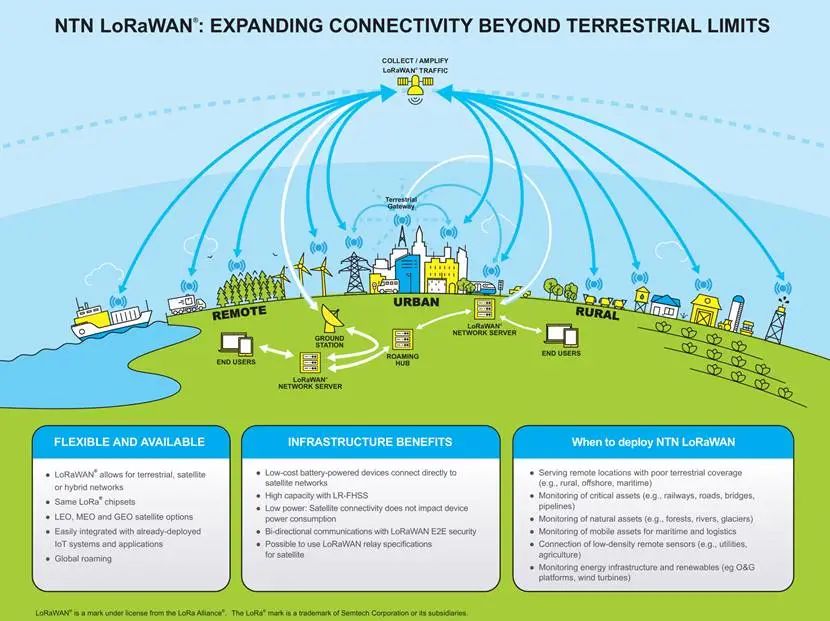
Core Insights - The article discusses the evolution and current state of Low Power Wide Area Network (LPWAN) technologies, particularly focusing on the competition between the 3GPP and LoRa camps in the context of satellite Internet of Things (IoT) [1][13] - It highlights the emergence of satellite communication as a significant area for IoT, providing connectivity solutions in previously underserved regions [1][13] Group 1: LoRa Camp Developments - The LoRa camp has been exploring the application of LoRa technology for satellite IoT since 2018, achieving successful signal capture from low Earth orbit satellites [2] - In February 2022, the LoRa Alliance announced support for LR-FHSS (Long Range Frequency Hopping Spread Spectrum), enhancing network capacity and interference resistance [2] - By 2024, three members of the LoRa Alliance have begun commercializing NTN LoRaWAN, with Lacuna Space leading the way in providing satellite IoT services [4] Group 2: 3GPP Camp Developments - The 3GPP camp has been actively working on NTN standards, with significant progress made in various phases, including R15, R16, and R17, which laid the groundwork for NTN deployment and integration with 5G [7][8] - The R17 phase marked substantial advancements, with the formal initiation of NTN specification development, focusing on both broadband access and narrowband IoT scenarios [8] - By 2024, several satellite operators have embraced 3GPP standards, indicating a growing support base for NTN solutions [9] Group 3: Market Dynamics and Challenges - The satellite IoT market is projected to reach $1 billion by 2026, but the limited number of connections (0.1% of total IoT connections) suggests a crowded competitive landscape [12] - Challenges for NTN LoRaWAN include interference issues due to operating in unlicensed ISM bands, necessitating efforts to achieve interoperability between licensed and unlicensed frequency bands [6] - The article emphasizes the potential for innovation in satellite IoT services, driven by the unique data and applications that can be developed from satellite connectivity [13]