MACE

Search documents
独家|Vattention 获数百万美元投资:从非线性到指数剪辑,定义视频编辑3.0时代
Z Potentials· 2026-03-02 05:14
Core Insights - Vattention is pioneering a paradigm shift in video post-production by developing AI agents that understand creator intent and support autonomous execution, moving beyond simple one-click generation tools [2][12] - The company has secured millions in seed funding to enhance its core team and technology development, focusing on three main engines: MACE, ACE, and PACE [1][10] Group 1: Evolution of Video Post-Production - The evolution of video post-production has transitioned from linear editing to non-linear editing, and now aims for exponential editing efficiency, termed "PostPro 3.0" [3][5] - Current video editing tools still require creators to engage in repetitive tasks, indicating a need for smarter solutions that can understand context and enhance workflow efficiency [5][6] Group 2: Technology and Product Development - Vattention's approach emphasizes Context Modeling, which allows AI to continuously learn and predict creator intent, thereby improving efficiency exponentially as context richness increases [6][10] - The three core engines—MACE (Meta Action Classification Engine), ACE (Asset Comprehension Engine), and PACE (Predictive Action Chain Engine)—are designed to enhance the understanding of creator intent and facilitate intelligent operations [10][11] Group 3: Team and Competitive Advantage - Vattention's competitive edge lies in its team, which combines expertise in AI and video production, enabling a deep understanding of both technology and user needs [7][9] - The founder, with a background in computer science and extensive experience in video production, positions Vattention uniquely in the market [8][9] Group 4: Market Positioning and Future Outlook - Vattention targets the professional consumer segment (To P), which is seen as a viable market for AI tools, bridging the gap between consumer and business needs [10][12] - The company aims to create a system that evolves in real production environments, focusing on long-term development rather than short-term results [10][13]


穷人福音,MIT研究:不用堆显卡,抄顶级模型作业就成
3 6 Ke· 2026-01-09 13:20
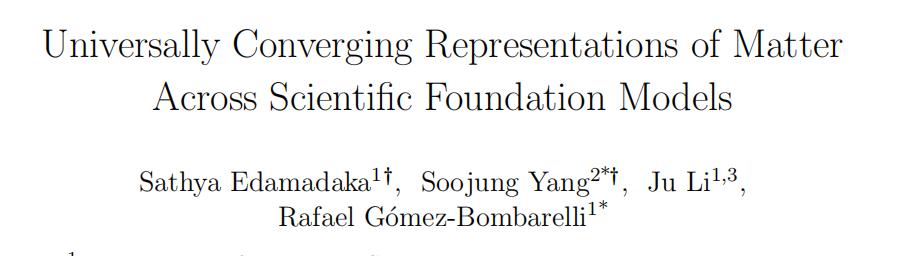
Core Insights - The study from MIT reveals that despite the diverse architectures of AI models, their understanding of matter converges as they become more powerful, suggesting a shared cognitive alignment towards physical truths [1][2][3] Group 1: Model Performance and Understanding - The research indicates that as AI models improve in predicting molecular energy, their cognitive approaches become increasingly similar, demonstrating a phenomenon known as representation alignment [3][5] - High-performance models, regardless of their structural differences, compress their feature space to capture essential physical information, indicating a convergence in understanding [5][6] Group 2: Cross-Architecture Alignment - The study highlights that models trained on different modalities, such as text and images, also show a tendency to align in their understanding of concepts, exemplified by the representation of "cats" [9][14] - This alignment suggests that powerful models, regardless of their input type, gravitate towards a unified internal representation of reality [14] Group 3: Implications for AI Development - The findings challenge the necessity of expensive computational resources for training large models, advocating for model distillation where smaller models can mimic the cognitive processes of larger, high-performance models [18][20] - The research emphasizes that the future of scientific AI will focus on achieving convergence in understanding rather than merely increasing model complexity, leading to more efficient and innovative AI solutions [22][24][25]