MatchAnything

Search documents
浙江大学研究员彭思达:底层空间感知技术对训练机器人有何作用?丨GAIR 2025
雷峰网· 2025-12-15 07:44
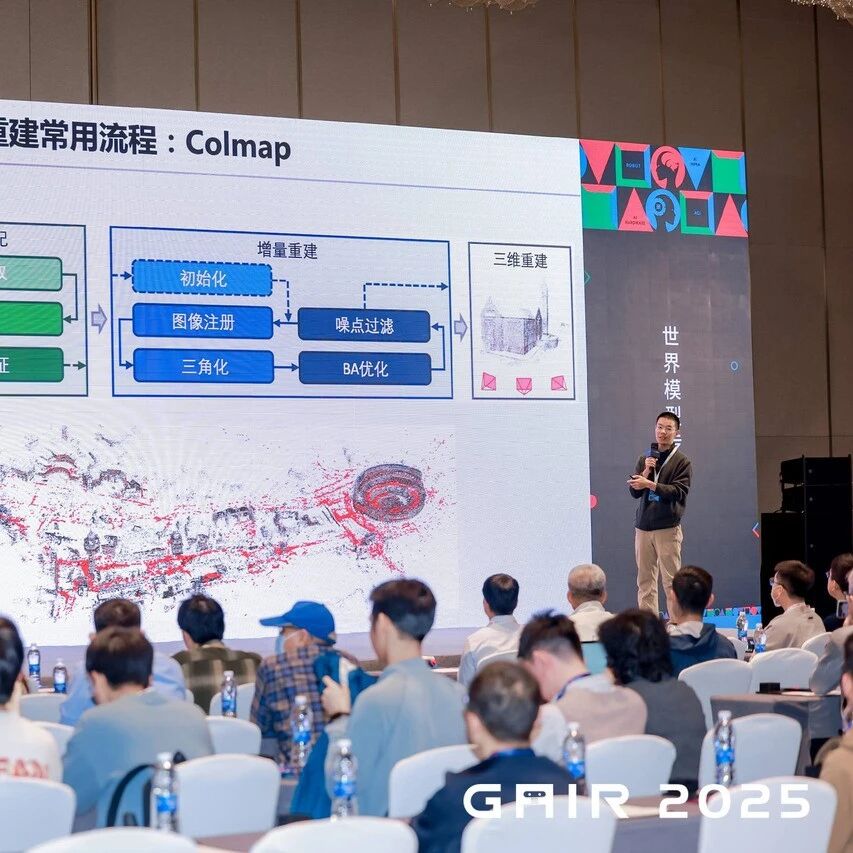
Core Viewpoint - The article discusses advancements in embodied intelligence and general spatial perception technologies, focusing on the work of a research team led by Peng Sida from Zhejiang University. The team aims to enhance robotic capabilities through improved camera pose estimation, depth estimation, and object motion estimation, which are essential for decision-making and training data generation for humanoid robots [2][3]. Group 1: Camera Pose Estimation - The traditional method for camera pose estimation is Colmap, which extracts features from images and matches them to generate a 3D point cloud [5]. - A new approach using the Transformer model, called LoFTR, has been proposed to improve image matching, especially in challenging environments [9]. - The MatchAnything method enhances cross-modal matching capabilities, allowing for better integration of various data sources, such as infrared and visible light images [10][11]. - The Detector-free SfM method addresses the limitations of existing algorithms by iteratively optimizing multi-view matching and 3D models [13][16]. - The VGGT model significantly speeds up camera position estimation, reducing processing time from hours to seconds, but struggles with large-scale scenes [21][23]. - The Scal3R method introduces a global view for better consistency in local scene predictions, enhancing the overall model performance [24]. Group 2: Depth Estimation - Depth estimation is crucial for embodied intelligence, and the Pixel-Perfect-Depth approach aims to eliminate "flying points" in depth predictions by optimizing directly in pixel space [31][34]. - This method also improves video depth estimation by maintaining temporal continuity and integrating semantic features [36]. - The Prompt Depth Anything algorithm enhances robotic grasping capabilities and can be applied in various fields, including autonomous driving [41]. - The InfiniDepth solution provides a more comprehensive geometric estimation by evaluating not just pixel depth but also sub-pixel depth, improving precision in robotic applications [43]. Group 3: Object Motion Estimation - The conversion of human behavior data into effective training data is essential for the development of embodied intelligence, relying on depth information, camera motion, and semantic tracking [45]. - The SpatialTracker model enhances tracking capabilities by projecting 2D images into 3D space, allowing for improved trajectory optimization using Transformer models [48].