Minimax M2

Search documents
中国互联网:两家 AI 实验室的一小步…… 关于战略、竞争与盈利路径的思考-China Internet One small step for two AI labs... thoughts on strategy, competition, and the path to profits
2026-01-29 02:42
Summary of China Internet AI Labs Conference Call Industry Overview - The conference call focused on the AI lab sector within the China Internet industry, specifically discussing the recent IPOs of Z.ai (also known as Zhipu, Knowledge Atlas) and Minimax, which have significantly influenced AI sentiment in China since January 2026 [1][11]. Key Companies - **Z.ai**: Focuses on enterprise and developer markets, primarily offering on-premise solutions. Reported significant revenue growth and has been recognized for its model development progress [2][17]. - **Minimax**: Initially focused on consumer applications, now pivoting towards enterprise solutions. It has reported substantial revenue growth and aims for international expansion [3][14]. Core Insights and Arguments - **Market Sentiment**: The IPOs of Z.ai and Minimax have led to a surge in AI-related investments, with Z.ai and Minimax shares increasing by 101% and 196% respectively since their listings [11]. - **Model Development**: Both companies are positioned as "model as a product" entities, with their latest models ranking highly on global benchmarks. Z.ai's GLM-4.7 and Minimax's M2.1 models are noted for their competitive performance [12][28]. - **Revenue Growth**: Z.ai reported a 325% year-on-year revenue growth for H1 2025, while Minimax reported a 175% increase for 9M 2025, indicating strong market demand despite low initial revenue bases [12][64]. - **Economic Viability**: The companies are expected to maintain solid gross margins (60-70%) and are focusing on leveraging model training costs to enhance profitability. The anticipated increase in training spend at over 30% CAGR is seen as a positive indicator for growth [4][53]. Strategic Directions - **Minimax's Shift**: The company is transitioning from consumer-focused applications to enterprise solutions, with 73% of its revenue coming from overseas markets in 9M 2025. This pivot is driven by the need to compete against larger domestic players [3][14][49]. - **Z.ai's Focus**: Z.ai continues to prioritize enterprise clients, with 85% of its revenue from on-premise deployments. The company has a strong customer base, with 8,000 enterprise clients as of H1 2025 [19][66]. Financial Metrics - **Valuation Comparisons**: The conference highlighted the valuation metrics of various companies within the China Internet sector, with Tencent and Alibaba being top picks. Z.ai and Minimax's financials suggest a path to breakeven at revenue scales between $500 million to $1 billion [8][54]. - **Cost Structures**: Both companies face significant costs related to cloud hosting and compute, with Minimax's cloud costs representing 85.1% of revenue in 2024. R&D expenses are also substantial, with Minimax and Z.ai spending $180 million and RMB 1.6 billion respectively on R&D through their recent reporting periods [67][68]. Additional Insights - **Investor Sentiment**: There is a strong market appetite for AI investments, although some investors express concerns about high valuations based on price-to-ARR multiples. The ongoing competition from established players like Tencent and Alibaba poses challenges for new entrants [5][56]. - **Future Outlook**: The ability of both companies to deliver competitive next-generation models will be crucial for their success. The anticipated launch of new models in Q1 2026 is expected to drive further growth [52][53]. Conclusion - The conference call provided valuable insights into the evolving landscape of AI labs in China, highlighting the competitive dynamics, growth strategies, and financial health of Z.ai and Minimax. The overall sentiment remains bullish, with expectations for continued innovation and market expansion in the AI sector [7][11].
深度|Hugging Face联创:中国模型成初创公司首选,开源将决定下一轮AI技术主导权
Z Potentials· 2025-11-28 02:52
Core Insights - The article discusses the evolving landscape of AI competition leading into 2026, highlighting trends such as the concentration of power among a few key players and the rise of new entrants in the open-source community, particularly from China [3][7][8] - It emphasizes the limitations of current large language models (LLMs) in achieving super intelligence and the challenges in generalization capabilities [15][18][22] - The article also explores the implications of open-source versus closed-source models, talent attraction, and the importance of policy support for fostering innovation in the AI sector [33][40][41] Group 1: AI Competition Trends - The AI industry is witnessing a concentration of power among a few core players due to the availability of computational resources, which will be a significant topic in 2026 [7][11] - There is a notable emergence of new laboratories in China producing high-quality models, which has prompted a resurgence of open-source initiatives in the U.S. as a response to China's advancements [8][9] - Companies seeking to explore new AI applications are increasingly turning to open-source models, as closed-source systems impose limitations [8][10] Group 2: Limitations of Current AI Models - Current LLMs exhibit weaker generalization capabilities than previously expected, leading to a ceiling effect that hinders the achievement of super intelligence [15][18] - The article posits that while AI can serve as a valuable research assistant, it struggles to define new research questions, which is crucial for groundbreaking scientific discoveries [20][22] - The notion that expanding model size will naturally lead to greater intelligence is challenged, with the argument that true innovation requires more than just scaling [22][24] Group 3: Open-source vs Closed-source Dynamics - The choice between open-source and closed-source models is influenced by various factors, including the need to attract top talent and the cultural context of the research environment [36][37] - In the U.S., closed-source models are becoming more attractive for researchers, while in China, open-source models are preferred [37][39] - The article suggests that policy support for open-source initiatives is crucial for maintaining a competitive edge in AI development [40][41] Group 4: Business Model and Future Directions - Hugging Face is transitioning its business model to focus on enterprise solutions, providing tools for organizations to manage and deploy AI models securely [50][51] - The company has entered the robotics field, emphasizing the importance of open-source ecosystems in this domain and launching affordable entry-level robotic products [52][58] - The introduction of a low-cost robotic arm and the Ritchie Mini robot aims to enhance human-robot interaction and make robotics more accessible [58][59]


K2 Thinking再炸场,杨植麟凌晨回答了21个问题
36氪· 2025-11-12 13:35
Core Insights - The article discusses the recent release of K2 Thinking, a large AI model developed by Kimi, highlighting its significant advancements and the implications for the AI industry [5][14][15]. Group 1: Model Release and Features - K2 Thinking is a model with 1 trillion parameters, utilizing a sparse mixture of experts (MoE) architecture, making it one of the largest open-source models available [14]. - The model has shown impressive performance in various benchmark tests, particularly in reasoning and task execution, outperforming GPT-5 in certain assessments [15][16]. - K2 Thinking's operational cost is significantly lower than that of GPT-5, with a token output price of $2.5 per million tokens, which is one-fourth of GPT-5's cost [16]. Group 2: Development and Training Insights - The Kimi team has adopted an open-source approach, engaging with communities like Reddit and Zhihu to discuss the model and gather feedback [7][8]. - The training of K2 Thinking was conducted under constrained conditions, utilizing H800 GPUs with Infiniband, and the team emphasized maximizing the performance of each GPU [29]. - The training cost of K2 Thinking is not officially quantified, as it includes significant research and experimental components that are difficult to measure [29][34]. Group 3: Market Trends and Competitive Landscape - The release of K2 Thinking, along with other models like GLM-4.6 and MiniMax M2, indicates a trend of accelerated innovation in domestic AI models, particularly in the context of supply chain disruptions [28][30]. - Different companies are adopting varied strategies in model development, with Kimi focusing on maximizing performance and capabilities, while others like MiniMax prioritize cost-effectiveness and stability [32][33]. - The article notes that the open-source model ecosystem in China is gaining traction, with international developers increasingly building applications on these models [33].

全球开源大模型杭州霸榜被终结,上海Minimax M2发布即爆单,百万Tokens仅需8元人民币
3 6 Ke· 2025-10-28 02:12
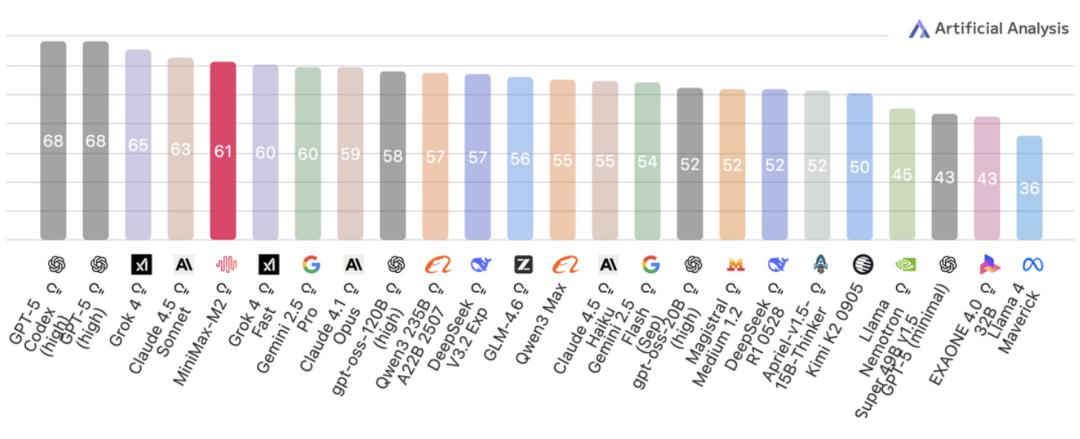
Core Insights - The open-source model throne has shifted to Minimax M2, surpassing previous leaders DeepSeek and Qwen, with a score of 61 in evaluations by Artificial Analysis [1][7]. Performance and Features - Minimax M2 is designed specifically for agents and programming, boasting exceptional programming capabilities and agent performance. It operates at twice the reasoning speed of Claude 3.5 Sonnet while costing only 8% of its API price [3][4]. - The model features a high sparsity MoE architecture with a total parameter count of 230 billion, of which only 10 billion are activated, allowing for rapid execution, especially when paired with advanced inference platforms [4][6]. - M2's unique interleaved thinking format enables it to plan and verify operations across multiple dialogues, crucial for agent reasoning [6]. Competitive Analysis - In the Artificial Analysis tests, M2 ranked fifth overall and first among open-source models, evaluated across ten popular datasets [7]. - M2's pricing is significantly lower than competitors, at $0.3 per million input tokens and $1.2 per million output tokens, representing only 8% of Claude 3.5 Sonnet's costs [8][14]. Agent Capabilities - Minimax has deployed M2 on an agent platform for free, showcasing various applications, including web development and game creation [23][30]. - Users have successfully utilized M2 to create complex applications and games, demonstrating its programming capabilities [36][38]. Technical Aspects - M2 employs a hybrid attention mechanism, combining full attention and sliding window attention, although initial plans to incorporate sliding window attention were abandoned due to performance concerns [39][40]. - The choice of attention mechanism reflects Minimax's strategy to optimize performance for their specific use cases, despite ongoing debates in the research community regarding the best approach for long-sequence tasks [47].
全球开源大模型杭州霸榜被终结,上海Minimax M2发布即爆单,百万Tokens仅需8元人民币
量子位· 2025-10-28 01:18
Core Insights - The open-source model throne has shifted to Minimax M2, surpassing previous leaders DeepSeek and Qwen, which were based in Hangzhou, now replaced by the Shanghai-based Minimax [1] Performance and Features - Minimax M2 achieved a score of 61 in the Artificial Analysis test, ranking it as the top open-source model, just behind Claude 4.5 Sonnet [2] - The model is designed specifically for agents and programming, showcasing exceptional programming capabilities and agent performance [4] - Minimax M2 is economically efficient, with a reasoning speed twice that of Claude 3.5 Sonnet, while its API pricing is only 8% of Claude's [5][9] - The model's total parameter count is 230 billion, with only 10 billion active parameters, allowing for rapid execution [9][10] - It employs an interleaved thinking format, crucial for planning and verifying operations across multiple dialogues, enhancing agent reasoning [11] Comparative Analysis - In the overall performance ranking, M2 placed fifth in the Artificial Analysis test, securing the top position among open-source models [14] - The test utilized ten popular datasets, including MMLU Pro and LiveCodeBench, to evaluate model performance [15] - M2's pricing is set at $0.3 per million input tokens and $1.2 per million output tokens, representing only 8% of Claude 3.5 Sonnet's cost [16] Agent Capabilities - Minimax has deployed M2 on an agent platform for limited free use, showcasing various existing projects created with the model [32][35] - The platform allows users to create diverse web applications and even replicate classic games in a web environment [36][38] - Users have successfully developed projects like an online Go game platform, demonstrating M2's programming capabilities [40][43] Technical Insights - M2 utilizes a hybrid attention mechanism, combining full attention and sliding window attention, although initial plans to incorporate sliding window attention were abandoned due to performance concerns [45][46] - The choice of attention mechanism reflects Minimax's strategy to optimize performance for long-range dependency tasks [49][54]