Mobile ALOHA

Search documents
具身界影响力最大的两位博士创业了!
自动驾驶之心· 2025-11-18 00:05
Core Insights - The article highlights the entrepreneurial ventures of two influential figures in the embodied intelligence field, Tony Z. Zhao and Cheng Chi, who have recently co-founded a company named Sunday Robotics [2][4]. Group 1: Key Individuals - Tony Z. Zhao is a dropout PhD student from Stanford University, known for his contributions to ALOHA, ALOHA2, and Mobile ALOHA projects [4][5]. - Cheng Chi is a PhD from Columbia University and a student of the New Faculty at Stanford University, recognized for his work on Universal Manipulation Interface (UMI) and Diffusion Policy [10]. Group 2: Company Overview - Sunday Robotics is the new venture co-founded by Tony Z. Zhao and Cheng Chi, indicating a significant development in the embodied intelligence sector [2].

具身界影响力最大的两位博士创业了!
具身智能之心· 2025-11-17 04:00
Core Insights - The article highlights the entrepreneurial ventures of two influential figures in the field of embodied intelligence, Tony Z. Zhao and Cheng Chi, who have recently co-founded a company named Sunday Robotics [2][4]. Group 1: Key Individuals - Tony Z. Zhao is a dropout PhD student from Stanford University, known for his contributions to ALOHA, ALOHA2, and Mobile ALOHA during his academic tenure [4][5]. - Cheng Chi, a PhD from Columbia University and a student of Shuran Song at Stanford, is recognized for his work on Universal Manipulation Interface (UMI) and Diffusion Policy, the latter being a finalist for Best Systems Paper at RSS 2024 [10]. Group 2: Company Overview - Sunday Robotics is the new venture launched by Tony Z. Zhao and Cheng Chi, indicating a significant step in the development of embodied intelligence technologies [2].

移动操作&双臂操作开源硬件与方案
具身智能之心· 2025-10-20 00:03
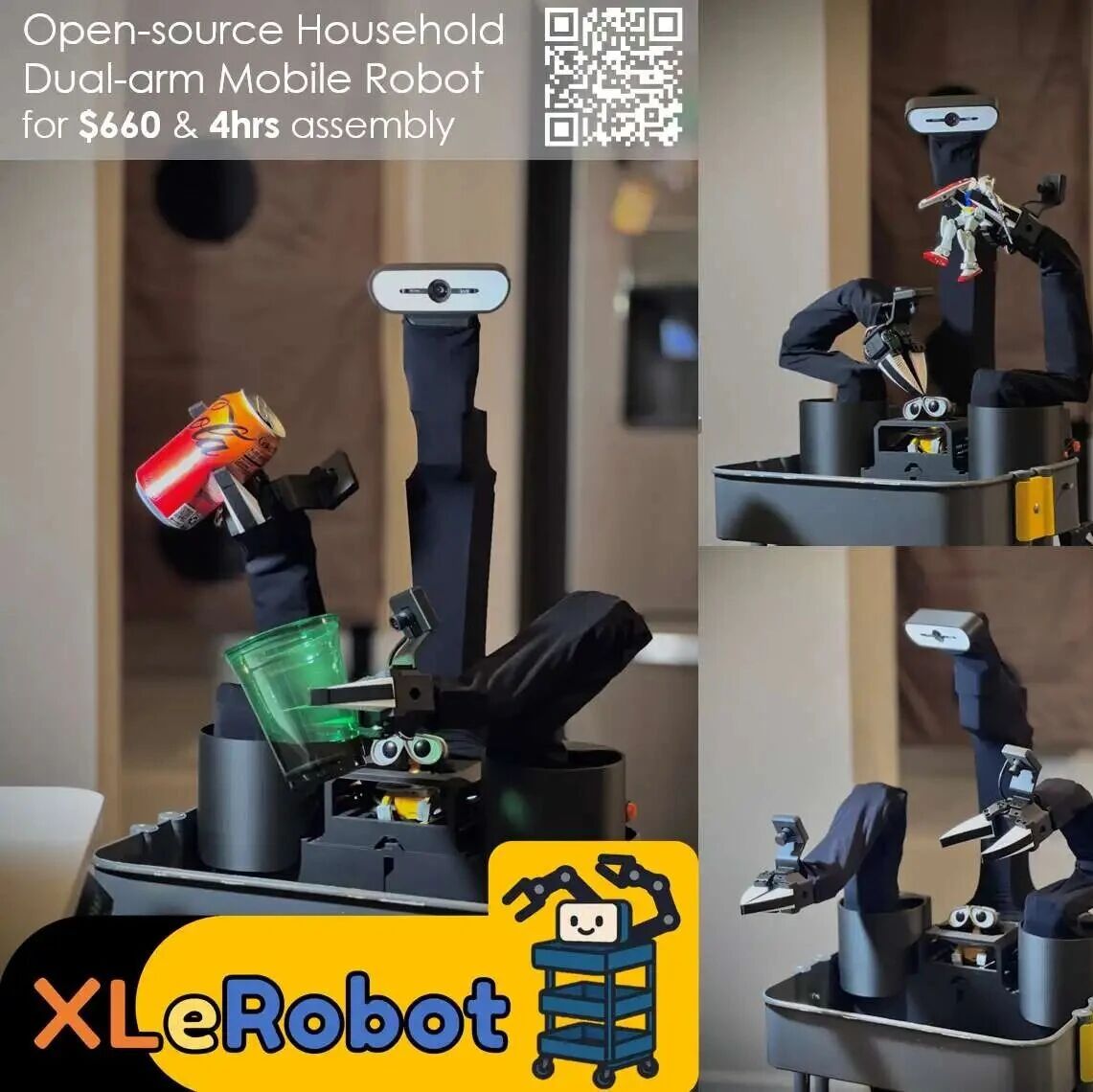
Core Viewpoint - The article emphasizes the importance of open-source projects in advancing mobile and dual-arm robotic operations, highlighting their role in breaking down technical barriers and accelerating innovation in various applications, from household robots to industrial automation [3]. Group 1: Open-Source Projects Overview - XLeRobot, developed by Nanyang Technological University, focuses on flexible movement and precise operation in complex environments, providing a reference framework for mobile and dual-arm control [4]. - AhaRobot from Tianjin University emphasizes autonomy and environmental adaptability in dual-arm operations, integrating perception, planning, and control modules for service robots [6]. - ManiGaussian++, released by Tsinghua University, optimizes dual-arm operation accuracy using Gaussian models, particularly in 3D environment perception and motion planning [8]. - H-RDT, a collaboration between Tsinghua University and Horizon Robotics, aims at efficient decision-making and real-time operations for mobile robots in various settings [11]. - RoboTwin 2.0, developed by Shanghai Jiao Tong University and the University of Hong Kong, integrates simulation and physical platforms for mobile and dual-arm operations [14]. - Open X-Embodiment, from Arizona State University, focuses on a generalized learning framework for robotic operations, supporting cross-scenario skill transfer [16]. - 3D FlowMatch Actor, a joint project by Carnegie Mellon University and NVIDIA, enhances dynamic adaptability in 3D space for mobile and dual-arm operations [19]. - OmniH2O, developed by Carnegie Mellon University, focuses on human-robot action mapping and humanoid operation, facilitating remote control and action teaching [24]. - TidyBot++, a collaboration between Princeton University and Stanford University, targets household organization tasks, integrating object recognition and dual-arm collaboration algorithms [27]. - robosuite, from the University of California, Berkeley, is a mature simulation platform for robotic operations, providing standardized tasks and evaluation tools [29]. - SO-ARM100, a standardized dual-arm operation hardware and software solution, aims to lower development barriers for educational and research purposes [32]. - GOAT, developed by UIUC and CMU, focuses on goal-directed movement and operation for robots, emphasizing robustness and versatility [34]. - Mobile ALOHA, from Stanford University, combines mobile chassis and dual-arm operations for low-cost, easily deployable service robots [35].