Modelo Especial

Search documents
Diageo vs Constellation Brands: One Beverage Giant Breaks as the Other Breaks Out
247Wallst· 2026-03-30 11:15
Core Viewpoint - Diageo is undergoing a painful restructuring with declining sales and a reduced dividend, while Constellation Brands is experiencing growth and maintaining a stable dividend, making it the preferable choice for income-focused investors [2][4][11]. Dividend and Income - Diageo has rebased its interim dividend to $0.20 per share, with a new minimum annual floor of $0.50, indicating a shift towards debt reduction over income [6]. - Constellation Brands maintains a quarterly dividend of $1.02 ($4.08 annualized), which has been consistently reaffirmed, providing stability for income-dependent investors [7]. Growth Trajectory - Diageo anticipates a 2% to 3% organic sales decline in FY2026, with significant drops in U.S. spirits sales (down 9.3%) and a 50.4% collapse in China white spirits volumes [3][7]. - In contrast, Constellation Brands has achieved its 15th consecutive year of beer volume growth, with notable increases in brands like Pacifico (over 15% growth) and Victoria (over 13% growth) [8]. Valuation and Risk - Diageo's stock has decreased by 29.7% over the past year and is down 14.5% year-to-date, trading below its 200-day moving average of $96.41, with a challenging path to the analyst consensus target of $105.29 due to high leverage and ongoing restructuring [9]. - Constellation Brands has seen a 17.9% decline over the past year but has recovered 9.7% year-to-date, with a current price near $151.40 and an analyst consensus target of $171.86 [10]. Conclusion - Diageo is not deemed uninvestable due to potential growth in its Guinness brand and expected proceeds from asset sales, but it is more suitable for risk-tolerant investors with a long-term horizon [10]. - For retirement-focused investors seeking income stability and a clearer growth path, Constellation Brands is the better option, given its consistent dividend, strong beer business, and positive stock momentum [11].



Diageo vs. Constellation Brands vs. Ambev: Three Ways to Bet on the Global Drinks Trade
247Wallst· 2026-03-16 11:16
Core Insights - Diageo, Constellation Brands, and Ambev present distinct investment opportunities in the global drinks trade, with varying financial performances and strategic focuses [4][16]. Diageo - Diageo reported H1 FY2026 net sales of $10.46 billion, a decrease of 4.0% year-over-year, primarily due to a 7.4% decline in North America and a 13.0% drop in Asia Pacific [7][4]. - The company cut its dividend to address a leverage ratio of 3.4x, which exceeds its target range of 2.5-3.0x [7][4]. - Tequila brands, particularly Don Julio and Casamigos, experienced significant declines, with organic sales dropping 20.9% and 30.9% respectively [7][4]. - New CEO Sir Dave Lewis sees opportunities for enhancing competitiveness and broadening the portfolio, although the stock has fallen 26.48% over the past year [8][4]. Constellation Brands - Constellation's revenue for the quarter was $2.22 billion, down 9.8% year-over-year, but the organic decline was only about 2% after accounting for divestitures [9][4]. - The beer segment maintained a strong operating margin of 38.0%, despite facing aluminum tariff pressures [9][4]. - Growth drivers include Pacifico and Victoria, with depletions increasing over 15% and 13% respectively, while Modelo Especial remains the top-selling beer brand in the U.S. [9][4]. - The company is focusing on expanding its Mexican beer imports while managing tariff challenges [2][4]. Ambev - Ambev achieved a full-year 2025 EBITDA margin of 33.4%, marking a 50 basis point improvement and the third consecutive year of margin expansion [10][4]. - The company reported high-single-digit growth in premium and super-premium beer volumes, alongside a 70% growth in GMV for its BEES B2B platform [10][4]. - Ambev's digital distribution infrastructure is seen as a competitive advantage in the Latin American market [2][4]. - The company is trading at a forward P/E of around 14x with a dividend yield near 11%, indicating strong recent profit growth [16][4]. Comparative Analysis - Diageo's core bet is on the recovery of premium spirits, while Constellation focuses on Mexican beer imports, and Ambev emphasizes Latin American beer and digital distribution [11][4]. - Key risks for Diageo include balance sheet issues and U.S. consumer trends, for Constellation, tariff impacts on imports, and for Ambev, foreign exchange risks and inflation in Argentina [11][4]. - Bright spots for Diageo include growth in Guinness and ready-to-drink (RTD) products, while Constellation benefits from Pacifico and Victoria, and Ambev sees premium beer volume growth and BEES platform success [11][4].

Is Constellation Brands, Inc. (STZ) A Good Stock To Buy Now?
Yahoo Finance· 2026-03-13 16:49
Core Thesis - Constellation Brands, Inc. (STZ) is viewed positively due to its strong market position, brand strength, and operational control, which contribute to consistent growth in the beer and beverage industry [3][4][5] Company Performance - STZ's share price was $148.32 as of March 12th, with trailing and forward P/E ratios of 23.54 and 11.96 respectively [1] - Modelo Especial has surpassed Bud Light to become the top-selling beer in the U.S. by sales dollars, indicating a shift towards premium Mexican imports [3] Competitive Advantages - The company has a robust distribution network and a strong balance sheet, providing pricing power and brand loyalty, which are essential for maintaining a competitive edge [4] - STZ's disciplined brand positioning and focus on premiumization allow for ongoing margin expansion, even in a mature market [4] Investment Appeal - Investors may find STZ attractive due to its stable cash flow, strong market position, and potential for growth driven by consumer preference for premium beverages [5] - The operational strength and cultural relevance of STZ position it for sustainable long-term growth, making it a compelling investment in the consumer staples sector [5] Market Sentiment - At the end of the fourth quarter, 53 hedge fund portfolios held STZ, an increase from 50 in the previous quarter, indicating growing interest [7] - Despite the positive outlook, there is a belief that certain AI stocks may offer higher returns in a shorter timeframe compared to STZ [7]
Is Constellation Brands' Focus on Core Brands the Key to Success?
ZACKS· 2026-03-11 17:56
Core Insights - Constellation Brands, Inc. (STZ) is a leading player in the beer, wine, and spirits market, focusing on premiumization, brand strength, and disciplined portfolio management [1][5] - The company has a strong portfolio of consumer-driven brands, including Modelo Especial, Corona Extra, and Robert Mondavi Winery, positioning it well to capture growth opportunities [1][4] Strategy and Growth Drivers - The company's strategy centers on high-growth premium brands to strengthen market share, improve margins, and drive sustainable growth [2][5] - Key growth drivers include high-end Power Brands like The Prisoner Brand Family and Kim Crawford, with the beer segment benefiting from premiumization trends [3][9] - Constellation Brands is investing in capacity expansion in Mexico to support its brand growth [3][9] Market Position and Performance - The company emphasizes high-margin growth categories in the beverage alcohol industry, leveraging direct-to-consumer platforms and a strong global presence [4] - STZ's beer brands, including Modelo, Corona, and Pacifico, reinforce its leadership in the U.S. beer market [4][9] Financial Performance and Estimates - Constellation Brands' shares have gained 7.6% over the past six months, compared to the industry's growth of 9.7% [6] - The company trades at a forward price-to-earnings ratio of 12.09X, below the industry average of 15.17X [7] - The Zacks Consensus Estimate for STZ's fiscal 2026 earnings indicates a year-over-year decline of 15.5%, while fiscal 2027 shows an expected growth of 6.5% [10]

Constellation Brands Announces CEO Succession Plan
Globenewswire· 2026-02-12 21:16
Core Viewpoint - Constellation Brands has announced the appointment of Nicholas Fink as the new President and CEO, effective April 13, 2026, succeeding Bill Newlands, who will transition to a strategic advisor role [1][2][3]. Leadership Transition - Nicholas Fink has been a member of Constellation's Board of Directors since 2021 and is expected to bring a diversified leadership experience and a deep understanding of the company's business model [2]. - Bill Newlands will step down as President and CEO on April 13, 2026, after serving in this role since 2019, and will retire from the Board on the same date [1][4]. Fink's Background - Fink has a proven track record in the beverage alcohol industry, having served as CEO at Fortune Brands Innovations since January 2020, where he led the company through the COVID-19 pandemic and accelerated its digital transformation [2]. - His previous experience includes senior leadership roles at Suntory Global Spirits, where he was responsible for the Asia Pacific and South America regions [2]. Company Performance Under Newlands - Under Bill Newlands' leadership, Constellation Brands consistently ranked among the top growth leaders in the large consumer packaged goods (CPG) sector, with Modelo Especial becoming the 1 selling beer in U.S. dollar sales [4]. - Newlands oversaw the reshaping of the Wine & Spirits portfolio, focusing on higher-end, higher-margin brands aligned with consumer trends [4]. Future Outlook - Fink expressed enthusiasm about joining Constellation Brands and aims to build on the company's strong track record of industry leadership, focusing on brand development and innovation to meet evolving consumer needs [3][4].

Constellation Brands (STZ) Up 11.9% Since Last Earnings Report: Can It Continue?
ZACKS· 2026-02-06 17:30
Core Viewpoint - Constellation Brands reported its Q3 fiscal 2026 results, showing a decline in sales and earnings year over year, primarily due to weak consumer demand trends, despite surpassing analyst estimates for both metrics [2][3]. Financial Performance - Comparable earnings per share (EPS) for Q3 were $3.06, down 6% year over year, but exceeded the Zacks Consensus Estimate of $2.65. Reported EPS was $2.88 compared to $3.39 in the same quarter last year [3]. - Net sales fell 10% year over year to $2.22 billion, surpassing the Zacks Consensus Estimate of $2.18 billion. Organic net sales decreased by 2% year over year [3]. Segment Performance - The beer segment's sales decreased by 1% year over year to $2.01 billion, with shipment volumes down 2.2%. Depletions fell 3%, with declines in Modelo Especial (4%), Corona Extra (9%), and Modelo Chelada (2%), partially offset by growth in Pacifico (over 15%) and Victoria (over 13%) [4]. - The wine and spirits segment saw a significant decline of 51% year over year in sales, totaling $213.1 million, impacted by a 70.6% drop in shipment volumes due to divestitures and strategic pricing changes [5]. Margins and Income - Comparable loss for the company was $46.9 million, compared to a loss of $9.2 million in the prior-year quarter, attributed to weak operating income across beer, wine, and spirits [6]. - Operating income for the beer segment decreased by 1% year over year to $763.5 million, with an operating margin increase of 10 basis points to 38% due to favorable pricing [7]. - The wine and spirits segment reported an operating income of $33.7 million, down 65% from the previous year, with an operating margin contraction to 15.8% from 22.1% [8]. Financial Position - As of November 30, 2025, cash and cash equivalents stood at $152.4 million, long-term debt was $10.3 billion, and total shareholders' equity was $7.7 billion. The company generated an operating cash flow of $2.1 billion and an adjusted free cash flow of $1.5 billion in the first nine months of fiscal 2026 [9]. Future Expectations - Management projects an enterprise organic net sales decrease of 4-6% for fiscal 2026, with beer segment net sales expected to decline by 2-4% and wine and spirits segment net sales anticipated to drop by 17-20% [12]. - The company expects a reported operating income increase of 657-677% for fiscal 2026, while comparable operating income is projected to decline by 9-11% [13]. - Comparable EPS guidance for fiscal 2026 is set at $11.30-$11.60, with fiscal 2026 EPS expected to be $9.72-$10.02 [14]. Market Sentiment - There has been a downward trend in estimates, with the consensus estimate shifting down by 13.46% recently [16]. - Constellation Brands holds a Zacks Rank 3 (Hold), indicating expectations for an in-line return from the stock in the coming months [18].
Constellation Brands Stock Pops on Profit, Revenue Beat
Schaeffers Investment Research· 2026-01-08 16:34
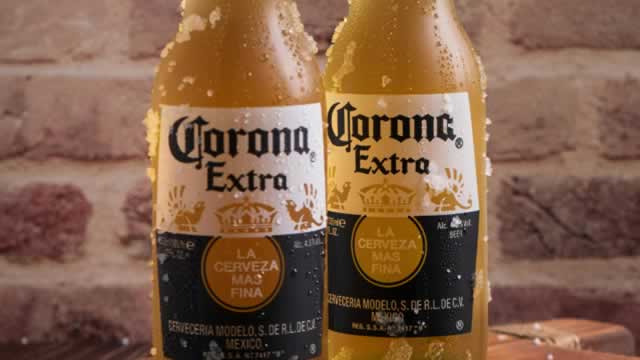
Group 1 - Constellation Brands Inc shares increased by 4.2% to $146.41 after surpassing profit and revenue estimates for the fiscal third quarter, driven by stable demand for its Corona and Modelo Especial beer brands [1] - The stock has risen 15% since reaching a five-year low of $126.45 on November 10, and has recently achieved its highest level since December, supported by the 40-day moving average [2] - Despite the recent positive trading sessions, the shares still reflect a year-over-year decline of 33.7% [2] Group 2 - Options traders have shown increased bearish sentiment, as indicated by the equity's 50-day put/call volume ratio being higher than 74% of annual readings [3] - There has been a notable shift in sentiment, with 15,000 calls and 9,909 puts traded, which is four times the average intraday volume, indicating a potential unwinding of pessimism [4] - The most actively traded contract is the weekly 1/9 160-strike call, with new positions being established [4]

Constellation Brands Posts Q3 Earnings Beat, Soft Wine & Spirits Sales
ZACKS· 2026-01-08 16:31
Core Insights - Constellation Brands, Inc. (STZ) reported third-quarter fiscal 2026 results with sales and earnings exceeding Zacks Consensus Estimates, despite year-over-year declines due to weak consumer demand trends [1][10] Financial Performance - Comparable earnings per share (EPS) for Q3 were $3.06, a 6% decline year over year, but above the Zacks Consensus Estimate of $2.65. Reported EPS was $2.88 compared to $3.39 in the same quarter last year [1] - Net sales decreased by 10% year over year to $2.22 billion, surpassing the Zacks Consensus Estimate of $2.18 billion. Organic net sales fell by 2% year over year [2] - The beer business generated $2.01 billion in sales, down 1% year over year, with a 2.2% decline in shipment volumes, partially offset by favorable pricing. Depletions fell by 3% [4] - The wine and spirits segment saw a significant decline of 51% in sales to $213.1 million, driven by a 70.6% drop in shipment volumes due to divestitures and strategic pricing efforts [5] Margin Analysis - Comparable loss for the company was $46.9 million, compared to a loss of $9.2 million in the prior-year quarter, attributed to weak operating income across beer, wine, and spirits businesses [6] - Operating income for the beer segment decreased by 1% to $763.5 million, with an operating margin increase of 10 basis points to 38% [7] - The wine and spirits segment reported an operating income of $33.7 million, down 65% from the previous year, with an operating margin contraction to 15.8% [8] Financial Position - As of November 30, 2025, cash and cash equivalents stood at $152.4 million, long-term debt at $10.3 billion, and total shareholders' equity at $7.7 billion. The company generated an operating cash flow of $2.1 billion and adjusted free cash flow of $1.5 billion in the first nine months of fiscal 2026 [11] - The board announced a quarterly dividend of $1.02 per share, payable on November 13, 2026, with nearly $604 million returned to shareholders through share repurchases [12] Future Outlook - The company forecasts an operating cash flow of $2.5-$2.6 billion and adjusted free cash flow of $1.3-$1.4 billion for fiscal 2026, with capital expenditures of $1.2 billion primarily for Mexico beer operations [13] - Management projects a 4-6% decrease in enterprise organic net sales for fiscal 2026, with beer segment net sales expected to decline by 2-4% and wine and spirits segment net sales anticipated to drop by 17-20% [14] - Comparable EPS guidance is set at $11.30-$11.60 for fiscal 2026, with a reported EPS expectation of $9.72-$10.02 [16]
Constellation Brands(STZ) - 2026 Q3 - Earnings Call Presentation
2026-01-08 15:30
Financial Performance - The company updated its FY26 reported EPS outlook to $972-$1002 and affirmed a comparable EPS outlook of $1130-$1160[16] - The company affirmed FY26 targets for operating cash flow of $25 billion to $26 billion and free cash flow of $13 billion to $14 billion[16] - Enterprise Q3 FY26 reported net sales were $2223 billion, a 10% decrease year-over-year, while organic net sales also reached $2223 billion, reflecting a 2% decrease[21, 24] - Enterprise Q3 FY26 reported operating income was $692 million, a 13% decrease year-over-year, but comparable operating income was $739 million, remaining flat[21, 28] Segment Results - The Beer Business experienced a 1% decrease in net sales, reaching $20 billion in Q3 FY26[21] - The Wine and Spirits Business reported a 51% decrease in net sales to $213 million, with organic net sales down 7%[21] - The Wine and Spirits Business operating margin contracted significantly from 221% to 158%[17] Capital Allocation - The company maintained a net leverage ratio at the target of approximately 30X[17, 19] - The company executed $220 million in share repurchases in Q3, bringing the fiscal year-to-date total to $824 million[17, 19] - Capital expenditures in Q3 were $246 million, with a fiscal year-to-date total of $656 million, primarily focused on Beer brewing capacity additions[17, 19] Strategic Initiatives - The company achieved a net benefit through efficiency and cost optimization initiatives of over $40 million in Q3 FY26 and over $145 million fiscal year-to-date[20]
Constellation Brands beats third-quarter estimates on steady Modelo, Corona beer demand
Reuters· 2026-01-07 23:10
Group 1 - Constellation Brands reported third-quarter sales and profit above Wall Street estimates [1] - The growth was driven by steady demand for Modelo Especial and Corona beer brands [1]