Monlunabant

Search documents
Skye's CB1 Inhibitor, Nimacimab, Demonstrates Superior Weight Loss and Differentiated Mechanisms from Monlunabant, and Continues to Show Enhanced Combination with Tirzepatide with Durable Post-Treatment Weight Maintenance in DIO Model
Globenewswire· 2025-09-04 11:00
Core Insights - Skye Bioscience reported promising results from preclinical studies on nimacimab, indicating its potential as a superior treatment for obesity compared to existing therapies [1][5] Group 1: Study Findings - The first preclinical study showed that nimacimab demonstrated similar or better weight loss compared to monlunabant, with superior maintenance of weight loss post-treatment [1][6] - The second study indicated that nimacimab, when combined with tirzepatide, resulted in over 40% weight loss and limited rebound weight gain after treatment cessation [5][6] - Nimacimab is positioned as a potential standalone, combination, and maintenance therapy in the obesity drug development landscape [1][5] Group 2: Mechanism and Differentiation - Nimacimab is a peripherally-acting CB1-inhibiting monoclonal antibody that may offer a better safety and tolerability profile compared to small molecule inhibitors like monlunabant [6] - The mechanism of action for nimacimab suggests improved metabolic homeostasis and reduced compensatory rebound upon treatment withdrawal [3][6] - The ability to maintain weight loss after GLP-1 treatment aligns with real-world needs, addressing issues of durability and adherence [3][6] Group 3: Future Outlook - Skye plans to present these findings at a KOL event, discussing the potential of combining peripherally-acting CB1 antagonism with GLP-1 therapies to enhance weight loss outcomes [3][4] - Top-line data from the Phase 2 CBeyond study is expected to be reported in late Q3 or early Q4 2025, indicating ongoing development and potential market entry [5]



速递|Nature发布2026年后有望获批的下一代减肥药,全方位提升
GLP1减重宝典· 2025-05-31 10:15
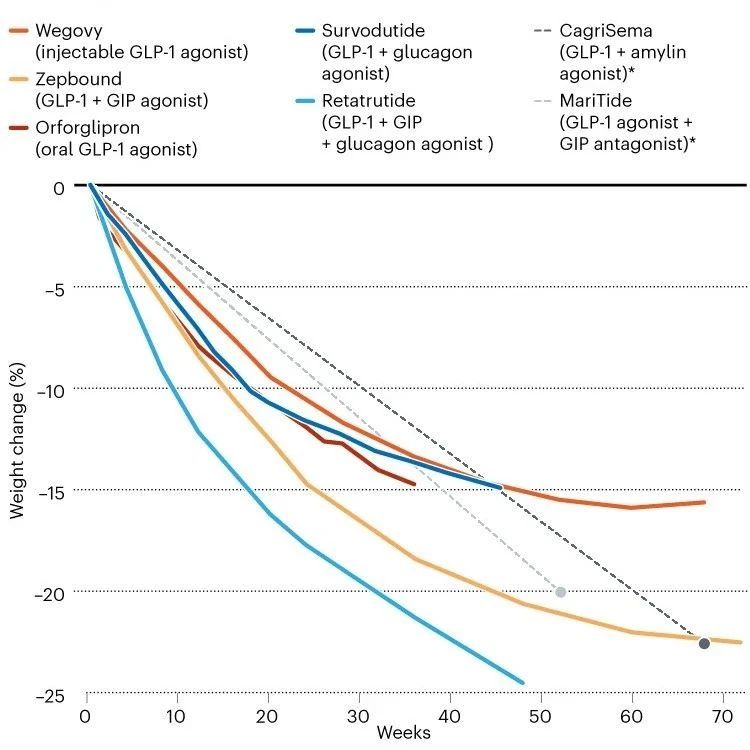
Core Viewpoint - Obesity has become a global health challenge, with significant advancements in the development of anti-obesity drugs, with over 100 new treatments in development aimed at providing safer and more effective weight loss options for patients [1] Group 1: Upcoming Drug Approvals - Orforglipron from Eli Lilly is expected to be approved in 2026 as an oral small-molecule drug activating the GLP-1 receptor [2] - CagriSema from Novo Nordisk, also expected in 2026, is an injectable that activates both amylin and GLP-1 receptors [2] - Survodutide from Boehringer Ingelheim and Retatrutide from Eli Lilly are anticipated in 2027, both being injectables that activate multiple receptors [3] - MariTide from Amgen and Bimagrumab from Eli Lilly are projected for approval in 2028 and beyond, with unique mechanisms targeting GLP-1 and myostatin signaling respectively [3] Group 2: Mechanisms and Efficacy - New generation drugs are focusing on protecting muscle quality while promoting weight loss, addressing the limitations of traditional drugs like semaglutide, which can lead to muscle loss [4] - Dual-action drugs like tirzepatide, which mimics both GLP-1 and GIP, have shown superior weight loss results, with participants losing an average of 20% of their body weight [5] - CagriSema has demonstrated an average weight loss of nearly 23% in a 68-week Phase III trial [9] Group 3: Delivery Methods and Patient Compliance - The industry is exploring more convenient delivery methods, including monthly injections and oral medications, to improve patient compliance [13] - Orforglipron is expected to be the first oral anti-obesity drug, with a 15% weight loss observed in a 36-week Phase II study [13] Group 4: Genetic Insights and New Targets - Advances in genetic sequencing have identified new targets for obesity treatment, with companies like Alnylam Pharmaceuticals developing therapies based on gene mutations associated with lower body weight [14][17] - The potential of next-generation CB1 antagonists is being explored, aiming to avoid severe side effects while improving metabolic outcomes [18] Group 5: Muscle Preservation - Muscle preservation is becoming a key focus in obesity treatment, with existing GLP-1 drugs potentially leading to muscle loss [19] - Bimagrumab, a monoclonal antibody targeting myostatin, has shown promise in reducing muscle loss while promoting fat breakdown, with a 22% reduction in fat mass observed in a 48-week trial [20][22] - The development of muscle-targeting therapies is still in early stages but is gaining attention as a crucial component of future obesity treatment strategies [25]