抗肥胖药物研发

Search documents
减重药物界最大谜团破解!同一受体"激活"或"抑制"都能减肥?《自然·代谢》揭秘GIPR双重作用机制的生命科学革命
GLP1减重宝典· 2026-01-26 11:48
Core Insights - The article highlights the significant advancements in weight loss medications, particularly focusing on the role of GLP-1R agonists like semaglutide and the emerging interest in GIPR as a target for obesity treatment [5][8]. Group 1: Mechanisms of Action - Semaglutide, a GLP-1R agonist, has revolutionized weight loss by stimulating insulin secretion, regulating metabolism, and suppressing appetite [5]. - GIPR, another member of the incretin hormone family, has shown a perplexing ability to facilitate weight loss through both activation and inhibition, with distinct mechanisms involved [5][11]. - Recent studies reveal that GIPR agonists primarily act on GABAergic neurons, while antagonists rely on GLP-1R signaling, indicating different neuronal pathways activated in the central nervous system [5][11]. Group 2: New Drug Developments - The dual-target weight loss drug tirzepatide, which activates both GIPR and GLP-1R, has demonstrated significant weight loss effects, surpassing the sum of individual effects [8]. - The GIPR-Ab/GLP-1 peptide antibody conjugate developed by Amgen requires the presence of both GIPR and GLP-1R in the brain to exert its anti-obesity effects, confirming the findings of the Gutgesell team [6][11]. - AMG133, a bispecific hybrid antibody that activates GLP-1R and antagonizes GIPR, has shown promising results in reducing appetite and promoting weight loss in animal models [8][11]. Group 3: Implications for Future Research - The understanding of GIPR and GLP-1R mechanisms opens new avenues for developing more precise and effective weight loss therapies [11]. - The contrasting transcriptional responses induced by GIPR agonists and antagonists in the brain suggest potential for tailored therapeutic strategies in obesity management [11].


速递|Nature发布2026年后有望获批的下一代减肥药,全方位提升
GLP1减重宝典· 2025-05-31 10:15
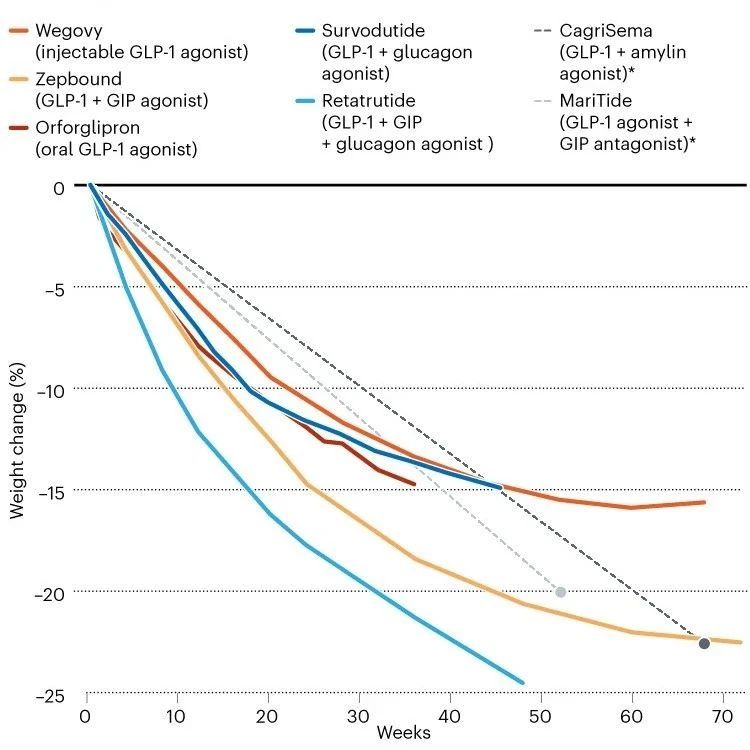
Core Viewpoint - Obesity has become a global health challenge, with significant advancements in the development of anti-obesity drugs, with over 100 new treatments in development aimed at providing safer and more effective weight loss options for patients [1] Group 1: Upcoming Drug Approvals - Orforglipron from Eli Lilly is expected to be approved in 2026 as an oral small-molecule drug activating the GLP-1 receptor [2] - CagriSema from Novo Nordisk, also expected in 2026, is an injectable that activates both amylin and GLP-1 receptors [2] - Survodutide from Boehringer Ingelheim and Retatrutide from Eli Lilly are anticipated in 2027, both being injectables that activate multiple receptors [3] - MariTide from Amgen and Bimagrumab from Eli Lilly are projected for approval in 2028 and beyond, with unique mechanisms targeting GLP-1 and myostatin signaling respectively [3] Group 2: Mechanisms and Efficacy - New generation drugs are focusing on protecting muscle quality while promoting weight loss, addressing the limitations of traditional drugs like semaglutide, which can lead to muscle loss [4] - Dual-action drugs like tirzepatide, which mimics both GLP-1 and GIP, have shown superior weight loss results, with participants losing an average of 20% of their body weight [5] - CagriSema has demonstrated an average weight loss of nearly 23% in a 68-week Phase III trial [9] Group 3: Delivery Methods and Patient Compliance - The industry is exploring more convenient delivery methods, including monthly injections and oral medications, to improve patient compliance [13] - Orforglipron is expected to be the first oral anti-obesity drug, with a 15% weight loss observed in a 36-week Phase II study [13] Group 4: Genetic Insights and New Targets - Advances in genetic sequencing have identified new targets for obesity treatment, with companies like Alnylam Pharmaceuticals developing therapies based on gene mutations associated with lower body weight [14][17] - The potential of next-generation CB1 antagonists is being explored, aiming to avoid severe side effects while improving metabolic outcomes [18] Group 5: Muscle Preservation - Muscle preservation is becoming a key focus in obesity treatment, with existing GLP-1 drugs potentially leading to muscle loss [19] - Bimagrumab, a monoclonal antibody targeting myostatin, has shown promise in reducing muscle loss while promoting fat breakdown, with a 22% reduction in fat mass observed in a 48-week trial [20][22] - The development of muscle-targeting therapies is still in early stages but is gaining attention as a crucial component of future obesity treatment strategies [25]