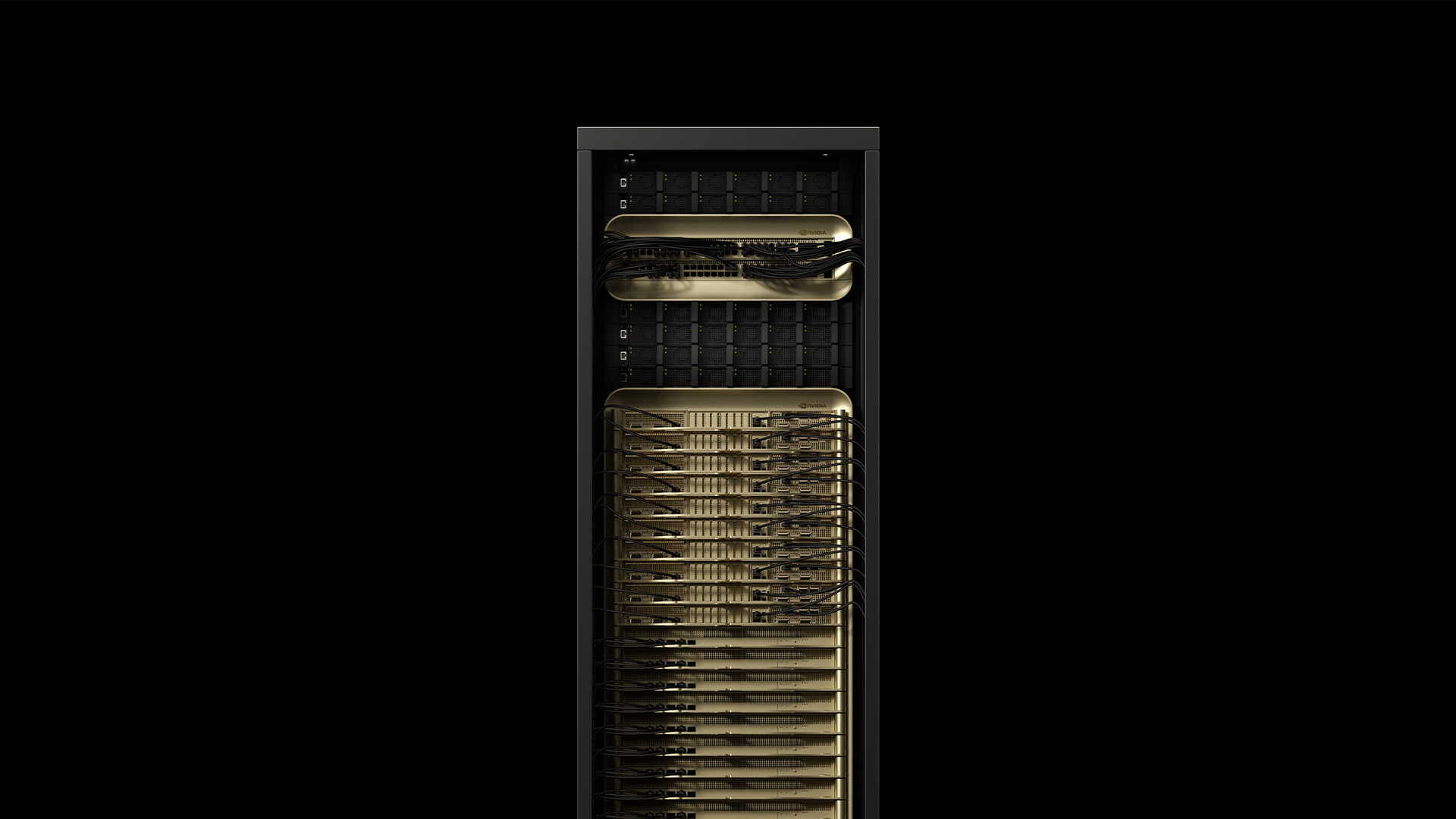
NVIDIA Blackwell Ultra

Search documents
Nebius (NBIS) Launches AI Cloud 3.1 Powered by NVIDIA Blackwell Ultra
Yahoo Finance· 2026-01-08 15:09
Core Insights - Nebius Group N.V. (NASDAQ:NBIS) is highlighted as a significant investment opportunity in the AI sector, particularly following the release of its updated AI cloud platform, Nebius AI Cloud 3.1 [1] Group 1: Product Launch and Features - Nebius AI Cloud 3.1 introduces next-generation NVIDIA Blackwell Ultra compute capabilities, facilitating the transition from AI experiments to large-scale production deployments [2] - The update enhances compute power, capacity management, and transparency, along with various developer and ecosystem features [2] - The GB300 NVL72 platform now supports rack-scale operations, functioning like a single giant GPU, which is essential for large-scale model training and high-throughput inference [3] - The platform expands its ecosystem with native integration with Dstack for streamlined workflows and simplified access to NVIDIA BioNeMo NIM microservices [3] Group 2: Security and Compliance - The update includes strengthened security features such as object storage data-plane audit logs for HIPAA compliance, per-object access controls, and enhanced identity management through Microsoft Entra ID integration [4] Group 3: Company Overview - Nebius Group N.V., based in Amsterdam, specializes in developing and operating AI cloud infrastructure tailored for training and inference of advanced machine learning models, offering full-stack GPU clusters and networking solutions [5]

Can NBIS AI Cloud 3.1's Blackwell Ultra Launch Trigger Growth Momentum?
ZACKS· 2025-12-18 13:16
Core Insights - Nebius Group N.V. (NBIS) has launched Nebius AI Cloud 3.1, addressing operational challenges related to GPU availability and resource management for enterprises scaling AI workloads [1][4] - The new version incorporates NVIDIA Blackwell Ultra infrastructure, enhanced GPU capacity management, and improved security features, positioning it as a competitive platform in the AI cloud market [1][2] Infrastructure and Operations - Nebius is the first cloud provider in Europe to deploy NVIDIA Blackwell Ultra systems in production, including the GB300 NVL72 with 800 Gbps NVIDIA Quantum-X800 InfiniBand [2] - The introduction of Capacity Blocks and a real-time dashboard allows enterprises to manage GPU capacity and costs more effectively [2][8] - Nebius AI Cloud 3.1 has achieved top MLPerf Training v5.1 results, reinforcing its competitive edge [2] Ecosystem and Development - The platform simplifies access to NVIDIA BioNeMo NIM microservices for healthcare and life sciences, enhancing the developer experience with improved orchestration and billing features [3] - Security enhancements include HIPAA-ready audit logs and granular access controls, catering to regulated workloads [3] Market Position and Competition - Nebius' revenue guidance for 2025 has been raised to $500–$550 million, reflecting confidence in capacity expansion despite near-term risks from power constraints and competition [4][8] - Competitors like CoreWeave and Amazon are ramping up investments in AI infrastructure, with CoreWeave securing significant GPU inventories and Amazon doubling its power capacity by 2027 [5][6] Financial Performance - Nebius shares have increased by 179% over the past year, outperforming the Internet – Software and Services industry, which grew by 26.8% [9] - However, Nebius is considered overvalued with a Price/Book ratio of 3.95X compared to the industry average of 3.74X [10] - The Zacks Consensus Estimate for NBIS' 2025 earnings has seen downward revisions, indicating potential challenges ahead [11][12]



Nebius AI Cloud 3.1 Delivers Next-Generation NVIDIA Blackwell Ultra Compute with Transparent Capacity Management for AI at Scale
Businesswire· 2025-12-17 14:27
Core Insights - Nebius has launched Nebius AI Cloud 3.1, enhancing its AI cloud platform with next-generation NVIDIA Blackwell Ultra compute and improved operational capabilities [1][2] - The new version focuses on providing operational visibility, resource planning, and addressing the needs of customers transitioning to large-scale AI adoption [2][4] Infrastructure and Performance - Nebius is deploying NVIDIA Blackwell Ultra infrastructure globally, being the first cloud provider in Europe to operate both NVIDIA GB300 NVL72 and HGX B300 systems in production [3] - The platform achieves leading results in MLPerf® Training v5.1 benchmarks, supported by hardware-accelerated networking and enhanced storage caching [3][9] Operational Transparency - Version 3.1 introduces Capacity Blocks and a real-time Capacity Dashboard, offering customers visibility into reserved GPU capacity and availability across data center regions [4][9] - Project-level quotas and new lifecycle object storage rules provide granular control over resource allocation and cost management [4][9] Ecosystem and Developer Usability - The Nebius AI Cloud ecosystem is expanding with new native integration with Dstack and simplified deployment of NVIDIA BioNeMo NIM microservices [5] - Enhanced developer usability features include improved Slurm-based orchestration and FOCUS-compliant billing exports [5][9] Security and Compliance - The latest release builds on Aether's security foundation with HIPAA-compliant audit logs, per-object access controls, and enhanced IAM with Microsoft Entra ID integration [6][12] - These features advance compliance capabilities for customers in regulated sectors and government [6][12]

VRT Rides on Accelerating AI Infrastructure Demand: What's Ahead?
ZACKS· 2025-11-26 18:40
Core Insights - Vertiv (VRT) is experiencing significant growth due to the rising demand for AI infrastructure, particularly in the Americas and APAC regions, with organic sales growth of 43% and 21% respectively in Q3 2025 [1][2] Group 1: Sales and Orders - The company reported a robust order pipeline with organic orders increasing by approximately 21% over the trailing 12 months, and a book-to-bill ratio of 1.4 for Q3 2025, indicating strong future prospects [2][10] - Vertiv's backlog reached $9.5 billion, growing 12% sequentially and 30% year over year, driven by the demand for AI and data center solutions [2][10] Group 2: Investment and Capacity Expansion - The company is actively investing in research and capacity expansion to meet the growing needs of AI infrastructure, particularly in advanced power and cooling systems [3][10] - Vertiv has developed a high-density reference design for NVIDIA's GB300 NVL72 platform, capable of supporting up to 142kW per rack, which is essential for high-density computing environments [4][10] Group 3: Competitive Landscape - Vertiv faces increasing competition from Super Micro Computer (SMCI) and Hewlett Packard Enterprise (HPE), both of which are expanding their capabilities in the AI infrastructure market [5][6] - Super Micro Computer reported that over 75% of its revenues in Q1 fiscal 2026 came from AI-focused systems, with significant back orders indicating strong market positioning [6] - HPE achieved record AI systems revenues of $1.6 billion in Q3 2025, along with a record AI backlog of $3.7 billion, showcasing its competitive strength in the AI infrastructure sector [7] Group 4: Stock Performance and Valuation - Vertiv's stock has appreciated by 49.3% year to date, outperforming the broader Zacks Computer & Technology sector, which increased by 25% [8][10] - The company's trailing 12-month Price/Book ratio stands at 18.48X, significantly higher than the sector average of 10.43X, indicating a premium valuation [11] - The consensus estimate for Vertiv's 2025 earnings is $4.11 per share, reflecting a 44.21% increase from 2024 [13]


Super Micro Stock Tests Support as AI Expansion Outpaces Its Cash Engine
Investing· 2025-11-06 19:53
Core Insights - Super Micro Computer Inc. is experiencing a significant contrast between its growth potential in the AI hardware sector and its current financial challenges, with Q1 FY2026 revenue declining by 15% year-on-year to $5.0 billion, missing the consensus estimate of $6 billion [1][2][14] - The company has raised its full-year revenue guidance to at least $36 billion, up from $33 billion, driven by substantial orders for NVIDIA's GB300 AI platform [1][2] Financial Performance - Q1 FY2026 results showed a decline in earnings per share (EPS) to $0.35, below the expected $0.46, and a gross margin contraction to 9.5%, the lowest in two years [1][14] - Operating cash flow turned negative at –$918 million, with inventories increasing by $1 billion to $5.7 billion, and the cash-conversion cycle extended to 123 days from 96 [2][11] - The company ended the quarter with $4.2 billion in cash and $4.8 billion in debt, resulting in a net-debt position of $575 million [2][14] Growth Strategy - CEO Charles Liang described FY2026 as a pivotal year for "hypergrowth consolidation," with over 75% of Q1 revenue derived from AI compute platforms [3][12] - The company aims to produce 6,000 racks per month, including 3,000 direct-liquid-cooling units, across expanded facilities in multiple regions [5][12] Market Position and Competition - Super Micro's unique value proposition lies in its speed-to-market and system integration capabilities, although it faces increased competition from Dell, HPE, and Celestica [9][10] - The company has shifted its regional exposure, with the U.S. contributing 37% of revenue (down 57% YoY) while Asia's share increased by 143% to 46% [9][10] Valuation and Investor Sentiment - The stock trades at approximately 18.5 times forward P/E and 0.9 times price-to-sales, significantly below peer medians, indicating a market discount for execution risk rather than growth potential [10][13] - Management emphasizes maintaining profitability and leveraging credit lines to manage liquidity, with a focus on restoring double-digit margins as the business scales [11][15]


五大数据中心支出展望更新,2025 年第二季度同比增长 57%15%-US Communications Equipment-Updated Big Five Data Center Spend Outlook; +57%15% YY
2025-09-17 01:51
Summary of Key Points from the Conference Call Industry Overview - **Industry**: US Communications Equipment - **Focus**: Data Center Spending by Major Cloud Service Providers Core Insights - **Growth Projections**: Data center spending by the Big Five Cloud providers is projected to grow by **57% year-over-year (Y/Y)** in **2025** and **15% Y/Y** in **2026** [1] - **Investment Focus**: The growth expectations are particularly strong for **Tier 2** and **Rest of Cloud** capital expenditures, indicating a broadening opportunity within data center infrastructure [1] - **AI Spending**: The forecasts emphasize **AI-related spending**, which is a key driver of the projected growth, differing from traditional capital expenditure estimates that include all types of spending [1] Notable Trends - **Server Spending**: The ramp-up of **NVIDIA Blackwell Ultra** is significantly driving server spending, alongside contributions from **Google** and **Amazon** custom accelerators [5] - **Infrastructure Anticipation**: Increased spending on networking and physical infrastructure is noted in anticipation of AI platform deployments [6] - **General Purpose Compute**: The top four cloud service providers are investing in general-purpose compute resources, particularly **Google** and **Amazon**, in addition to AI-specific investments [7] Demand Dynamics - **Hyperscaler Demand**: There is robust demand for data center infrastructure, with US hyperscalers pulling demand forward due to macroeconomic factors, leading to an upside in capital expenditures [8] - **Enterprise Spending**: Some macroeconomic factors may inhibit enterprise spending, suggesting a shift towards public cloud migration [10] Component Inventory - **Inventory Levels**: There is an increase in component inventory for **DRAM** and servers, but this has not yet impacted capital expenditures [9] Custom Accelerators - **Deployment Trends**: The deployment of high-end custom accelerators, particularly **Google's TPU**, is expected to exceed commercial high-end GPUs in volume this year. However, **Microsoft's** high-end custom accelerator, **Maia**, is experiencing delays [9] Regional Developments - **Data Center Construction**: **Meta** and **Microsoft** are constructing multiple new data centers in the US, with Microsoft planning launches in **11 new regions** this year and Meta in **14 regions** over the next 2-4 years [9] - **Oracle's Expansion**: **Oracle** is planning new data centers in **7 regions** within the next 12-18 months [9] Emerging Players - **Rest of Cloud Providers**: Data center capital expenditures for this segment have increased by more than **23% for four consecutive quarters**, driven by the adoption of accelerated computing, particularly from specialized cloud service providers offering **GPU-as-a-Service (GPUaaS)** [11] - **CoreWeave**: Notably, **CoreWeave** is targeting over **$20 billion** in data center capital expenditures this year, with plans to expand its GPU deployments significantly [11] Conclusion - The data center infrastructure market is experiencing significant growth driven by AI investments and the expansion of cloud service providers. The trends indicate a shift in spending patterns, with emerging players gaining traction alongside established hyperscalers.
OpenAI's Agreement with MSFT Opens For-Profit Path, SMCI Ships NVDA Blackwell
Youtube· 2025-09-12 14:15
OpenAI and Microsoft Relationship - OpenAI is nearing a resolution to convert from a nonprofit to a public benefit corporation, with Microsoft as its top shareholder, outlining terms for at least $100 billion in equity for its nonprofit arm [2][4] - The nonprofit will hold an equity stake that could amount to roughly 20% of OpenAI if a deal is finalized at a valuation of approximately $500 billion, potentially making OpenAI the largest startup globally [4][6] - The unusual structure of OpenAI has raised concerns, especially following the firing and reinstatement of CEO Sam Altman, highlighting the complexities of governance as the company grows [6][7] Financial Implications - The transition to a public benefit corporation allows OpenAI to pursue financial returns while maintaining a commitment to societal impact, blurring the lines between nonprofit and for-profit entities [7][8] - Microsoft investors have reacted positively to the news, alleviating fears regarding the relationship turmoil between the two companies [8][9] AI Market Dynamics - OpenAI's ChatGPT has become the fastest-growing app, reaching over 700 million users in less than three years, indicating strong market demand for AI solutions [11] - Despite the growth, there are concerns about the sustainability of AI startups, with some investors potentially facing losses, although OpenAI is not expected to be among them [12][13] Regulatory Challenges - OpenAI faces scrutiny from California and Delaware attorneys general regarding its proposed financial and governance changes, particularly concerning the impact of its products on children [14][15] Nvidia Developments - Super Micro has announced the availability of NVIDIA Blackwell Ultra solutions, which can utilize up to 1,400 watts per GPU and offer 50% greater inferencing performance compared to previous models [17][18] - The demand for Nvidia's advanced chips remains strong despite competition from companies like Alibaba, reaffirming Nvidia's position in the market [18][20]


Dell Technologies vs HPE: Which AI Server Stock Has Greater Upside?
ZACKS· 2025-04-08 20:00
Core Insights - The AI infrastructure market is expected to exceed $200 billion in spending by 2028, with both Dell Technologies and Hewlett Packard Enterprise well-positioned to benefit from this growth opportunity [2] Dell Technologies - Dell Technologies is experiencing strong demand for its AI-optimized servers, particularly the PowerEdge XE9680L, driven by digital transformation and interest in generative AI applications [3] - In Q4 of fiscal 2025, Dell's AI-optimized server orders increased by $1.7 billion, with shipments totaling $2.1 billion and a backlog of $4.1 billion [5] - Dell's partnership with companies like NVIDIA and Microsoft is expanding, enhancing its AI capabilities and enterprise AI adoption [6] - Dell's shares are trading at a forward Price/Sales ratio of 0.5X, indicating a relatively low valuation [13] - The Zacks Consensus Estimate for Dell's fiscal 2026 earnings is $9.34 per share, reflecting a 14.74% year-over-year increase [15] Hewlett Packard Enterprise - Hewlett Packard is also benefiting from strong demand for its AI-optimized servers, with its server business growing 30% year-over-year to $4.3 billion in Q1 of fiscal 2025 [7] - The launch of HPE's ProLiant Gen 12 server platform is expected to improve performance and energy efficiency, potentially replacing multiple older server generations and reducing power consumption by at least 65% [8] - HPE's GreenLake cloud product has achieved significant growth, with annual recurring revenue surpassing $2 billion, a 46% increase year-over-year [9] - HPE's shares are trading at a forward Price/Sales ratio of 0.52X, slightly higher than Dell's [13] - The Zacks Consensus Estimate for HPE's fiscal 2025 earnings is $1.94 per share, indicating a 2.51% decline year-over-year [15] Stock Performance - Year-to-date, Dell's shares have decreased by 34.9%, while HPE's shares have dropped by 37.6%, largely due to broader market weaknesses and rising trade tensions [10] - Dell holds a Zacks Rank of 3 (Hold), making it a stronger pick compared to HPE, which has a Zacks Rank of 4 (Sell) [17]


NVIDIA Blackwell Ultra AI Factory Platform Paves Way for Age of AI Reasoning
Globenewswire· 2025-03-18 18:34
Core Insights - NVIDIA has introduced the Blackwell Ultra AI factory platform, enhancing AI reasoning capabilities and enabling organizations to accelerate applications in AI reasoning, agentic AI, and physical AI [1][15] - The Blackwell Ultra platform is built on the Blackwell architecture and includes the GB300 NVL72 and HGX B300 NVL16 systems, significantly increasing AI performance and revenue opportunities for AI factories [2][3] Product Features - The GB300 NVL72 system delivers 1.5 times more AI performance compared to the previous GB200 NVL72, and increases revenue opportunities by 50 times for AI factories compared to those built with NVIDIA Hopper [2] - The HGX B300 NVL16 offers 11 times faster inference on large language models, 7 times more compute, and 4 times larger memory compared to the Hopper generation [5] System Architecture - The GB300 NVL72 connects 72 Blackwell Ultra GPUs and 36 Arm Neoverse-based Grace CPUs, designed for test-time scaling and improved AI model performance [3] - Blackwell Ultra systems integrate with NVIDIA Spectrum-X Ethernet and Quantum-X800 InfiniBand platforms, providing 800 Gb/s data throughput for each GPU, enhancing AI factory and cloud data center capabilities [6] Networking and Security - NVIDIA BlueField-3 DPUs in Blackwell Ultra systems enable multi-tenant networking, GPU compute elasticity, and real-time cybersecurity threat detection [7] Market Adoption - Major technology partners including Cisco, Dell Technologies, and Hewlett Packard Enterprise are expected to deliver servers based on Blackwell Ultra products starting in the second half of 2025 [8] - Leading cloud service providers such as Amazon Web Services, Google Cloud, and Microsoft Azure will offer Blackwell Ultra-powered instances [9] Software Innovations - The NVIDIA Dynamo open-source inference framework aims to scale reasoning AI services, improving throughput and reducing response times [10][11] - Blackwell systems are optimized for running new NVIDIA Llama Nemotron Reason models and the NVIDIA AI-Q Blueprint, supported by the NVIDIA AI Enterprise software platform [12] Ecosystem and Development - The Blackwell platform is supported by NVIDIA's ecosystem of development tools, including CUDA-X libraries, with over 6 million developers and 4,000+ applications [13]