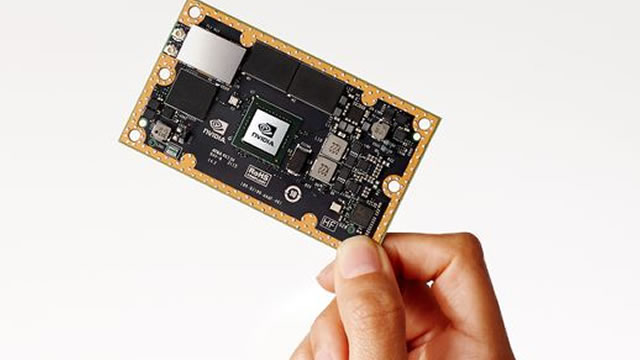
Nvidia DRIVE platform

Search documents
Why Is Uber Stock Surging On Tuesday?
Benzinga· 2026-03-17 11:43
Core Insights - Uber Technologies Inc shares experienced a rise in premarket trading following the announcement of its autonomous vehicle strategy [1] Group 1: Global Fleet Expansion Plans - Uber and Nvidia plan to launch a global fleet of autonomous vehicles, utilizing Nvidia software, with a rollout scheduled for the first half of 2027 [2] - Initial launches will focus on Los Angeles and San Francisco, with a goal to expand to 28 cities worldwide by 2028 [2] Group 2: Leadership on AI Integration - CEO Dara Khosrowshahi emphasized the potential of autonomous technology to enhance transportation safety, reliability, and accessibility, highlighting the synergy between advanced AI and Uber's global network [3] - Nvidia CEO Jensen Huang remarked on the significant technological shift, comparing it to a "ChatGPT moment" for physical AI, indicating advancements in robotic systems' reasoning capabilities [3] Group 3: Roadmap to Level 4 Autonomy - The deployment of autonomous vehicles will occur in phases, starting with data collection, followed by operator-led launches, ultimately aiming for fully driverless Level 4 deployments [4] Group 4: Earnings and Outlook - Uber is set to report first-quarter earnings on May 6, with analysts predicting an earnings per share of 71 cents on revenue of $13.30 billion [5] - In the previous quarter, Uber exceeded revenue expectations with $14.37 billion, and analysts have a consensus price forecast of $106.76 for UBER, with Evercore ISI Group setting a high target of $150 [5] Group 5: UBER Price Action - Uber shares closed at $74.66, up 1.72% on Monday, and increased by 3.74% to $77.45 during premarket trading on Tuesday [6]



Nvidia's Automotive Business Emerges With 32% Growth in Q3
PYMNTS.com· 2025-11-21 00:07
Core Insights - Nvidia's automotive segment experienced a significant growth of 32% year over year in Q3, indicating a shift in automakers' approach towards advanced driver-assistance and controlled-route autonomy driven by AI [1][3][8] Financial Performance - Nvidia reported a total revenue of $57 billion for the fiscal third quarter, marking a 62% increase compared to the previous year, with the data center business contributing $51.2 billion, a 66% increase [3] Automotive Segment Development - The automotive unit, while still a small part of Nvidia's overall performance, is entering a more mature development stage with automakers utilizing Nvidia's DRIVE platform for training vision systems and refining planning models [4][5] - Automakers are adopting centralized compute architectures and unified sensor suites, which enhance the reliability of advanced driver-assistance features and higher-level automation [5][8] Industry Trends - Major automakers, such as General Motors, are increasingly aligning around standardized platforms, utilizing Nvidia's AI chips and software for vehicle automation and factory operations [6] - Collaborations between companies like Qualcomm and Google Cloud are facilitating the deployment of multimodal AI agents in vehicles, indicating a trend towards shared development stacks among automakers [7] Technological Advancements - The rise in automotive revenue reflects a broader industry pivot towards modular compute systems that support various automated driving functions, including level 3 capabilities [8] - Nvidia's DRIVE AGX Hyperion 10 platform is gaining traction for supporting level-3 and level-4 autonomy development, with increased use of simulation pipelines to test edge-case scenarios [9] Mobility Operators' Role - Mobility networks and logistics operators are contributing to Nvidia's automotive results by focusing on controlled-route deployments, which provide predictable operating conditions and clearer safety-verification requirements [11] - Collaborations, such as between Nvidia and Uber, aim to enhance autonomous driving capabilities using diverse datasets from Uber's global fleet [12]
Nvidia launches massive AI push with major partnerships across multiple industries
Fox Business· 2025-10-28 18:55
Core Insights - Nvidia announced new partnerships with tech and telecommunications companies to advance AI infrastructure and operationalize AI capabilities [1] - The company is focusing on creating integrated technology stacks for operational AI, enhancing analytics, automation, and customizable AI agents [2][3] Partnership Initiatives - Palantir will integrate Nvidia models into its Ontology framework, creating a unique technology stack for operational AI [2] - Lowe's is utilizing the integrated tech stack to create a digital replica of its global supply chain, aiming for continuous AI optimization and improved customer satisfaction [6] AI Infrastructure Development - Nvidia is collaborating with several communications companies to develop America's first AI-native wireless stack for 6G, integrating AI across hardware and software [6] - The stack is based on the Nvidia AI Aerial platform, enabling advanced applications for public safety and AI-driven spectrum agility [7] 6G and AI-Native Networks - A partnership with Nokia aims to develop a 6G-ready computing platform for AI-native 5G and 6G networks, with trials expected in 2026 [10] - T-Mobile is involved in testing AI-RAN technologies as part of this collaboration [10] Manufacturing and Robotics - Nvidia is working with various manufacturing and robotics firms to promote U.S. reindustrialization through physical AI [11] - Companies like Belden, Caterpillar, and Toyota are using Nvidia's Omniverse to create digital twins for AI-driven manufacturing [14] Autonomous Vehicle Initiatives - Nvidia partnered with Uber to integrate human riders and robot drivers into a global ride-hailing network using the DRIVE platform [15] - Several automakers are collaborating on level 4-ready autonomous vehicles compatible with Nvidia's DRIVE platform [16]

2 Top Artificial Intelligence Stocks to Buy in March
The Motley Fool· 2025-03-11 07:45
Core Viewpoint - The growing adoption of artificial intelligence (AI) presents a significant long-term investment opportunity, with an estimated potential to add $6.6 trillion to the global economy by 2030 according to PwC Group 1: Nvidia - Nvidia continues to dominate the market for chips necessary for training AI models, with revenue doubling to $130 billion last year, driving its share price to record highs [2][5] - The company has successfully transitioned from primarily selling GPUs for PC graphics applications to focusing on data centers, which is currently a hot market [3][4] - Nvidia's automotive segment is also experiencing rapid growth, with revenue increasing by 55% to $1.7 billion last year, indicating a multibillion-dollar opportunity [4] - The company is investing in expanding its addressable market through software, services, and new chip types, with a forward price-to-earnings (P/E) multiple of 24 and projected earnings growth at a compound annual rate of 34% [5] Group 2: Alphabet (Google) - Alphabet owns valuable online properties and has over 2 billion users across its products, leading to a revenue growth of 14% to $350 billion last year, primarily from advertising [6][7] - The company has been leveraging AI to enhance its products, resulting in increased user engagement and advertising growth, with ad revenue growing 11% to $264 billion [7] - Improvements to the Gemini AI model present opportunities for subscription services like Google One, which already has over 100 million subscribers [8] - Google Cloud is one of the fastest-growing enterprise cloud services, with revenue growing 30% year-over-year in the fourth quarter, driven by demand for generative AI solutions [9] - Alphabet's stock is currently priced at 19 times this year's earnings estimate, with analysts expecting an annualized earnings growth rate of 17% in the coming years [10]