
Online Banking

Search documents
Fidelity D & D Bancorp, Inc. First Quarter 2026 Dividend
Globenewswire· 2026-01-22 13:05
Core Viewpoint - Fidelity D & D Bancorp, Inc. has declared a first quarter dividend of $0.43 per share for 2026, representing a 7.5% increase from the previous year's dividend of $0.40 per share [1] Group 1: Dividend Announcement - The dividend is scheduled to be paid on March 10, 2026, to shareholders of record as of February 13, 2026 [1] Group 2: Company Overview - Fidelity D & D Bancorp, Inc. operates through The Fidelity Deposit and Discount Bank, serving Lackawanna, Luzerne, Northampton, and Lehigh Counties with 21 full-service community banking offices [2] - The company also offers a digital banking experience through its Online Banking and Fidelity Mobile Banking app [2]



Is Capital One Stock Worth Owning Ahead of Q4 Earnings?
ZACKS· 2026-01-16 17:51
Core Viewpoint - Capital One (COF) is expected to report strong fourth-quarter results driven by its robust credit card business and the acquisition of Discover Financial, with significant revenue growth anticipated [1][7][25]. Financial Performance Estimates - The Zacks Consensus Estimate for COF's fourth-quarter revenues is $15.32 billion, reflecting a year-over-year growth of 50.3% [2]. - The full-year sales estimate stands at $53.25 billion, indicating a rise of 36.2% from the previous year [2]. - The earnings estimate for the upcoming quarter has been revised down by 2.2% to $3.98, which still represents a 28.8% improvement from the prior-year quarter [2][4]. Earnings Surprise History - COF has a strong earnings surprise history, having outperformed the Zacks Consensus Estimate in each of the last four quarters, with an average beat of 28% [4]. Key Factors Influencing Q4 Results - Net Interest Income (NII) is expected to rise over 50% due to strong loan demand and earning assets, despite recent interest rate cuts [6][7][9]. - The consensus estimate for fourth-quarter NII is $12.25 billion, indicating a 51.3% year-over-year growth [9]. - Fee income is projected to increase significantly, with interchange fees estimated at $1.88 billion, a 49.2% year-over-year jump [10][11]. Expense Trends - Capital One has been experiencing rising expenses due to increased marketing costs, technology investments, and the Discover acquisition, which may pressure profits [12][27]. Asset Quality and Risk Management - The company is not expected to set aside significant reserves for potential delinquent loans due to lower interest rates [13]. - Capital One's diversified customer base allows it to manage risks effectively while generating attractive yields [26]. Stock Performance and Valuation - COF stock has rallied 13.5% in the fourth quarter, outperforming its peers [16]. - The stock is currently trading at a forward P/E ratio of 11.71X, above the industry average of 10.02X, indicating a stretched valuation [20]. Long-term Outlook - The acquisition of Discover Financial is expected to enhance COF's market position and revenue prospects in the credit card sector [25]. - Despite near-term expense pressures, the long-term outlook remains positive due to disciplined risk management and strong consumer engagement [26][27].


Capital One vs. Synchrony: Which Credit Card Lender is a Better Pick?
ZACKS· 2025-11-27 17:46
Core Insights - Capital One (COF) and Synchrony Financial (SYF) are significant players in the consumer lending space, focusing on credit cards and related financing, with revenue primarily from interest income, transaction fees, and customer spending [1][35] - The Federal Reserve's interest rate adjustments raise questions about which firm presents a better investment opportunity [2] Group 1: Capital One Overview - Capital One acquired Discover Financial in May 2025 for $35 billion, becoming the largest U.S. credit card issuer by balances, enhancing its payments network and reducing reliance on Visa and Mastercard [3] - The company has a history of strategic acquisitions, transforming from a monoline credit card issuer to a diversified financial services firm with a presence in retail banking and digital banking [4] - Despite a slight revenue decline in 2020, Capital One has shown a five-year CAGR of 6.5% in revenues and 4.3% in net loans held for investment, with positive trends continuing into 2025 [5] Group 2: Financial Performance and Outlook for Capital One - Capital One's net interest income (NII) and net interest margin (NIM) have been increasing, benefiting from higher interest rates and steady demand for credit card loans [8] - NII grew at a CAGR of 6% over the five years ending in 2024, with NIM expanding from 6.63% in 2023 to 6.88% in 2024 [9] - The company faces challenges in consumer spending and auto lending, which may pressure asset quality and increase marketing and technology expenses [10] Group 3: Synchrony Financial Overview - Synchrony Financial leverages a strong distribution channel to offer a variety of products, including private-label credit cards, and has made strategic acquisitions to enhance its digital capabilities [11][12] - Recent partnerships with major companies like PayPal and Walmart have expanded its ecosystem and e-commerce reach [13] Group 4: Financial Performance and Outlook for Synchrony Financial - Synchrony Financial's revenues experienced a five-year CAGR of 2.6% but faced a decline in the first nine months of 2025 due to the absence of a one-time gain from the previous year [15] - Management revised its 2025 revenue guidance down to $15-$15.1 billion, reflecting higher Retailer Share Arrangements (RSAs) and lower loan receivables [18] - The company has a solid liquidity position with $16.2 billion in cash and cash equivalents as of September 30, 2025, indicating sustainable capital distribution plans [14] Group 5: Comparative Analysis - The Zacks Consensus Estimate indicates a significant revenue growth for Capital One in 2025 and 2026, with year-over-year growth of 35.6% and 17.9%, respectively, while Synchrony Financial's growth is more modest at 2.7% and 4.6% [20][21] - Capital One's stock is trading at a forward P/E of 10.95, higher than its five-year median, while Synchrony Financial's P/E is 8.47, also above its historical average [25] - Capital One's return on equity (ROE) is 10.94%, significantly lower than Synchrony Financial's 22.96%, indicating different efficiencies in utilizing shareholder funds [27] Group 6: Dividend Performance - Capital One increased its dividend by 33.3% to $0.80 per share in November 2025, while Synchrony Financial raised its dividend by 20% to $0.30 per share in January 2025 [29]


Capital One Hits 52-Week High: Should You Buy the Stock Now?
ZACKS· 2025-07-01 14:45
Core Insights - Capital One Financial Corporation (COF) shares reached a 52-week high of $215.62 after passing the Federal Reserve's 2025 stress test, indicating strong capital reserves to absorb significant losses [1][8] Stock Performance - Over the past three months, COF stock has increased by 16.8%, outperforming the industry growth of 11.5% and the S&P 500 Index's 9% [2] Growth Drivers - The company has pursued a robust inorganic expansion strategy, including the acquisition of Discover Financial for $35.3 billion and Velocity Black in 2023, enhancing shareholder value [5] - COF's total revenues have shown a five-year compound annual growth rate (CAGR) of 6.5% from 2019 to 2024, with continued growth momentum into the first quarter of 2025 [6] - The Domestic Credit Card division, which represents 94.9% of credit card net revenues, has seen improvements in loans held for investment, indicating strong growth opportunities [11] - The net interest margin (NIM) has increased from 6.63% in 2023 to 6.88% in 2024, benefiting from high rates and steady demand for credit card loans [12] - As of March 31, 2025, Capital One's total debt was $41.8 billion, with cash and cash equivalents at $48.6 billion, indicating a strong liquidity position [13] Challenges - COF has experienced a rising expense base, with a CAGR of 6.8% over the last five years, primarily due to increased marketing costs and inflation [16] - The provision for credit losses has increased with a CAGR of 13.4% from 2019 to 2024, reflecting deteriorating asset quality amid a challenging macroeconomic environment [20] Earnings Outlook - Analysts have revised earnings estimates for 2025 and 2026 upward by 16.9% and 4.7%, respectively, indicating optimism about the company's growth potential [22] - The estimated year-over-year growth rates for earnings are 5.8% for 2025 and 27.4% for 2026 [22] Valuation - COF stock has a P/E (F1) ratio of 14.41, which is higher than the industry's 11.51, suggesting that the stock may be trading at a premium [26]
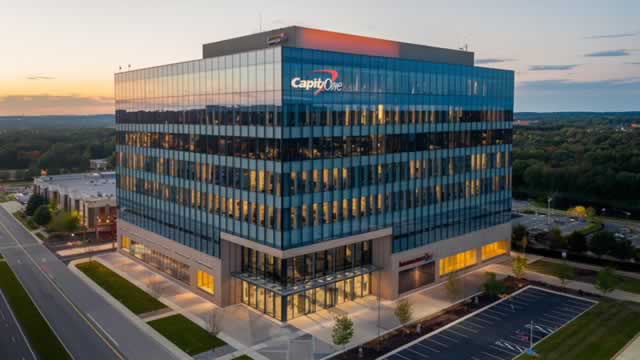
Capital One Rides on Strong Credit Card Business Despite Cost Woes
ZACKS· 2025-06-03 17:31
Core Viewpoint - Capital One Financial Corporation (COF) is positioned for growth due to strong consumer loan demand and solid credit card and online banking operations, despite concerns over elevated expenses and deteriorating asset quality [1][7]. Growth Drivers - COF's revenue growth has been bolstered by strategic acquisitions, including the recent $35.3 billion acquisition of Discover Financial, which is expected to unlock significant shareholder value [2]. - The Credit Card segment is anticipated to maintain strength, with a projected compound annual growth rate (CAGR) of 3.1% by 2027, despite a slight revenue decline in 2020 [3][6]. Revenue Growth - Total revenues are expected to grow at a CAGR of 4.2%, supported by strong loan demand and high interest rates, with Domestic Credit Card division revenues projected to increase by 3% in 2025 [6][7]. Net Interest Margin - COF's net interest margin (NIM) is on an upward trend, increasing from 6.63% in 2023 to 6.88% in 2024, with projections of 7.03% in 2025 and 7.27% in 2027 [8][9]. Balance Sheet Position - As of March 31, 2025, COF had total debt of $41.8 billion and cash and cash equivalents of $48.6 billion, indicating a strong liquidity profile [9]. Capital Distribution Plans - COF has restored its quarterly dividend to 60 cents per share and has a share repurchase program authorized for up to $5 billion, with $3.88 billion remaining as of March 31, 2025 [10][11]. Challenges - Deteriorating asset quality is a significant concern, with provisions for credit losses and net charge-offs (NCOs) increasing, reflecting a CAGR of 13.4% and 11.4% respectively from 2019 to 2024 [13]. - COF has experienced rising expenses, with a CAGR of 6.8% over the last five years, driven by increased marketing costs and inflationary pressures [16][18].

客户不转化、内容不合规?AI与Agent如何破解金融营销五大难题
3 6 Ke· 2025-05-12 08:15
Core Insights - The article emphasizes that AI and Agents are no longer optional tools but are essential drivers for transforming customer insights, decision-making efficiency, and service experience in financial marketing [1][2][3] Evolution of Financial Marketing - Financial marketing has evolved from a traditional model reliant on physical branches and customer managers (1.0) to a digital model utilizing CRM and online channels (2.0), but issues like data silos and fragmented experiences persist [2] - The industry is now entering the intelligent 3.0 era, where AI technologies, particularly large language models and Agents, are becoming the core engines driving marketing transformation [2][3] AI's Value Proposition - AI provides unprecedented customer insights by analyzing both structured and unstructured data, enabling the identification of deep, often unrecognized customer needs [2] - AI facilitates real-time and precise decision-making by integrating various data points to generate optimal marketing strategies tailored to individual customers [3] - AI-driven Agents enhance service execution by automating repetitive tasks, improving efficiency, and allowing human staff to focus on more complex, value-added services [4] Current Challenges in Financial Marketing - High customer acquisition costs and low conversion rates are significant challenges, with customer acquisition costs (CAC) often exceeding thousands of dollars [5][6] - Personalization remains a challenge, as many financial institutions struggle to provide truly individualized experiences due to data fragmentation [7] - Complex products lead to customer confusion, making it difficult for them to make informed purchasing decisions [8] - Regulatory compliance poses challenges to innovation, requiring a balance between compliance and efficiency [8] - Measuring marketing effectiveness is complicated, with traditional attribution models failing to provide clear insights into ROI [9] AI and Agent Solutions - A robust "intelligent marketing platform" is proposed as a solution, consisting of a data foundation that integrates internal and external data to create a comprehensive customer view [10] - The platform includes an "intelligent engine" for AI algorithms that support customer understanding, predictive analytics, and decision-making [11] - Successful case studies demonstrate the tangible benefits of AI and Agents in enhancing customer insights, improving conversion rates, and increasing marketing efficiency [12] Future Outlook - The future of financial marketing will focus on "intelligent density," where the effective use of smart technologies will create competitive advantages in understanding customers and optimizing experiences [14]
Fidelity D & D Bancorp, Inc. Second Quarter 2025 Dividend
Globenewswire· 2025-05-06 23:52
Group 1 - The Board of Directors of Fidelity D & D Bancorp, Inc. declared a second quarter dividend of $0.40 per share, payable on June 10, 2025, to shareholders of record as of May 20, 2025 [1] - Fidelity D & D Bancorp, Inc. operates 21 full-service community banking offices across Lackawanna, Luzerne, Northampton, and Lehigh Counties, and offers digital banking services through its Online Banking and Fidelity Mobile Banking app [2] - The company provides wealth management services through its Fidelity Bank Wealth Management Minersville Office located in Schuylkill County [2] Group 2 - For further information, Fidelity D & D Bancorp, Inc. directs interested parties to visit their investor relations website at www.bankatfidelity.com [3]
