PEM电解水制氢装备

Search documents
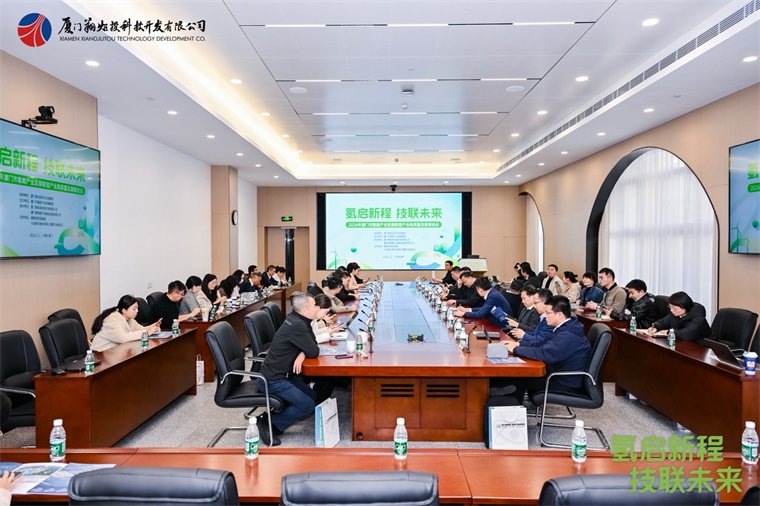
“氢启新程・技联未来”2026年厦门市氢能产业发展联盟产业高质量发展推进会圆满举办
Qian Zhan Wang· 2026-02-04 02:17
Core Insights - The conference titled "Hydrogen New Journey · Technology Alliance Future" was successfully held in Xiamen, focusing on the development path of the hydrogen energy industry in 2026 [1] - The event gathered representatives from government departments, industry experts, enterprises, and financial institutions to discuss the future of hydrogen energy in Xiamen [1] Group 1: Industry Development - Xiamen has actively laid out the hydrogen energy sector, establishing a complete industrial chain from production to application, and is beginning to export the "Xiamen solution" domestically and internationally [3] - The city has achieved multiple breakthroughs in technology, including the PEM electrolysis hydrogen production equipment recognized as a major technological equipment by the National Energy Administration [3] - Jinlong Automobile Group has developed a full range of hydrogen fuel vehicles, with its hydrogen fuel cell buses winning procurement projects, showcasing the industry's transition from laboratory to market [3] Group 2: Alliance Activities and Plans - The Xiamen Hydrogen Energy Industry Alliance's 2025 annual report and 2026 work plan were shared, focusing on expanding quality membership, enhancing policy frameworks, and promoting resource integration [4] - In 2026, the alliance plans to establish dedicated workstations in the airport economic zone and enhance member services through a digital platform and targeted promotional events [4] Group 3: Policy and Infrastructure - The Xiamen Airport Economic Zone will promote hydrogen industry development through improved mechanisms, policy support, application scenarios, public platforms, and industrial ecology [5] - A hydrogen innovation fund will be established to support high-quality industrial clustering, with a focus on integrated hydrogen production and application stations [5] Group 4: Marine Hydrogen Energy Focus - The conference highlighted the importance of "marine hydrogen energy" technology transfer, with plans for a national technology transfer center focusing on marine hydrogen energy [7] - The center aims to support projects related to high-end marine equipment and hydrogen energy materials, with financial backing available for significant investments [7] Group 5: Future Outlook - Xiamen aims to become a core hub for hydrogen energy development in Fujian, targeting 4,000 fuel cell vehicles and 50 billion yuan in output by 2025 [6] - The city plans to cultivate over 30 hydrogen-related enterprises by 2027, promoting high-quality development through technological innovation and diverse application scenarios [6] - The conference served as a summary of past achievements and a proactive response to the "Xiamen Hydrogen Energy Industry High-Quality Development Action Plan (2025-2027)" [11]

制储输用发力,开启能源“加氢减碳”之门
Zhong Guo Hua Gong Bao· 2026-01-13 06:26
Core Viewpoint - The hydrogen energy industry is seen as a key solution to energy issues, particularly in the context of expanding renewable energy capacity and addressing the challenges of wind and solar energy consumption [1]. Group 1: Green Hydrogen Development - Traditional hydrogen production mainly relies on fossil fuel reforming and industrial by-product gases, but there is significant demand for green hydrogen to replace gray hydrogen under carbon peak scenarios [2]. - By 2060, it is predicted that 30% of China's end-use thermal demand will come from non-fossil fuels, primarily through green electricity conversion, with a potential demand for 200 million tons of green hydrogen requiring approximately 10 trillion kilowatt-hours of green electricity [2]. - Water electrolysis is recognized as a crucial green hydrogen production technology, with advancements in equipment leading to cost reductions and broader applications [2]. Group 2: Hydrogen Storage Technologies - Efficient, safe, and low-cost hydrogen storage technologies are essential for energy peak shaving and valley filling [4]. - Current hydrogen storage methods include high-pressure, liquid, and solid-state storage, with liquid hydrogen being highlighted for its high storage efficiency and suitability for large-scale applications [4]. - Solid-state hydrogen storage, utilizing materials like carbon nanomaterials and metal hydrides, offers advantages such as higher storage density and longer cycle life compared to other methods [4]. Group 3: Hydrogen Transportation - Hydrogen transportation is critical for the industrial promotion of hydrogen energy, with pipeline transport being suitable for stable, continuous hydrogen demand in industrial clusters [5]. - Challenges in China's hydrogen pipeline transport include differences in hydrogen blending technology and a lack of unified national standards, which hinder industrialization [5]. - Non-metallic composite flexible pipelines are proposed as alternatives to metal pipelines, offering better corrosion resistance and lower costs [6]. Group 4: Market Opportunities in Hydrogen Energy - The hydrogen energy industry is entering a window of opportunity, with applications expanding in transportation, industry, and other energy sectors [7]. - Hydrogen energy has significant potential in the transportation sector, including hydrogen-powered heavy trucks and rail systems, which can replace diesel engines [7]. - In the industrial sector, hydrogen can replace coal in steel production, addressing carbon emissions at the source and enabling the production of high-quality steel [7].