PX5人形机器人

Search documents
众擎机器人踹翻自家老板背后:是技术突破,还是营销泡沫? 原创 凤凰网财经 凤凰网财经 2025年12月9日 20:49 北京
Feng Huang Wang Cai Jing· 2025-12-09 14:26
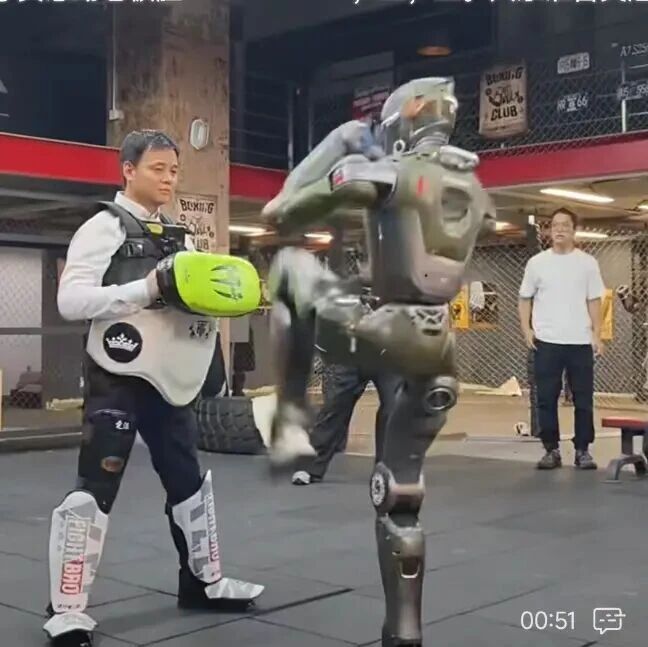
Core Viewpoint - The incident involving the T800 humanoid robot kicking its CEO, Zhao Tongyang, has sparked widespread discussion about the safety and marketing strategies of humanoid robots, highlighting the balance between innovation and consumer safety concerns [2][6]. Group 1: Product and Performance - The T800 humanoid robot is equipped with a high-performance solid-state battery, providing 4-5 hours of stable operation and capable of executing complex movements, achieving approximately 90% of an adult male's physical capabilities [3]. - The T800 is priced starting at 180,000 yuan, and it is the fourth humanoid robot launched by the company, which also offers various versions including basic, ecological, sharpened, and flagship models [4]. Group 2: Market and Competition - The company is in direct competition with other leading humanoid robot manufacturers, particularly Yushun Technology, as both companies aim to commercialize humanoid robots [3]. - The global humanoid robot market is projected to reach $154 billion by 2035, indicating significant growth potential despite current challenges in finding a clear profit model [13]. Group 3: Funding and Financial Backing - The company has successfully raised significant funding, including nearly 1 billion yuan in angel financing and a total of 1 billion yuan in Pre-A++ and A1 rounds, with major investors like JD.com and CATL participating [10]. - The company has also faced scrutiny regarding its production capabilities, particularly after reports of delays in its "robot police" product, raising questions about its operational sustainability [11]. Group 4: Industry Context and Challenges - The humanoid robot industry is becoming increasingly crowded, with major tech companies like Tesla, Xiaomi, and Google investing heavily in this space, indicating a competitive landscape [12]. - Despite the hype and investment, the industry has yet to establish a stable cash flow, with current profitable applications limited to specific industrial environments and research demonstrations [13].

众擎机器人踹翻自家老板背后:是技术突破,还是营销泡沫?
凤凰网财经· 2025-12-09 12:52
Core Viewpoint - The recent demonstration of the T800 humanoid robot, which accidentally knocked down its CEO Zhao Tongyang, has sparked widespread discussion about the safety and performance of humanoid robots in the industry [2][10]. Group 1: Product and Performance - The T800 humanoid robot is the first in the world to successfully perform a front flip and is equipped with a high-performance solid-state battery, allowing for 4-5 hours of stable operation [5]. - The robot can execute complex movements, achieving approximately 90% of an adult male's physical capabilities [5]. - The incident during the demonstration was attributed to a "sensor misjudgment" by the company, although some insiders suggested it was a deliberate marketing stunt [5][8]. Group 2: Market and Competition - The T800 is priced starting at 180,000 yuan and is part of a product matrix that includes various versions such as a basic version, ecological version, and a flagship version [8]. - The humanoid robot market is becoming increasingly competitive, with companies like UTree Technology also developing humanoid robots, leading to direct competition between Zhao's company and UTree [5][20]. - The global humanoid robot market is projected to reach $154 billion by 2035, indicating significant growth potential despite current challenges in finding a clear profit model [21]. Group 3: Company Background and Funding - Zhao Tongyang, the founder of Zhongqing Robotics, has a background in entrepreneurship and previously worked at Xiaopeng Motors before establishing his current company [11][15]. - Zhongqing Robotics has successfully raised significant funding, including nearly 1 billion yuan in angel financing and 1 billion yuan in subsequent rounds led by major investors like JD.com [17][18]. - The company aims to explore profitable applications for humanoid robots, particularly in entertainment and industrial sectors, as it faces pressure to demonstrate its technological capabilities [20].