ParkRecon3D

Search documents
小米&杭电提出ParkGaussian:业内首个泊车场景重建算法,效果还不错
自动驾驶之心· 2026-01-07 09:44
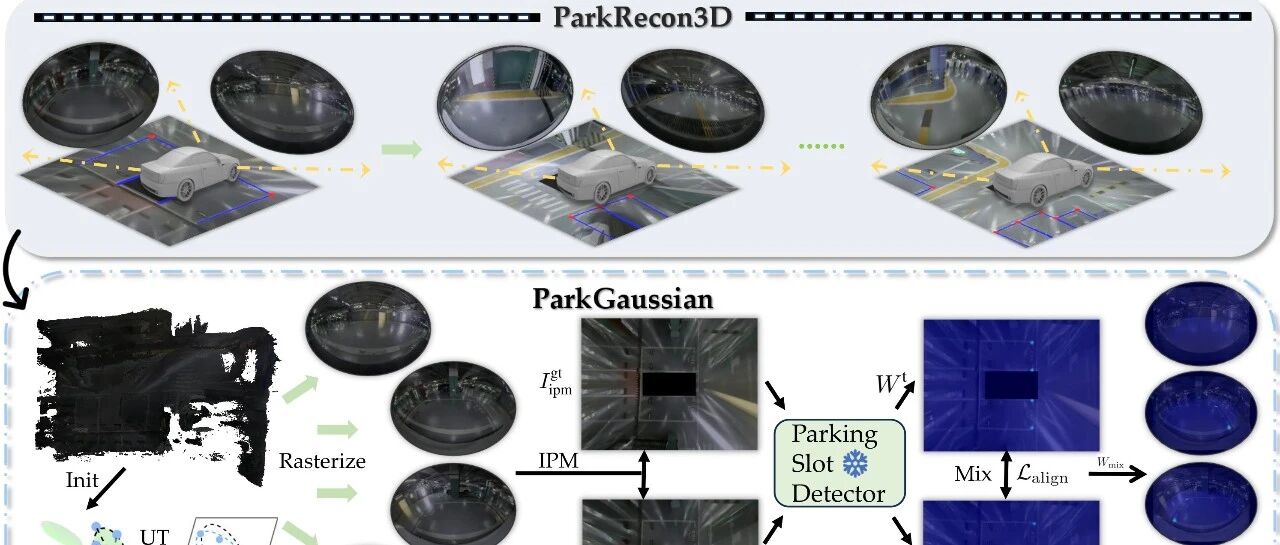
Core Viewpoint - The article discusses the development of ParkGaussian, a framework designed for 3D reconstruction of parking scenarios, which significantly enhances the quality of parking space detection and reconstruction in autonomous driving systems [2][8][57]. Group 1: Background and Importance - Autonomous parking is a critical component of autonomous driving systems (ADS), facing unique challenges in environments with limited GPS signals and complex spatial geometries [3][4]. - Existing research has primarily focused on 2D parking space perception and mapping, with insufficient exploration in 3D reconstruction, which is essential for capturing the intricate geometries of parking scenarios [2][3]. Group 2: ParkRecon3D Dataset - The ParkRecon3D dataset is the first benchmark specifically designed for 3D reconstruction in parking scenarios, containing over 40,000 frames of synchronized sensor data and 60,000 accurately labeled parking spaces [5][11][8]. - The dataset was collected in an underground parking lot using four calibrated fisheye cameras, providing a comprehensive resource for training and evaluating 3D reconstruction models [11][5]. Group 3: ParkGaussian Framework - ParkGaussian integrates 3D Gaussian Splatting (3DGS) with a parking space perception reconstruction strategy, enhancing the fidelity of reconstructed parking areas [8][6]. - The framework utilizes a novel approach to align the reconstruction process with downstream perception tasks, ensuring that the generated data is consistent with real-world parking space detection [6][20]. Group 4: Experimental Results - Experiments demonstrate that ParkGaussian achieves state-of-the-art reconstruction quality on the ParkRecon3D dataset, outperforming existing methods that focus solely on visual fidelity [48][49]. - The integration of the parking space perception strategy significantly improves detection performance, with both DMPR-PS and GCN-Parking networks achieving near-real-world detection accuracy [49][50]. Group 5: Limitations and Future Work - The ParkRecon3D framework faces inherent challenges in underground parking environments, such as mirror reflections, repetitive textures, and motion blur under low light conditions, which will be addressed in future research [55][57].