Ram 1500 BEV(纯电皮卡)

Search documents
从全面收缩到中国借力:斯泰兰蒂斯222亿欧元代价下的电动转型求生路
Bei Jing Shang Bao· 2026-02-08 12:07
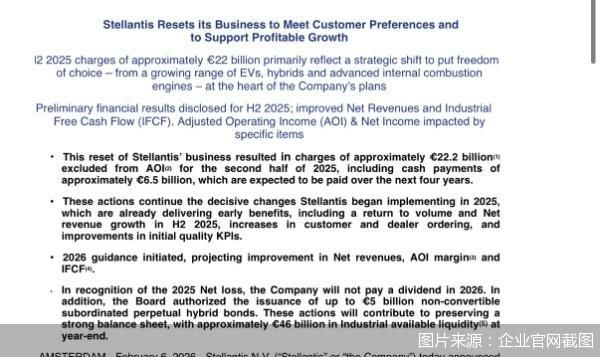
Core Insights - Stellantis, the world's fourth-largest automaker, is facing financial and stock price challenges due to a misjudgment in its electrification strategy, leading to a €22 billion restructuring charge in the second half of 2025 and a significant stock price drop of over 20% in one day, resulting in a market value loss of over $6 billion [1][3] Group 1: Financial Impact - The restructuring charge of approximately €22.2 billion includes around €6.5 billion in cash payments expected over the next four years, with a projected net loss of €21 billion for the second half of 2025 and a low single-digit operating profit margin for the year [2][3] - The company will not pay a dividend in 2026 due to the anticipated net loss for 2025, and it has authorized the issuance of up to €5 billion in non-convertible subordinated perpetual hybrid bonds to maintain a strong balance sheet [2] Group 2: Strategic Shift - Stellantis is scaling back its electric vehicle (EV) ambitions, exiting joint ventures like NextStar Energy with LG Energy in Canada, and focusing on a more market-driven approach to electrification rather than aggressive targets [4][5] - The company plans to deepen local R&D in China and view the Chinese market as a critical accelerator for its electrification goals, recognizing the significant potential in this market [1][8] Group 3: Market Position and Challenges - Stellantis has been marginalized in the Chinese market, with brands like Jeep and Maserati struggling to maintain sales, and the company is facing internal competition among its various brands [6][7] - The company is attempting to strengthen its position in China through strategic investments, such as a €1.5 billion stake in Leap Motor and a partnership with Pony.ai for autonomous vehicle development [5][6] - Analysts highlight that Stellantis's slow response to market changes and reliance on outdated strategies have hindered its competitiveness, particularly in the rapidly evolving Chinese automotive landscape [8]