Redemplo (plozasiran)

Search documents
Press Release: Myqorzo and Redemplo approved in China
Globenewswire· 2026-01-15 06:00
Core Insights - Sanofi has received approval from the National Medical Products Administration in China for two innovative medicines: Myqorzo (aficamten) for obstructive hypertrophic cardiomyopathy (oHCM) and Redemplo (plozasiran) for familial chylomicronaemia syndrome (FCS) [1][2][9] Myqorzo (aficamten) - Myqorzo is a selective, small-molecule cardiac myosin inhibitor designed to improve functional capacity and relieve symptoms in patients with oHCM, the most common monogenic inherited cardiovascular disorder [2][7] - The approval was based on the positive results from the pivotal SEQUOIA-HCM phase 3 study (clinical study identifier: NCT05186818) [2] - Myqorzo has been designated as breakthrough therapy and orphan drug in the US, and breakthrough therapy in China, with a positive opinion for marketing authorization in the EU expected in Q1 2026 [8] Redemplo (plozasiran) - Redemplo is a small-interfering RNA (siRNA) medicine that suppresses the production of apoC-III, targeting triglyceride reduction in patients with FCS, a severe and rare disease characterized by extremely high triglyceride levels [3][11] - The approval was based on the positive results from the pivotal PALISADE phase 3 study (clinical study identifier: NCT05089084) [3] - Redemplo has received multiple designations including breakthrough therapy and orphan drug in the US, and is also approved in Canada and China for treating FCS patients [11][12] Hypertrophic Cardiomyopathy (HCM) - HCM is characterized by abnormal thickening of the heart muscle, leading to impaired heart function and various symptoms such as chest pain and shortness of breath [4][5] - It has two forms: obstructive HCM (oHCM) affecting two-thirds of patients and non-obstructive HCM affecting one-third [5] - Serious complications from HCM include atrial fibrillation, stroke, and it is a leading cause of sudden cardiac death in young people [6] Familial Chylomicronaemia Syndrome (FCS) - FCS is a rare disease leading to triglyceride levels exceeding 880 mg/dL (9.94 mmol/L), which can result in severe complications such as pancreatitis and diabetes [10] - The approval of Redemplo addresses a significant unmet medical need for patients suffering from this condition [3][11] Sanofi's Commitment - The approvals of Myqorzo and Redemplo highlight Sanofi's long-term commitment to providing innovative medicines to patients in China, particularly in areas with large unmet medical needs [2][9]



Is Arrowhead Pharmaceuticals Stock a Buy or Sell After the CEO Sold Shares Worth $5.4 Million?
The Motley Fool· 2026-01-11 01:07
Company Overview - Arrowhead Pharmaceuticals is a clinical-stage biotechnology company focused on developing RNA interference (RNAi) therapeutics targeting serious diseases, particularly liver disorders and cardiometabolic conditions [8][9] - The company has a robust clinical pipeline that includes drug candidates such as ARO-AAT, ARO-APOC3, and JNJ-3989, and generates revenue through licensing agreements, research collaborations, and milestone payments from pharmaceutical partners [8][9] - As of the most recent financial data, Arrowhead Pharmaceuticals has 609 employees, a total revenue of $829.45 million, and a net income of -$1.63 million for the trailing twelve months (TTM) [5] Recent Developments - On December 17, 2025, CEO Christopher Richard Anzalone sold 85,000 shares of Arrowhead Pharmaceuticals for approximately $5.44 million, which aligns with his historical trading activity [1][2][7] - The sale occurred during a period of significant stock performance, with a total return of 249.37% over the prior year, and the stock closing at $64.80 on the transaction date [2][12] - The timing of the sale suggests it was part of a tax-planning strategy related to performance awards that vested in December [4][11] Market Context - The stock price surged following the FDA approval of Arrowhead's first medicine, plozasiran (marketed as Redemplo), for treating familial chylomicronemia syndrome, reaching a 52-week high of $76.76 on January 6 [12] - The current elevated price-to-sales ratio indicates that while it may be a good time for shareholders to sell, waiting for a price drop before reinvesting could be a more strategic approach [13] Competitive Edge - Arrowhead Pharmaceuticals' competitive advantage lies in its proprietary RNAi delivery technologies, which enable the treatment of previously untreatable diseases [10]


首创新药时代:2025年FDA新药全景透视
3 6 Ke· 2026-01-04 04:56
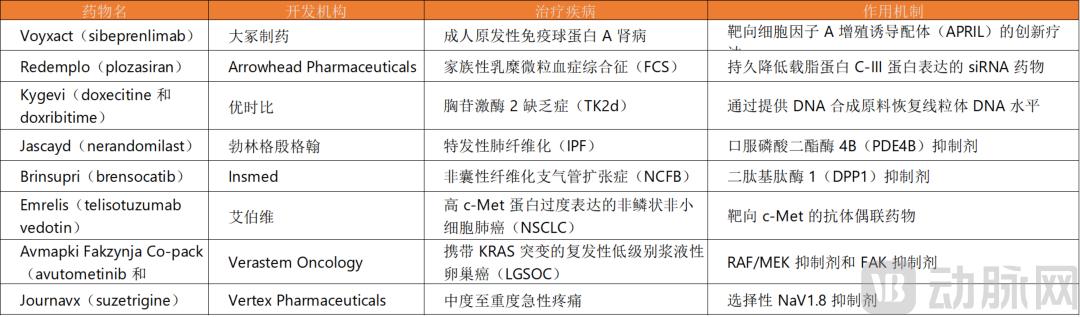
Core Insights - The FDA's CDER approved 44 new drugs by 2025, with over half being "first-in-class" drugs, indicating a shift from "incremental" to "disruptive" treatment paradigms in drug development [1][3][24] - The rise of small molecules continues, but their development is evolving from broad inhibition to precision modulation, enhancing efficacy while reducing side effects [6][7][9][10] First-in-Class Drugs - The approval of "first-in-class" drugs is driven by unmet clinical needs, particularly in rare and complex chronic diseases, where existing treatments are inadequate [3][4] - Brinsupri (brensocatib) is a notable example, targeting Dipeptidyl Peptidase 1 (DPP1) to address non-cystic fibrosis bronchiectasis, providing a new mechanism of action that significantly improves patient outcomes [3][20] - Eight drugs received breakthrough therapy designation, reflecting their innovative mechanisms and potential for substantial clinical improvement [5] Small Molecule Innovations - Small molecules accounted for 66% of new drug approvals, maintaining their central role in drug development while shifting towards precision approaches [6][10] - Aficamten (Myqorzo) exemplifies this trend as a selective allosteric modulator for obstructive hypertrophic cardiomyopathy, demonstrating improved safety and efficacy [7] - Covalent drugs, such as Zegfrovy (sunvozertinib), show promise in overcoming resistance issues by forming stable bonds with targets, enhancing therapeutic effectiveness [8] Peptide and Nucleic Acid Therapies - Peptide and nucleic acid therapies are emerging as significant players, with multiple innovative drugs approved in 2025, marking a shift towards RNA-targeted treatments [10][11] - Qfitlia (fitusiran) offers a revolutionary preventive solution for hemophilia by significantly reducing annual bleeding rates [10][12] - Dawnzera (donidalorsen) provides a long-acting preventive treatment for hereditary angioedema, demonstrating substantial reductions in attack frequency [11] Antibody-Drug Conjugates (ADCs) - ADCs are evolving beyond cancer treatment, with Datroway (datopotamab deruxtecan) showcasing innovative mechanisms and expanding indications [14][15] - Datroway's "bystander effect" allows it to target heterogeneous tumor populations effectively, improving treatment outcomes in breast cancer and non-small cell lung cancer [15][16] Future Directions - The landscape of drug development is shifting towards a broader understanding of drug value, emphasizing patient outcomes and treatment paradigms over traditional sales metrics [19][23] - The integration of advanced technologies like AI and gene editing into drug development processes is expected to yield therapies that fundamentally alter disease progression [24]