Rokid Ai Glasses Style

Search documents
Las gafas Rokid Ai ya están disponibles a nivel mundial
Prnewswire· 2026-01-24 16:18
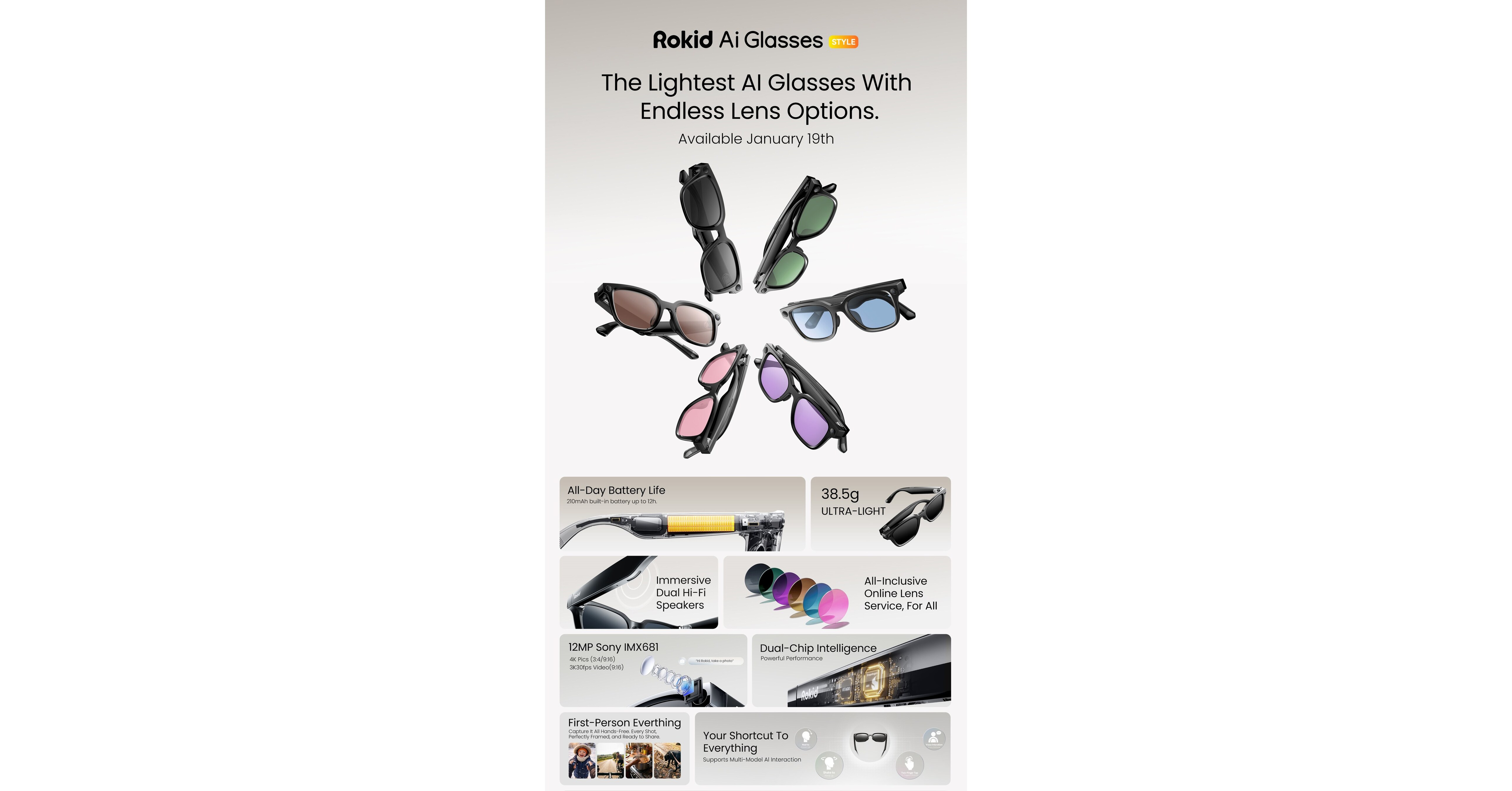
Core Insights - Rokid has officially launched the Rokid Ai Glasses Style, the world's first lightweight smart glasses with an open AI ecosystem, priced starting at $299 [1][2] - The glasses weigh 38.5 grams and offer up to 12 hours of daily use and 24 hours on standby, making them one of the lightest and most comprehensive AI glasses available [2] - Rokid aims to position glasses as the primary interface for AI interaction, moving away from smartphones as the dominant terminal [3][4] Product Features - The Rokid Ai Glasses Style features an open AI ecosystem, allowing access to multiple AI services and models, which supports the development of localized and vertical applications [6] - The glasses include a dual-chip architecture with NXP RT600 and Qualcomm AR1, voice interaction in 12 languages with translation capabilities, and multimodal AI interaction [8] - Users can upload their prescriptions online to receive customized lenses within 7 to 10 days, accommodating a wide range of vision corrections [9] Pricing and Availability - The initial price for the Rokid Ai Glasses Style is $299, with a premium package available for $398 that includes photochromic prescription lenses [10] - The glasses are available for purchase on Rokid's official website and Amazon, with additional color options launching in March 2026 [10] - Rokid is also implementing a "Leave No One Behind" initiative, offering $20 subsidies for visually impaired users globally [10] Company Background - Founded in 2014, Rokid is a global pioneer in augmented reality and AI, focusing on integrating AI into everyday life through user-centric smart glasses [11] - The company operates one of the largest XR and AI developer communities worldwide, with over 20,000 registered developers [7]

直击CES 2026:中国AI眼镜扎堆“秀肌肉”
Mei Ri Jing Ji Xin Wen· 2026-01-11 12:42
Core Insights - The 2026 International Consumer Electronics Show (CES 2026) showcased AI glasses as a significant highlight, with over 50 exhibitors, including more than 20 Chinese companies, indicating a strong presence in the market [1][2] Industry Trends - The global smart glasses market saw a shipment volume of 4.296 million units in Q3 2025, marking a year-on-year growth of 74.1%, while China's market reached 623,000 units, growing by 62.3% [1] - The AI glasses industry is focusing on lightweight designs, enhanced display technology, and improved AI capabilities, with a strong emphasis on user comfort and practical applications [2][5] - The integration of AI functionalities is becoming more sophisticated, with a trend towards proactive services and multi-modal interactions in product iterations [2][5] Product Innovations - Rokid launched the Rokid Ai Glasses Style, a lightweight model weighing only 38.5g, capable of music playback, translation, navigation, and AI Q&A [2] - The Rokid Glasses, weighing 49g, features advanced diffraction waveguide technology and supports various AI applications, including real-time navigation and translation [3] - Thunderbird Innovation introduced the world's first dual-lens AR glasses with eSIM functionality, allowing independent communication without a smartphone [3] Market Dynamics - The AI glasses market is expected to reach a shipment volume of 23.687 million units globally in 2026, with China's market projected to exceed 4.915 million units, indicating a shift towards large-scale growth [6] - The entry of internet and cloud companies into the AI glasses sector is increasing industry attention and capital activity, leading to resource integration across the supply chain [7] - The competitive landscape is intensifying, with established companies facing pressure while smaller firms seek differentiation in a crowded market [7] Challenges and Future Outlook - The AI glasses industry is still in its early stages, facing challenges in supply chain management and user experience, which could impact market stability [8] - As the market matures, improvements in supply chain coordination and product quality will be essential for retaining users and ensuring stable growth [8]
直击CES 2026|中国AI眼镜CES扎堆“秀肌肉” 2026年将迎来应用大年?
Mei Ri Jing Ji Xin Wen· 2026-01-10 13:55
Core Insights - The 2026 International Consumer Electronics Show (CES) showcased AI glasses as a significant highlight, with over 50 exhibitors, including more than 20 Chinese companies, indicating a strong presence in the market [1][3]. Industry Overview - The global smart glasses market is projected to reach a shipment volume of 4.296 million units by Q3 2025, reflecting a year-on-year growth of 74.1%. In China, the shipment volume is expected to be 623,000 units, with a growth rate of 62.3% [1]. - The AI glasses sector is seen as a crucial entry point for AI technology, with companies focusing on user experience and practical applications [2][5]. Product Innovations - Rokid introduced the Rokid Ai Glasses Style, a lightweight model weighing only 38.5g, capable of functions such as music playback, translation, navigation, and AI Q&A [3]. - Thunderbird Innovation launched the world's first dual-lens AR glasses with eSIM functionality, allowing independent communication without a smartphone [4]. - XREAL unveiled the new generation AR glasses XREAL 1S and announced a deepened collaboration with Alphabet [4]. Market Dynamics - The AI glasses market is experiencing a "arms race" with various manufacturers adopting differentiated strategies, focusing on audio interaction, camera integration, and waveguide display technology [5][6]. - Meta's announcement of a successful launch of its Ray-Ban Display smart glasses has led to a delay in its international market expansion plans due to overwhelming demand [6]. Future Projections - The smart glasses market is expected to reach a shipment volume of 23.687 million units globally by 2026, with China's market surpassing 4.915 million units, marking a new phase of growth [6]. - Analysts suggest that the participation of internet and cloud companies is enhancing industry attention and capital activity, leading to resource flow and integration within the supply chain [7]. Challenges and Considerations - The industry faces challenges in supply chain management and user experience, with many brands struggling with inventory and delivery issues [8]. - Ensuring product stability and quality control will be critical for retaining users, as the current demand is primarily driven by novelty rather than necessity [8].
CES 2026:乐奇Rokid以AI+AR眼镜开启下一个人机交互时代
Huan Qiu Wang· 2026-01-08 07:08
Core Viewpoint - The launch of Rokid's AI+AR glasses at CES 2026 signifies a shift from niche technology to a mainstream consumer product, positioning itself as a new core interaction terminal following smartphones [1]. Group 1: Product Features - Rokid Glasses weigh only 49 grams and incorporate advanced features such as a 12-megapixel camera, directional audio, real-time multilingual translation, AR navigation, smart teleprompter, and contactless payment [3]. - The glasses have been deployed in 115 countries with over 100,000 active users, averaging 8 hours of daily wear, indicating a transition from a "concept product" to a "daily necessity" [3]. Group 2: Technological Integration - Rokid emphasizes full-stack self-research, utilizing Qualcomm's AR1 chip and integrating various domestic AI models, allowing users to switch AI engines and breaking down technical barriers [5]. - The glasses support practical features like "what you see is what you get" preview, automatic meeting minutes generation, and seamless integration of AI capabilities into daily tasks [5]. Group 3: Market Strategy and Growth - Rokid launched a new model, Rokid Ai Glasses Style, designed for overseas markets, weighing 38.5 grams and supporting various optical prescriptions and protective features [7]. - The product is the only AI glasses supporting Cantonese interaction and includes accessibility features for visually impaired users, reflecting a commitment to technology for good [10]. - The wearable device market, particularly AI glasses, is projected to grow rapidly, with IDC forecasting 2.907 million units shipped in China by 2025, a year-on-year increase of over 120% [10]. - Rokid has formed a strategic partnership with Focus Media to reach 400 million mainstream consumers through elevator media, while also accelerating its global expansion into high-end markets [10]. - The successful mass production and application of Rokid Glasses mark a shift for Chinese companies in the AI terminal sector from "catching up" to "keeping pace" and even "leading," showcasing systemic innovation capabilities in AI, optical engineering, and human-computer interaction [10].