
智能眼镜

Search documents
康耐特光学(02276):战略投资Rokid,客户合作深化、共拓蓝海市场
Xinda Securities· 2026-03-30 09:03
Investment Rating - The investment rating for 康耐特光学 (2276.HK) is not explicitly stated in the provided documents, but the report indicates a positive outlook on the company's strategic investments and growth potential [1]. Core Insights - 康耐特光学 plans to invest 180 million yuan in 灵伴科技 (Rokid's parent company) to participate in its latest financing round, acquiring up to 5% of its common stock, which is expected to deepen the collaboration between the two companies [1]. - The global AI glasses market is projected to see significant growth, with an expected shipment of 8.7 million units in 2025, representing a year-on-year increase of 322%. The Chinese market is anticipated to grow even more dramatically, with a forecasted shipment of 950,000 units, reflecting a year-on-year increase of 3534% [2]. - 康耐特光学's main business is stable, with an expected net profit growth of over 30% in 2025. The company has completed a placement to raise 1.4 billion HKD, with a significant portion allocated for XR production line construction and R&D capability upgrades [3]. Financial Summary - The total revenue for 康耐特光学 is projected to reach 2,061 million yuan in 2024, with a year-on-year growth rate of 17%. By 2027, revenue is expected to increase to 3,401 million yuan, with a growth rate of 23% [4]. - The net profit attributable to the parent company is forecasted to be 428 million yuan in 2024, growing to 894 million yuan by 2027, with a consistent growth rate of around 30% [4]. - Key financial metrics include an expected EPS of 1.03 yuan in 2024, increasing to 1.86 yuan by 2027, and a P/E ratio projected to decrease from 21.27 in 2024 to 25.74 in 2027 [4].
苹果公司CEO蒂姆·库克亲临Apple 2026游戏盛会,雷鸟创新成焦点
Sou Hu Cai Jing· 2026-03-20 11:11
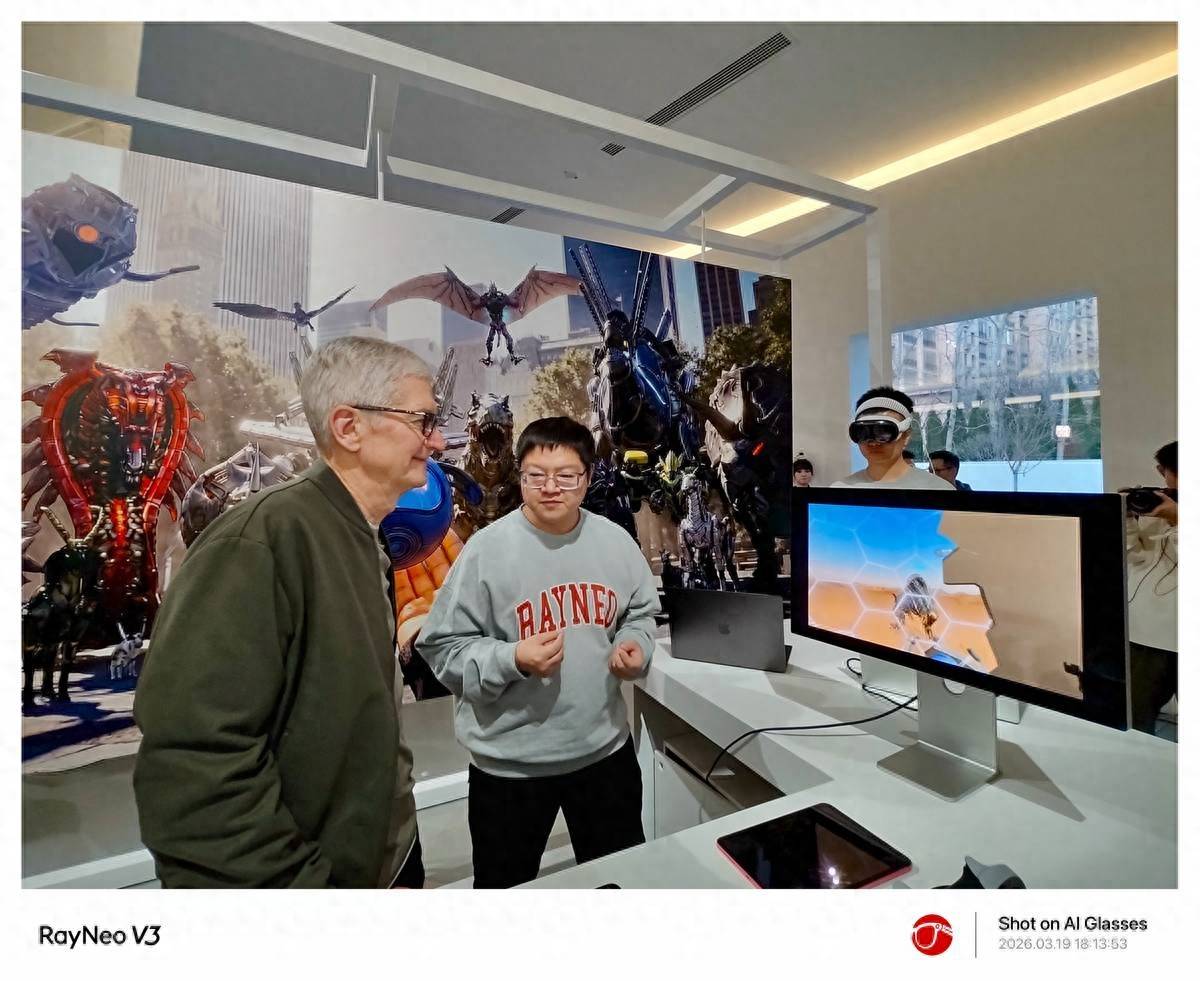
Core Insights - RayNeo, a leading consumer AR brand, showcased its spatial computing game "Digital Era: Elu Legend" at the Apple 2026 Game Showcase, highlighting Apple's focus on next-generation spatial computing content [1][4] - The game is the only one developed specifically for the Apple Vision Pro platform, sharing the stage with top global titles, and has become a focal point of the event [1][4] - RayNeo's participation signifies its evolution from an AR hardware leader to a key ecosystem builder for immersive experiences [1][4] Group 1 - RayNeo's self-developed game "Digital Era: Elu Legend" has achieved top download rankings on the Apple Vision Pro platform, showcasing its breakthrough mixed-reality gaming experience [4] - The game integrates five core technologies: spatial scanning and digital reconstruction, natural gesture interaction, eye-tracking, AI-driven character models, and immersive spatial audio, representing RayNeo's vision for future immersive experiences [4] - The company has validated complex spatial interaction technologies through the Apple Vision Pro platform, preparing for technology migration to lighter smart glasses [4] Group 2 - RayNeo's exploration of spatial computing games began with its first consumer-grade AR glasses, RayNeo X2, which won a gold medal at the Qualcomm XR Innovation Application Challenge for its innovative spatial interaction gameplay [6] - The company is advancing its gaming ecosystem with the RayNeo X3 Pro, the world's first mass-produced dual-lens full-color MicroLED waveguide AR glasses, enhancing visual quality and computational power [6] - RayNeo's continuous self-developed practices enrich the application scenarios of smart glasses and provide a solid technical foundation for high-quality AR applications [6] Group 3 - A key moment of the event was the dialogue between Apple CEO Tim Cook and RayNeo, discussing how spatial computing is reshaping human-computer interaction and entertainment paradigms [7] - Cook expressed high recognition of RayNeo's forward-looking exploration and technological achievements in the spatial computing field, signaling that spatial computing is becoming a mainstream direction for digital content [7] - RayNeo's game "Digital Era: Elu Legend" validated key technologies in spatial computing, while its lightweight applications demonstrate its capability for mass-market services [7] Group 4 - RayNeo's achievements are rooted in its comprehensive self-research and production capabilities, creating a strong barrier in the industry [9] - The company has a top-tier multidisciplinary team across optics, algorithms, software, and ecosystem fields, ensuring seamless integration from foundational technology to user experience [9] - RayNeo has established a complete closed-loop brand in the smart glasses industry, covering hardware, software, and ecosystem development, marking a significant industry declaration of the onset of the spatial computing era [9]


康耐特光学(02276):阿里即将推出千问AI眼镜,端侧AI落地有望加速:康耐特光学(02276.HK)重大事项点评
Huachuang Securities· 2026-03-01 11:06
Investment Rating - The report maintains a "Strong Buy" rating for 康耐特光学 (02276.HK) [1] Core Views - 阿里巴巴 is set to launch its first AI glasses named "千问" at the 2026 MWC in Barcelona, with online and offline reservations starting on March 2. This product launch is expected to accelerate the implementation of edge AI technology [1] - The upgrade of the "夸克" brand to "千问" signifies 阿里巴巴's intention to bring its core AI capabilities directly to consumer devices, enhancing brand recognition for "千问" as a smart assistant [1] - 康耐特光学 is actively positioning itself in the smart glasses market, with increasing overseas collaborations and steady progress on existing projects. Some key domestic projects have already delivered products with positive user feedback [1] - The report highlights the growing ecosystem for smart glasses, with major companies like Meta increasing production capacity, indicating a promising future for the industry [1] Financial Summary - Total revenue projections for 康耐特光学 are as follows: - 2024: 2,061 million HKD - 2025: 2,347 million HKD (17.1% YoY growth) - 2026: 2,835 million HKD (20.8% YoY growth) - 2027: 3,380 million HKD (19.2% YoY growth) [3] - Net profit projections are as follows: - 2024: 428 million HKD - 2025: 564 million HKD (31.0% YoY growth) - 2026: 696 million HKD (23.3% YoY growth) - 2027: 869 million HKD (25.0% YoY growth) [3] - Earnings per share (EPS) estimates are: - 2024: 0.84 HKD - 2025: 1.11 HKD - 2026: 1.37 HKD - 2027: 1.72 HKD [3] - The target price for 2026 is set at 69.80 HKD, with the current price at 61.60 HKD [3]
阿里千问将发布AI眼镜,关注AI眼镜相关投资机会
HUAXI Securities· 2026-03-01 02:45
Investment Rating - The industry rating for the light industry sector is "Recommended" [1] Core Insights - Alibaba's Qianwen will launch AI glasses at the 2026 Mobile World Congress, with a full-channel reservation starting on March 2. Additional products like AI rings and AI headphones are also expected to be released throughout the year [1] - The first generation of Alibaba's Quark AI glasses has seen impressive sales, topping sales charts on major platforms within hours of release, with over 7,000 units sold on Tmall alone on the first day and total orders exceeding 10,000 within two days [2] - The AI glasses market is rapidly growing, with global sales expected to reach 7 million units in 2025, driven by major players like Meta, which currently holds a 75.7% market share [3][4] - Domestic sales of AI glasses in China have surged, with a 731% year-on-year increase in the first three quarters of 2025, primarily driven by brands like Xiaomi and Ray-Ban Meta [3] - Key suppliers in the AI glasses industry include Conant Optical, the exclusive lens supplier for Quark AI glasses, and Mingyue Lens, which is collaborating with Xiaomi [5] Summary by Sections - **Event Overview**: Alibaba's Qianwen is set to unveil AI glasses at the MWC, with a focus on global market expansion and additional product launches [1] - **Sales Performance**: The Quark AI glasses achieved remarkable sales figures shortly after launch, indicating strong consumer demand and market interest [2] - **Market Trends**: The AI glasses industry is experiencing significant growth, with projections indicating a rise in global sales and a strong performance from domestic manufacturers [3][4] - **Industry Players**: Major companies like Conant Optical and Mingyue Lens are strategically positioning themselves within the AI glasses supply chain [5] - **Investment Recommendations**: The report suggests investment opportunities in companies collaborating with Alibaba in the AI glasses sector, highlighting the favorable market conditions and government support [6]

中国智能眼镜行业发展状况与用户行为调查数据-艾媒智库
Sou Hu Cai Jing· 2026-02-28 01:25
Market Overview - The global smart glasses market is projected to grow from $1.03 billion in 2022 to $138.73 billion by 2029, indicating a significant growth potential [1][14] - The Chinese smart glasses market is expected to increase from ¥450 million in 2022 to ¥119.11 billion by 2029, reflecting a strong upward trend [1][18] Consumer Behavior - Consumer awareness of smart glasses is nearly universal in China, with evaluation articles and recommendations from friends being the primary sources of information [1][25] - Major brands attracting consumer attention include Xiaomi, DJI, and Thunderbird Innovation, with over 80% of consumers acknowledging the importance of brand reputation in their purchasing decisions [1][28] - Currently, only 34.21% of consumers have purchased smart glasses, while 46.15% express a willingness to buy in the future [1][8] Purchase Drivers and Barriers - Key factors driving purchase intentions include the desire for daily functionality and technological appeal, while high prices, concerns about vision health, and privacy issues are the main barriers to purchase [1][8] - E-commerce platforms are identified as the primary channels for purchasing smart glasses [1][8] Product Preferences - AR glasses and video glasses are the most popular types among consumers, with battery life, comfort, and functionality being the core considerations for purchase [2][11] - Consumers prefer head-mounted designs and show a strong interest in features like voice interaction and health monitoring, with expectations for new functionalities such as smart home control and translation [2][11] User Experience and Expectations - Satisfaction with battery life is low, with over half of consumers expecting a battery life of one week or more, and acceptable weight is generally below 40 grams [2][12] - The psychological price range for consumers is concentrated between ¥1001 and ¥3000, while issues such as unstable functionality, discomfort, and high prices are seen as major pain points [2][12] Demographics and Satisfaction - The primary consumer demographic consists of males, married individuals, and those living in new first-tier and third-tier cities, with over 70% earning more than ¥10,000 monthly [2][12] - Overall satisfaction with smart glasses is moderate, with comfort and design being the most appreciated aspects, while many consumers believe the technology will only find applications in specific fields or demographics [2][12]

康耐特光学午前涨超4% 今年多个头部科技企业多款AI眼镜有望量产落地
Zhi Tong Cai Jing· 2026-02-12 03:57
Group 1 - 康耐特光学's stock rose over 4%, currently up 4.58% at 64 HKD, with a trading volume of 36.48 million HKD [1] - 康耐特光学 plans to issue 27 million shares, with net proceeds estimated at approximately 1.4 billion HKD [1] - 华创证券 believes the share placement is not due to cash flow issues, but rather a proactive measure for future capital expenditures and capacity expansion over the next 2-3 years [1] Group 2 - The company is collaborating with several leading 3C companies to develop smart glasses, indicating promising growth potential [1] - 中信建投 reports that Meta has initiated the AI glasses era in September 2023, with an expected product explosion in the industry by 2025 [1] - Northeast Securities states that Meta and Alibaba are actively investing in AI+AR glasses, with multiple leading tech companies expected to launch various AI glasses by 2026 [1]
VITURE出手反击 XREAL全线产品或被禁产禁售|AR专利战第二回合
财联社· 2026-02-07 09:30
Core Viewpoint - The patent dispute between VITURE and XREAL represents a significant escalation in the competition within the XR glasses industry, highlighting the importance of technological innovation and patent rights in the global market [1][2]. Group 1: Patent Dispute Overview - XREAL initiated patent lawsuits against VITURE in Germany and the United States, prompting VITURE to file counterclaims in Chinese courts for patent infringement related to its electrochromic technology [1][24]. - The ongoing patent conflict illustrates the competitive landscape of the XR glasses industry, where companies are increasingly engaging in legal battles over technology patents [2][31]. Group 2: Technology and Market Impact - VITURE's core patent infringement claim against XREAL centers on its electrochromic technology, which allows AR glasses to adjust transparency based on lighting conditions, enhancing user experience [3][4]. - The introduction of electrochromic technology addresses previous challenges faced by AR glasses users, such as the need for physical light shields and privacy concerns [4][6]. - VITURE was the first to incorporate this technology into its ONE XR product in April 2022, achieving significant crowdfunding success and recognition [6][12]. Group 3: Competitive Landscape - The patent dispute has implications for both companies' market strategies, with VITURE asserting that its innovation is the true reason behind XREAL's legal actions [16][27]. - The global smart glasses market is projected to grow significantly, with IDC forecasting over 23.68 million units shipped by 2026, indicating a competitive environment where both Chinese and international brands are vying for market share [29][30]. - Chinese manufacturers accounted for 26.6% of global smart glasses shipments in the first half of 2025, reflecting a 64.2% year-on-year increase, showcasing their growing influence in the market [29][30]. Group 4: Future Implications - The ongoing patent disputes are expected to continue as the XR industry evolves, with the complexity of technology and varying legal frameworks across countries contributing to the likelihood of further conflicts [28][31]. - The situation serves as a case study for Chinese companies expanding into international markets, emphasizing the need for strategic management of intellectual property and competitive practices [31].
视频丨惠及1613万人次 “新国补”实施首月带动产销两旺
Sou Hu Cai Jing· 2026-02-05 13:53
Group 1 - The "New National Subsidy" policy has been fully implemented, leading to a surge in consumer interest in replacing old products, benefiting 16.13 million people and generating sales of 92.56 billion yuan in automotive, home appliances, digital, and smart products in its first month [1] - The offline retail sector is experiencing significant growth, with nearly 80% of new purchases in home appliances and digital products coming from in-store sales, reflecting a year-on-year increase of approximately 20% [7] - The policy is driving cross-scenario consumption in leisure, transportation, and dining, creating a positive cycle of consumer engagement and spending [9] Group 2 - The "New National Subsidy" is promoting a new consumption trend focused on green and smart products, with the subsidy standard for home appliances raised to first-level energy efficiency, leading to increased sales of high-performance appliances [12] - Consumers are attracted to energy-efficient products, with subsidies of up to 1,500 yuan for first-level energy-efficient appliances, making them both cost-effective and environmentally friendly [14] - The demand for green and environmentally friendly electric vehicles is also rising, with significant increases in orders for these models due to the subsidy [16] Group 3 - The implementation of the "New National Subsidy" is fostering new industry growth, providing companies with new market opportunities [23] - A smart glasses manufacturing company has seen a surge in orders, doubling its annual sales target from 50,000 to 100,000 units due to the increased demand from the subsidy [25] - To meet the rising demand, upstream component manufacturers in the smart glasses industry are operating at full capacity and expanding production lines [28]

裕同科技:重大事项点评-20260205
Huachuang Securities· 2026-02-05 04:10
Investment Rating - The report maintains a "Recommend" rating for the company, indicating an expectation to outperform the benchmark index by 10%-20% over the next six months [7][13]. Core Insights - Yutong Technology (002831) is positioned as a leading player in the packaging industry, benefiting from stable growth and high dividend payouts. The company is expected to gain from the development of its smart glasses business [2][7]. - The company holds a 0.48% stake in Longqi Technology, which recently listed on the Hong Kong Stock Exchange, potentially enhancing collaboration in the smart glasses sector [2][7]. - Yutong's overseas production capacity provides a significant competitive advantage, with higher gross margins in international markets compared to domestic ones. The gross margin for overseas markets was 28.79% in the first half of 2025, while domestic margins were only 19.41% [2][7]. Financial Summary - Projected total revenue (in million) for the years 2024 to 2027 is as follows: - 2024: 17,157 - 2025: 18,818 - 2026: 20,907 - 2027: 22,922 - Year-on-year revenue growth rates are projected at 12.7% for 2024, 9.7% for 2025, 11.1% for 2026, and 9.6% for 2027 [2][8]. - Projected net profit (in million) for the same period is: - 2024: 1,409 - 2025: 1,643 - 2026: 1,902 - 2027: 2,172 - Year-on-year net profit growth rates are expected to be -2.1% for 2024, 16.6% for 2025, 15.8% for 2026, and 14.2% for 2027 [2][8]. - The target price for the stock is set at 35.13 CNY, with the current price at 30.01 CNY [3][7].

惠及1613万人次 “新国补”实施首月带动产销两旺
Yang Shi Xin Wen· 2026-02-05 00:59
Group 1 - The "New National Subsidy" policy has led to a surge in consumer participation, benefiting 16.13 million people and generating sales of 92.56 billion yuan in various sectors including automobiles, home appliances, and digital products [1] - The implementation of the "New National Subsidy" has significantly boosted offline retail, with nearly 80% of new purchases in January coming from the replacement program, reflecting a year-on-year growth of approximately 20% [1] - The policy is driving cross-scenario consumption in leisure, transportation, and dining, creating a positive cycle of consumer engagement and revenue growth [1] Group 2 - The "New National Subsidy" is promoting a new consumption trend focused on green and intelligent products, with the subsidy standard for home appliances raised to first-level energy efficiency, leading to increased sales of high-performance appliances [3] - The demand for electric vehicles has surged, with consumers favoring long-range, spacious, and cost-effective models, supported by additional subsidies from manufacturers [3] - The shorter update cycle for digital products has encouraged consumers to purchase higher-end devices, benefiting from the "New National Subsidy" [4] Group 3 - The "New National Subsidy" is fostering new industry growth, providing companies with new market opportunities [5] - Orders for smart eyewear have surged post-subsidy implementation, prompting manufacturers to double their sales targets and innovate new products [6] - The supply chain for the smart eyewear industry is operating at full capacity, with production lines being expanded to meet the rising demand [6]