RuiPath智慧病理一体机——FusionCube A1000

Search documents
推动医疗AI走向基层,医疗人工智能协同创新论坛在沪举办
Zhong Guo Jing Ji Wang· 2026-02-02 06:20
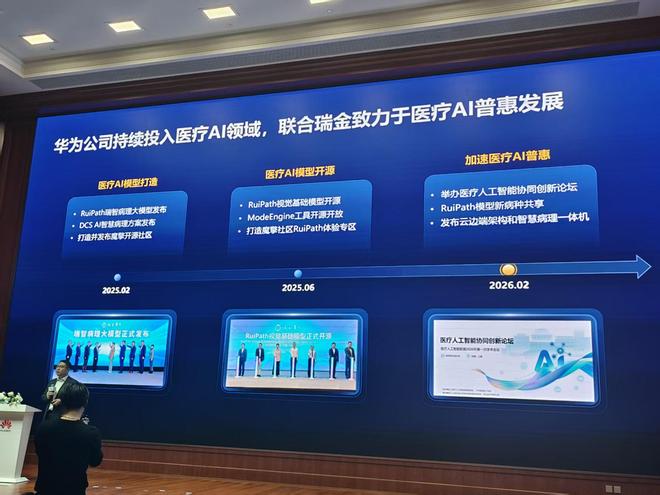
Core Viewpoint - The integration of AI in healthcare is poised to fundamentally transform traditional medical service models, enhancing the efficiency of scarce quality medical resources in China and accelerating the accessibility of medical AI [1][2]. Group 1: Industry Insights - The healthcare sector is at a historic crossroads, driven by the dual forces of technological evolution and market explosion, creating an unprecedented urgency for the adoption of AI in medical practices [2]. - The core battleground for medical AI has shifted from technical demonstrations to the competition for clinical scenarios and user habit formation, emphasizing the need for safe, effective, and trustworthy integration of AI into daily clinical processes [2]. - The rapid development of AI is profoundly reshaping the healthcare industry, necessitating a balance between clinical needs, safety, and innovation in the medical AI ecosystem [2]. Group 2: Company Initiatives - Huawei has launched a significant smart pathology cloud-edge-end solution and jointly released the RuiPath smart pathology integrated machine with Ruijin Hospital, aimed at enabling grassroots hospitals to quickly deploy AI pathology models and enhance diagnostic capabilities [3]. - Despite the maturity of AI-assisted pathology diagnosis technology, grassroots hospitals face challenges such as high costs of smart construction, long deployment cycles, and slow improvement in diagnostic accuracy, which hinder the widespread adoption of medical AI [3]. - The release of Huawei's solution marks a transition in China's medical AI application towards a phase of accessibility, facilitating the efficient and precise pathology diagnosis in grassroots hospitals and addressing the uneven distribution of medical resources [3].
华为加速医疗AI“从三甲下基层”
Guan Cha Zhe Wang· 2026-02-01 09:13
Core Insights - Huawei is accelerating the implementation of AI in various industries, particularly in healthcare, by launching the "Industry AI Dream Factory" and collaborating with Shanghai Jiao Tong University and Ruijin Hospital to introduce AI pathology solutions [1][9] - The urgent need for early detection and treatment of cancer in China is highlighted, with approximately 4.82 million new cancer cases reported in 2022, making it crucial to enhance pathology diagnostics [1][2] Group 1: AI Implementation in Healthcare - Huawei introduced the RuiPath smart pathology integrated machine, FusionCube A1000 and FusionCube E200, aimed at helping grassroots hospitals quickly deploy AI pathology models [1][2] - The RuiPath pathology model, developed in collaboration with Ruijin Hospital, utilizes a dataset of one million high-quality digital pathology slices, enabling rapid and accurate identification of pathological areas in slices, with AI diagnosis time reduced to seconds [2][5] - Despite advancements, grassroots hospitals face challenges such as high costs of smart construction and long deployment cycles for AI applications, hindering the widespread adoption of medical AI [4] Group 2: Technological Solutions and Collaboration - Huawei's smart pathology cloud-edge-end solution integrates core ICT and cloud technologies to enhance AI-assisted pathology diagnostic capabilities in grassroots hospitals [5][6] - The "cloud" component provides AI enabling services for doctors, while the "edge" component offers DCS AI smart pathology solutions for tertiary hospitals, facilitating low-threshold training and inference of pathology models [6] - The "end" component, represented by the RuiPath smart pathology integrated machine, allows for lightweight and efficient deployment of AI models in grassroots hospitals, ensuring continuous updates and data sharing with tertiary hospitals [6] Group 3: Industry Impact and Future Directions - Experts believe the launch signifies a shift towards the democratization of medical AI applications, improving efficiency and accuracy in grassroots hospital diagnostics and addressing uneven distribution of medical resources [9] - Huawei's strategic focus is on applying AI across various industries, emphasizing practical applications over mere invention, with a vision for AI to significantly contribute to sectors like healthcare, agriculture, and technology in the next 3-5 years [9]