智慧病理云边端解决方案

Search documents
华为云加码医疗AI 力推智慧医疗专区
2 1 Shi Ji Jing Ji Bao Dao· 2026-02-02 12:18
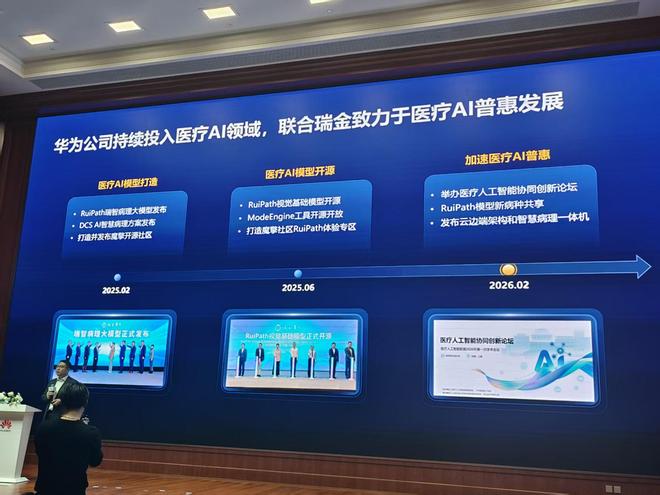
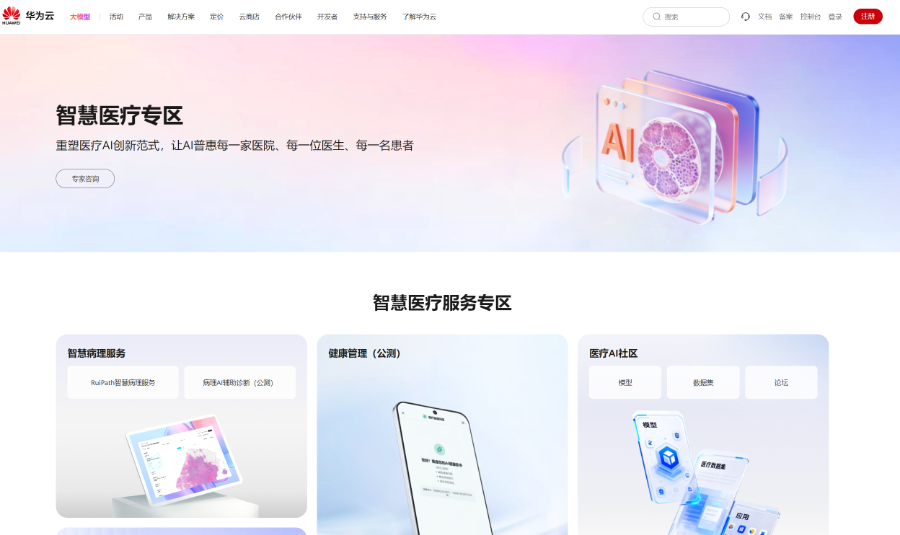
Core Viewpoint - Huawei is focusing on the integration of AI technology in the healthcare sector, launching the "Smart Healthcare Zone" as part of its "Industry AI Dream Factory" strategy, aiming to enhance AI applications in medical settings [1][5]. Group 1: AI Strategy and Implementation - The "Smart Healthcare Zone" is the first practical implementation of Huawei's "Industry AI Dream Factory" strategy in the medical field, designed to integrate clinical practices from top medical institutions with Huawei's core technologies in ICT, cloud, and AI [1][5]. - Huawei plans to collaborate with leading industry clients and partners to develop 30 specialized models, 10 high-quality industry datasets, and 50 ecological applications and tools in the healthcare sector within the first half of this year [1]. Group 2: Addressing Industry Challenges - This initiative aims to alleviate long-standing issues in the healthcare industry, such as slow digital progress, severe data silos, high costs of redundant development, and high barriers to AI application [5]. - The introduction of the RuiPath pathology model, which covers 90% of annual cancer cases in China, signifies a shift from laboratory research to clinical application, enhancing diagnostic capabilities in grassroots healthcare settings [5][6]. Group 3: Market Potential and Future Outlook - The market for AI-driven medical diagnostic products is projected to reach nearly 20 billion yuan in the B-end and G-end sectors from 2025 to 2029, with the C-end market potentially exceeding 70 billion yuan annually [6]. - Huawei's efforts in the healthcare AI sector aim to balance the distribution of medical resources and promote equitable access to quality healthcare services [7].

AI日报丨小鹏全球首款AI汽车正式开启海外大规模发运,马斯克帝国大合并?特斯拉上周五逆市收涨
美股研究社· 2026-02-02 11:06
Group 1 - The article highlights the rapid development of artificial intelligence technology, presenting significant opportunities in the market [3] - OpenClaw has announced that its Kimi K2.5 model will be available for free use, marking it as the first major model to be offered at no cost, contributing to OpenClaw's rise as a leading open-source project [5] - Huawei Cloud has launched the industry's first smart pathology cloud-edge-end solution, aimed at grassroots hospitals and doctors, in collaboration with Ruijin Hospital [6] Group 2 - Xpeng Motors has commenced large-scale overseas shipments of its new AI car, the P7+, which is set to be delivered to 18 countries, with local production in Austria [8] - Alipay's 2026 Spring Festival "Collecting Blessings" event introduces a new "Health Blessing" issued by the health AI "Antifortune," alongside 19 themed blessing cards [9] - Tesla's stock rose by 3.32% as discussions about potential mergers involving SpaceX and Tesla or xAI evolve from possibilities to realistic options [11] - Apple's Q1 2026 financial results exceeded expectations, with revenue reaching $143.8 billion, a 16% year-over-year increase, and diluted earnings per share of $2.84, a 19% increase [12]



推动医疗AI走向基层,医疗人工智能协同创新论坛在沪举办
Zhong Guo Jing Ji Wang· 2026-02-02 06:20
Core Viewpoint - The integration of AI in healthcare is poised to fundamentally transform traditional medical service models, enhancing the efficiency of scarce quality medical resources in China and accelerating the accessibility of medical AI [1][2]. Group 1: Industry Insights - The healthcare sector is at a historic crossroads, driven by the dual forces of technological evolution and market explosion, creating an unprecedented urgency for the adoption of AI in medical practices [2]. - The core battleground for medical AI has shifted from technical demonstrations to the competition for clinical scenarios and user habit formation, emphasizing the need for safe, effective, and trustworthy integration of AI into daily clinical processes [2]. - The rapid development of AI is profoundly reshaping the healthcare industry, necessitating a balance between clinical needs, safety, and innovation in the medical AI ecosystem [2]. Group 2: Company Initiatives - Huawei has launched a significant smart pathology cloud-edge-end solution and jointly released the RuiPath smart pathology integrated machine with Ruijin Hospital, aimed at enabling grassroots hospitals to quickly deploy AI pathology models and enhance diagnostic capabilities [3]. - Despite the maturity of AI-assisted pathology diagnosis technology, grassroots hospitals face challenges such as high costs of smart construction, long deployment cycles, and slow improvement in diagnostic accuracy, which hinder the widespread adoption of medical AI [3]. - The release of Huawei's solution marks a transition in China's medical AI application towards a phase of accessibility, facilitating the efficient and precise pathology diagnosis in grassroots hospitals and addressing the uneven distribution of medical resources [3].
科创100ETF华夏(588800)盘中成交1.74亿,AI加速赋能医疗产业
Xin Lang Cai Jing· 2026-02-02 03:13
Group 1 - The core viewpoint is that AI is accelerating the transformation of the healthcare industry, with significant growth potential in companies like Huaxi Biological, which expects a net profit increase of 54.93%-83.63% by 2025 [1] - Huaxi Biological's stock led the gains in the Sci-Tech Innovation Board, rising by 7.70%, indicating strong market interest and confidence in its future performance [1] - The Sci-Tech 100 ETF has shown significant liquidity and growth, with a recent trading volume of 1.74 billion yuan and a 1.32 billion yuan increase in scale over the past two weeks [1] Group 2 - According to Everbright Securities, AI has become a core productivity driver in the new infrastructure of healthcare, with AI drug development and AI medical imaging being the most mature sectors [2] - The future competition in the AI healthcare space will focus on exclusive high-quality private data and the ability to create closed-loop business scenarios [2] - The Sci-Tech 100 ETF closely tracks the Sci-Tech 100 Index, which focuses on high-growth sectors including semiconductors, pharmaceuticals, and new energy [2]

华为加速医疗AI“从三甲下基层”
Guan Cha Zhe Wang· 2026-02-01 09:13
Core Insights - Huawei is accelerating the implementation of AI in various industries, particularly in healthcare, by launching the "Industry AI Dream Factory" and collaborating with Shanghai Jiao Tong University and Ruijin Hospital to introduce AI pathology solutions [1][9] - The urgent need for early detection and treatment of cancer in China is highlighted, with approximately 4.82 million new cancer cases reported in 2022, making it crucial to enhance pathology diagnostics [1][2] Group 1: AI Implementation in Healthcare - Huawei introduced the RuiPath smart pathology integrated machine, FusionCube A1000 and FusionCube E200, aimed at helping grassroots hospitals quickly deploy AI pathology models [1][2] - The RuiPath pathology model, developed in collaboration with Ruijin Hospital, utilizes a dataset of one million high-quality digital pathology slices, enabling rapid and accurate identification of pathological areas in slices, with AI diagnosis time reduced to seconds [2][5] - Despite advancements, grassroots hospitals face challenges such as high costs of smart construction and long deployment cycles for AI applications, hindering the widespread adoption of medical AI [4] Group 2: Technological Solutions and Collaboration - Huawei's smart pathology cloud-edge-end solution integrates core ICT and cloud technologies to enhance AI-assisted pathology diagnostic capabilities in grassroots hospitals [5][6] - The "cloud" component provides AI enabling services for doctors, while the "edge" component offers DCS AI smart pathology solutions for tertiary hospitals, facilitating low-threshold training and inference of pathology models [6] - The "end" component, represented by the RuiPath smart pathology integrated machine, allows for lightweight and efficient deployment of AI models in grassroots hospitals, ensuring continuous updates and data sharing with tertiary hospitals [6] Group 3: Industry Impact and Future Directions - Experts believe the launch signifies a shift towards the democratization of medical AI applications, improving efficiency and accuracy in grassroots hospital diagnostics and addressing uneven distribution of medical resources [9] - Huawei's strategic focus is on applying AI across various industries, emphasizing practical applications over mere invention, with a vision for AI to significantly contribute to sectors like healthcare, agriculture, and technology in the next 3-5 years [9]