行业AI梦工厂

Search documents
华为云加码医疗AI 力推智慧医疗专区
2 1 Shi Ji Jing Ji Bao Dao· 2026-02-02 12:18
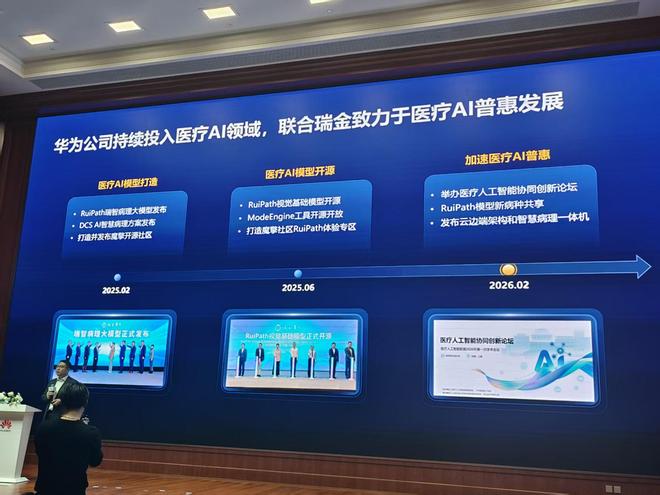
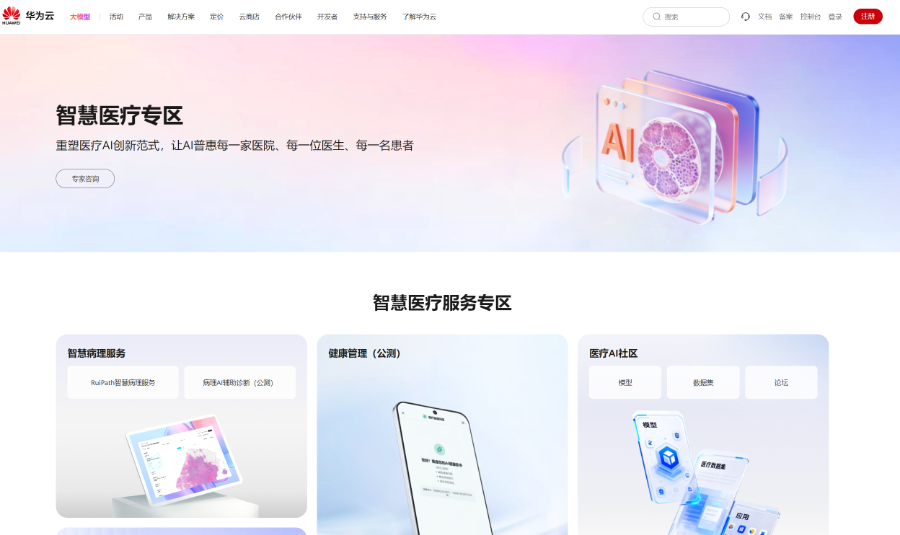
Core Viewpoint - Huawei is focusing on the integration of AI technology in the healthcare sector, launching the "Smart Healthcare Zone" as part of its "Industry AI Dream Factory" strategy, aiming to enhance AI applications in medical settings [1][5]. Group 1: AI Strategy and Implementation - The "Smart Healthcare Zone" is the first practical implementation of Huawei's "Industry AI Dream Factory" strategy in the medical field, designed to integrate clinical practices from top medical institutions with Huawei's core technologies in ICT, cloud, and AI [1][5]. - Huawei plans to collaborate with leading industry clients and partners to develop 30 specialized models, 10 high-quality industry datasets, and 50 ecological applications and tools in the healthcare sector within the first half of this year [1]. Group 2: Addressing Industry Challenges - This initiative aims to alleviate long-standing issues in the healthcare industry, such as slow digital progress, severe data silos, high costs of redundant development, and high barriers to AI application [5]. - The introduction of the RuiPath pathology model, which covers 90% of annual cancer cases in China, signifies a shift from laboratory research to clinical application, enhancing diagnostic capabilities in grassroots healthcare settings [5][6]. Group 3: Market Potential and Future Outlook - The market for AI-driven medical diagnostic products is projected to reach nearly 20 billion yuan in the B-end and G-end sectors from 2025 to 2029, with the C-end market potentially exceeding 70 billion yuan annually [6]. - Huawei's efforts in the healthcare AI sector aim to balance the distribution of medical resources and promote equitable access to quality healthcare services [7].

华为加速医疗AI“从三甲下基层”
Guan Cha Zhe Wang· 2026-02-01 09:13
Core Insights - Huawei is accelerating the implementation of AI in various industries, particularly in healthcare, by launching the "Industry AI Dream Factory" and collaborating with Shanghai Jiao Tong University and Ruijin Hospital to introduce AI pathology solutions [1][9] - The urgent need for early detection and treatment of cancer in China is highlighted, with approximately 4.82 million new cancer cases reported in 2022, making it crucial to enhance pathology diagnostics [1][2] Group 1: AI Implementation in Healthcare - Huawei introduced the RuiPath smart pathology integrated machine, FusionCube A1000 and FusionCube E200, aimed at helping grassroots hospitals quickly deploy AI pathology models [1][2] - The RuiPath pathology model, developed in collaboration with Ruijin Hospital, utilizes a dataset of one million high-quality digital pathology slices, enabling rapid and accurate identification of pathological areas in slices, with AI diagnosis time reduced to seconds [2][5] - Despite advancements, grassroots hospitals face challenges such as high costs of smart construction and long deployment cycles for AI applications, hindering the widespread adoption of medical AI [4] Group 2: Technological Solutions and Collaboration - Huawei's smart pathology cloud-edge-end solution integrates core ICT and cloud technologies to enhance AI-assisted pathology diagnostic capabilities in grassroots hospitals [5][6] - The "cloud" component provides AI enabling services for doctors, while the "edge" component offers DCS AI smart pathology solutions for tertiary hospitals, facilitating low-threshold training and inference of pathology models [6] - The "end" component, represented by the RuiPath smart pathology integrated machine, allows for lightweight and efficient deployment of AI models in grassroots hospitals, ensuring continuous updates and data sharing with tertiary hospitals [6] Group 3: Industry Impact and Future Directions - Experts believe the launch signifies a shift towards the democratization of medical AI applications, improving efficiency and accuracy in grassroots hospital diagnostics and addressing uneven distribution of medical resources [9] - Huawei's strategic focus is on applying AI across various industries, emphasizing practical applications over mere invention, with a vision for AI to significantly contribute to sectors like healthcare, agriculture, and technology in the next 3-5 years [9]