ShareRobot

Search documents
VLA的基础模型与大规模训练任务汇总
具身智能之心· 2025-10-08 02:49
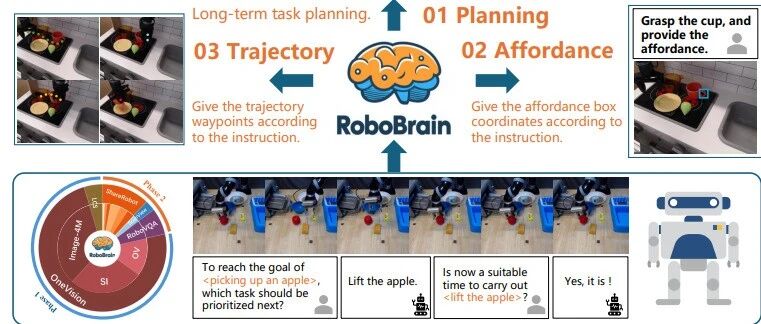
Core Insights - The article summarizes several research papers related to Vision-Language-Action (VLA) models and their training strategies, highlighting advancements in embodied intelligence and robotics [2][3][5][7][9][11][13][15][17][19]. Group 1: Training Strategies and Model Improvements - The paper "Training strategies for efficient embodied reasoning" discusses the use of Chain of Thought (CoT) reasoning to enhance the performance and generalization of VLA models, achieving a threefold increase in reasoning speed compared to standard methods [3]. - "CAST: Counterfactual labels improve instruction following in vision-language-action models" introduces a method to generate counterfactual labels, which significantly improves the instruction-following capabilities of VLA models, with a 27% increase in navigation task success rates [5]. - "RoboBrain: A unified brain model for robotic manipulation" presents a new dataset, ShareRobot, which enhances the planning and trajectory prediction capabilities of robots, leading to state-of-the-art performance in various tasks [7]. Group 2: Dataset Development and Evaluation - The "DROID" dataset is introduced as a large-scale, diverse dataset for robot manipulation, containing 76,000 demonstration trajectories collected over 350 hours, which improves performance and generalization of trained strategies [9]. - "ViSA-Flow" proposes a framework for learning from large-scale video data, achieving state-of-the-art performance in robot skill learning, particularly in low-data scenarios [11]. - The "CORTEXBENCH" benchmark evaluates pre-trained visual representations for embodied AI, revealing that no single representation excels across all tasks, but task-specific adaptations can lead to significant performance improvements [13]. Group 3: Generalist Robot Policies and Learning Frameworks - "Effective tuning strategies for generalist robot manipulation policies" identifies key factors influencing the performance of Generalist Manipulation Policies (GMPs) during fine-tuning, establishing a new benchmark for future research [15]. - The "CACTI" framework focuses on scalable multi-task learning in robotic systems, demonstrating effective training across various kitchen tasks in both real and simulated environments [17]. - "R3m: A universal visual representation for robot manipulation" shows that pre-trained visual representations can enhance data-efficient learning in real-world environments, improving task success rates by over 20% compared to training from scratch [19].