SimScale

Search documents
李弘扬团队最新!SimScale:显著提升困难场景的端到端仿真框架......
自动驾驶之心· 2026-01-06 00:28
点击下方 卡片 ,关注" 自动驾驶之心 "公众号 戳我-> 领取 自动驾驶近30个 方向 学习 路线 >>直播和内容获取转到 → 自动驾驶之心知识星球 点击按钮预约直播 李弘扬老师团队的新工作 - SimScale,中科院、港大OpenDriveLab和小米汽车联合完成。 近年来,大模型领域背靠 Data Scaling 取得了前所未有的突破,但到了自动驾驶,这套方法却突然失灵了。不是因为模型不够大,而是现实世界根本给 不了足够多的关键场景。 现实道路中的绝大多数驾驶片段都是重复而安全的"常态行为",真正决定策略能力上限的高风险、长尾、极端场景却往 往难以遇见,更难以大规模收集。因此自动驾驶不是缺数据,而是缺"对的"数据,行业亟需一种能系统性生成大量关键 场景、并规模化训练的新路径。 针对这些问题,SimScale应运而生,SimScale探索了在scalable的3DGS交互式仿真下,生成reward、recovery等多种数据, 进行联合训练以最大化现有训练数据的利用效率。 最终在NavSim leaderboard 上取得了新的 SOTA,并在多类主流 E2E planner 上带来了显著提升! 今天自 ...

仿真数据也能Scaling!虚实结合训练,端到端性能全面提升|中科院x港大x小米汽车
量子位· 2025-12-11 01:33
来自香港大学OpenDriveLab、中科院自动化所、小米汽车的联合团队提出了一种解决方案—— SimScale 。 自动驾驶数据荒怎么破? OpenDriveLab 投稿 量子位 | 公众号 QbitAI 该方案 通过真实世界仿真生成关键场景,以及真实仿真协同训练策略,首次揭示了自动驾驶仿真数据的规模效应 。 现实世界难以提供足够的关键与长尾场景,采集到的大多是价值有限的常态片段,导致 数据越多、提升越难 。 因此,自动驾驶的瓶颈不在规模,而在缺乏能系统生成关键场景并支撑大规模训练的新路径。 无需更多真实数据, 只靠扩大仿真数量,一样能持续突破任何端到端驾驶模型的性能上限 。 为什么要有SimScale? 因为让大模型屡创新高的Data Scaling,在自动驾驶场景中失灵了—— 为此,SimScale应运而生。 什么是SimScale? SimScale是一个能"无限扩张世界"的仿真生成框架,通过高保真神经渲染,自动制造多样化反应式交通场景与伪专家示范。 它也是一套让仿真与真实"相互增益"的训练策略,使各种端到端模型都能越训越强,鲁棒性与泛化性全面提升。 它还是一份首次系统揭示自动驾驶仿真规模效益的"实践 ...

李弘扬团队最新!SimScale:显著提升困难场景的端到端仿真框架,NavSim新SOTA
自动驾驶之心· 2025-12-04 03:03
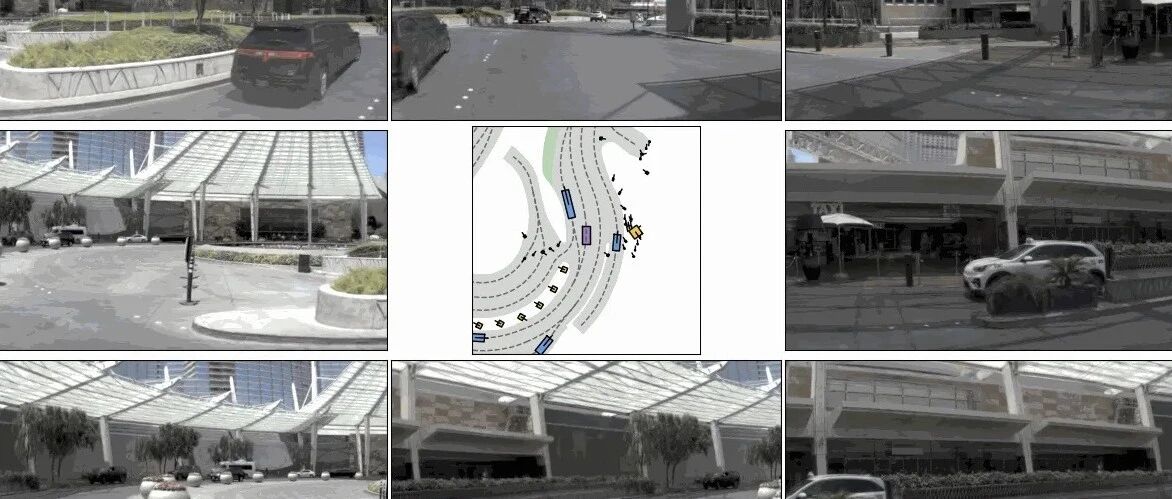
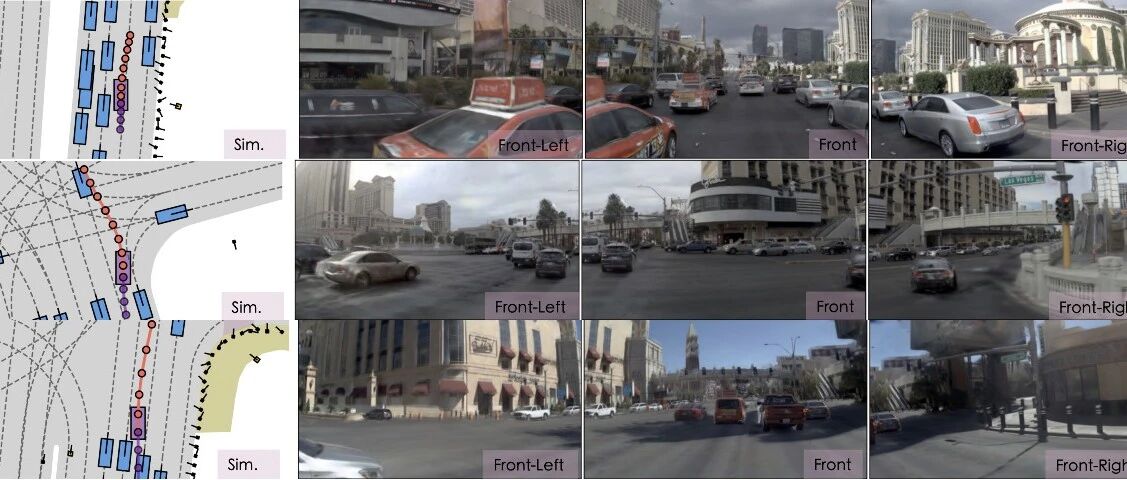
Core Viewpoint - The article discusses the limitations of current data scaling methods in autonomous driving and introduces SimScale, a framework designed to generate critical driving scenarios through scalable 3D simulation, enhancing the performance of end-to-end driving models without the need for more real-world data [2][5][44]. Background Review - Data scaling has been a fundamental principle in modern deep learning across various fields, including language and vision. In autonomous driving, end-to-end planning leverages large-scale driving data to create fully autonomous systems [5][44]. SimScale Framework - SimScale is a simulation generation framework that utilizes high-fidelity neural rendering to create diverse reactive traffic scenarios and pseudo-expert demonstrations. It integrates simulation and real-world data to enhance the robustness and generalization of various end-to-end models [6][12][44]. Simulation Data Generation - The framework employs a 3D Gaussian Splatting (3DGS) simulation data engine to control the states of the vehicle and other agents over time, rendering multi-view videos from the vehicle's perspective. This process involves perturbing vehicle trajectories to maximize state space coverage and generating corresponding expert trajectories for comparison [13][15][19]. Experimental Results - The results from the navhard and navtest benchmark tests show significant performance improvements across all models, with GTRS-Dense achieving a score of 47.2 on navhard, marking a new state-of-the-art performance. The integration of simulation data enhances model robustness in challenging and unseen scenarios [30][31][32][44]. Data Scaling Analysis - The study analyzes the scaling behavior of different planners under fixed real-world data conditions, revealing that the performance of planners improves predictably with increased simulation data. The exploration of pseudo-expert behaviors and interactive environments significantly enhances the effectiveness of simulation data [33][38][39][44]. Conclusion - SimScale demonstrates how large-scale simulation can amplify the value of real-world datasets in end-to-end autonomous driving. The framework's ability to generate pseudo-expert data and its collaborative training approach lead to notable improvements in model performance, emphasizing the importance of simulation in the development of autonomous driving technologies [44].