Solar cell

Search documents
【早报】中央一号文件发布;央行今日将开展8000亿元买断式逆回购操作
财联社· 2026-02-03 23:12
Industry News - The Central Committee of the Communist Party of China and the State Council issued the first central document of the 15th Five-Year Plan, emphasizing "regular precise assistance" for rural revitalization [2] - The People's Bank of China announced an 800 billion yuan reverse repurchase operation to maintain liquidity in the banking system, with a term of three months [4] - In January 2026, A-share new accounts reached 4.9158 million, a month-on-month increase of 89% and a year-on-year increase of 213% compared to January 2025 [3][4] Company News - Guizhou Moutai announced that as of the end of January 2026, it had repurchased a total of 416,900 shares, with a total payment of 571 million yuan [6] - Cambrian Technology is expected to achieve a revenue scale of 20 billion yuan in 2026, although this figure is significantly lower than expectations [6] - Ningde Times reported that as of January 31, it had repurchased 15.9908 million A-shares, with a total transaction amount of 4.386 billion yuan [11]



中国经济展望 -数据解读(2025 年 11 月)-China Economic Perspectives_ China by the Numbers (November 2025)
2025-12-01 01:29
Summary of Key Points from the Conference Call Industry Overview - The conference call primarily discusses the **Chinese economy**, focusing on various sectors including **property**, **manufacturing**, **infrastructure**, and **retail**. Core Insights and Arguments 1. **Economic Growth Trends**: - October growth showed a significant slowdown across various sectors, with **fixed asset investment (FAI)** declining by **11.2% YoY** in October, worsening from **-6.8%** previously [4][88]. - The **property sector** experienced a notable contraction, with property sales growth dropping to **-18.8% YoY** in October, compared to **-10.5%** in September [74]. - **Industrial production (IP)** growth slowed to **4.9% YoY** in October, down from **6.5%** in September, indicating a broader economic deceleration [98]. 2. **Sector-Specific Performance**: - **Manufacturing** investment fell by **6.7% YoY**, while **infrastructure investment** declined by **12.1% YoY** [88]. - Retail sales growth decreased to **2.9% YoY** in October, reflecting a high base effect from previous trade-in subsidies [112]. 3. **Future Economic Outlook**: - GDP growth is expected to decelerate to around **4.2% YoY** in Q4 2025, with a full-year average of **4.9%** for 2025, aligning with the government's target of "around 5%" [4][6]. - The property downturn is anticipated to persist, with expectations of a **5-10% decline** in property sales and new starts in 2026, and a smaller contraction in 2027 [74]. 4. **Policy Measures**: - Modest policy easing is underway, including **RMB 500 billion** from special financial tools and additional local government bond quotas to stabilize economic activity [5]. - The People's Bank of China (PBC) is expected to cut policy rates by **20bps** by the end of 2026, with potential mortgage rate cuts of **30-40bps** [5]. 5. **Inflation and Credit Conditions**: - October's **CPI** increased to **0.2% YoY**, while **PPI** narrowed its decline to **-2.1% YoY** [127]. - Credit growth has softened, with new bank loans recorded at **RMB 220 billion** in October, significantly lower than the previous year [142]. Other Important Insights - The **high-frequency data** indicates continued weakness in property activities, with a **33% YoY** decline in property sales in early November [40]. - The **consumer confidence index** has shown slight recovery but remains below pre-COVID levels, reflecting cautious consumer sentiment [112]. - The **accumulated household excess savings** remain high, indicating a cautious outlook on spending [106]. This summary encapsulates the critical insights from the conference call, highlighting the challenges and expectations for the Chinese economy moving forward.
ReNew Announces Results for the Second Quarter for Fiscal Year 2026 (Q2 FY26), Ended September 30, 2025; Reports 84% Net Profit Increase YOY in H1 FY2026
Businesswire· 2025-11-10 14:02
Core Insights - ReNew Energy Global Plc reported an 84% year-over-year increase in net profit for the first half of fiscal year 2026, with total income reaching INR 79,715 million (US$ 898 million) compared to INR 54,713 million (US$ 616 million) in the same period last year [1][5]. Financial Performance - Total income for Q2 FY26 was INR 38,557 million (US$ 434 million), up from INR 29,887 million (US$ 337 million) in Q2 FY25 [5]. - Net profit for Q2 FY26 was INR 4,675 million (US$ 53 million), slightly down from INR 4,939 million (US$ 56 million) in Q2 FY25 [5]. - Adjusted EBITDA for H1 FY26 was INR 53,459 million (US$ 602 million), compared to INR 43,188 million (US$ 486 million) for H1 FY25 [5]. - Revenue from power sales for H1 FY26 was INR 51,548 million (US$ 581 million), compared to INR 48,342 million (US$ 545 million) for H1 FY25 [5]. Operational Highlights - The company's portfolio consisted of approximately 18.5 GW (+1.1 GW BESS) as of September 30, 2025, an increase from ~15.6 GW a year earlier [5]. - Commissioned capacity increased by 12.8% year-over-year to ~11.4 GW (+150 MWh BESS) as of September 30, 2025, with an additional 212 MW commissioned in October 2025 [5]. - The company expects to complete the construction of 1.6 to 2.4 GW by the end of fiscal year 2026 [4]. Manufacturing and Sales - External sales from solar module and cell manufacturing contributed INR 23,351 million (US$ 263 million) to total income for H1 FY26 [5]. - The company anticipates that external sales from solar module and cell manufacturing will contribute INR 10-12 billion to Adjusted EBITDA for FY26 [4]. Future Outlook - The company continues to expect net gains in asset sales as part of its capital recycling strategy, including INR 1-2 billion related to asset sales in the Adjusted EBITDA guidance [4].


美国光伏产业仍存发展空间
Qi Huo Ri Bao Wang· 2025-05-20 03:34
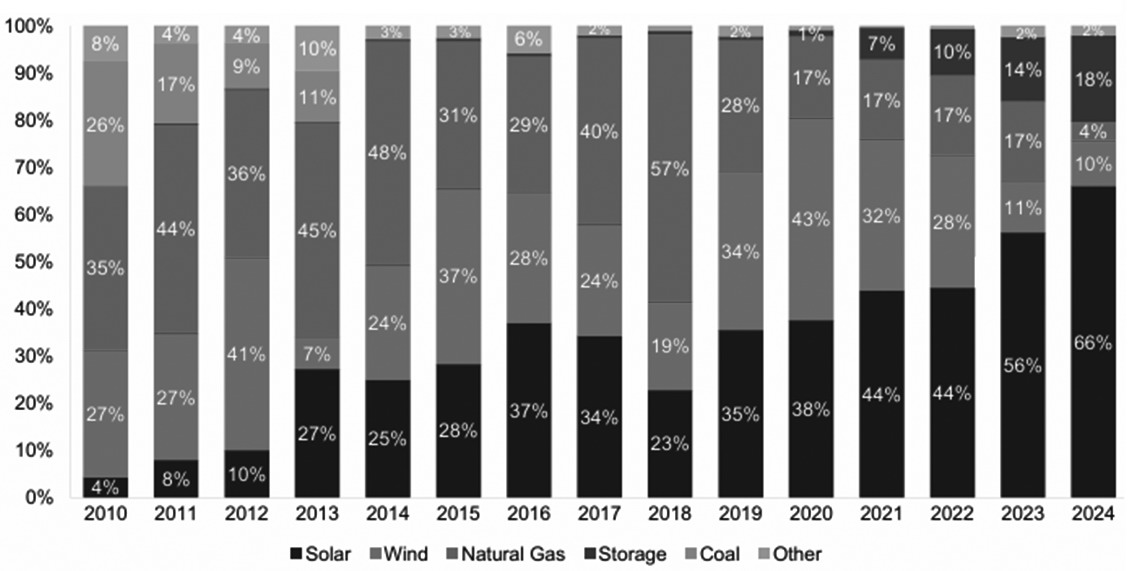
Core Insights - The U.S. photovoltaic (PV) industry is experiencing growth driven by increased electricity demand from artificial intelligence (AI) applications, indicating ongoing development potential [1][9][17] Group 1: Industry Growth and Projections - The U.S. solar industry is expected to add nearly 50 GW of new installations in 2024, representing a 21% increase from 2023 [8] - By 2025, the U.S. is projected to achieve self-sufficiency in solar module production and new installations, although significant import demand for battery cells will persist [11][12] - Solar power is anticipated to contribute 66% of new electricity generation in 2024, marking the highest share since 2018 [8][9] Group 2: Supply Chain and Import Dynamics - The U.S. solar supply chain is primarily focused on downstream activities, with significant growth in module manufacturing capacity expected to rise from 14.5 GW in 2023 to 42.1 GW in 2024 [11] - Despite the increase in domestic module production, the U.S. will still rely on imports for battery cells, with a projected shortfall of approximately 37 GW in battery capacity by 2025 [12] - In 2024, over 80% of U.S. solar module imports are expected to come from Southeast Asia, with significant contributions from Vietnam, Thailand, Malaysia, and Cambodia [15][16] Group 3: Challenges and Future Outlook - The demand for electricity in the U.S. is projected to grow from 4,300 TWh in 2024 to 4,600 TWh by 2030, driven by new data centers, factories, and residential developments [9] - The U.S. Department of Commerce is set to finalize anti-dumping and countervailing duties on solar products from Southeast Asia, which may impact import dynamics and pricing [16][17] - The reliance on imports for battery cells is expected to shift towards countries like Laos and Indonesia due to the imposition of tariffs on products from certain Southeast Asian nations [16][17]