Sora AI

Search documents
计算机行业跟踪报告:“Token”中文名确定为“词元”,关注“词元经济”和AI大模型的商业化路径
Wanlian Securities· 2026-03-30 13:21
Investment Rating - The report maintains a "Market Perform" rating for the computer industry, indicating that the industry index is expected to fluctuate within a range of -10% to +10% relative to the broader market over the next six months [25]. Core Insights - The report highlights the significant growth in the daily average usage of "Token" (词元), projected to reach 100 billion by early 2024 and 100 trillion by the end of 2025, with a remarkable increase to 140 trillion in March 2026, reflecting a growth of over 1000 times in two years [2][10]. - The surge in Token usage is attributed to the rapid commercialization of various AI applications, establishing Token as a key unit for quantifying and monetizing AI services [2][10]. - OpenAI's decision to cease its Sora AI video generation service is noted as a strategic move to streamline its product line ahead of an anticipated IPO, focusing on enterprise-level products [3][20]. - The report emphasizes the importance of AI companies' ecosystem development around Token and suggests monitoring firms with superior commercialization paths for AI models [2][11]. Summary by Sections Industry Dynamics - The report discusses the establishment of "Token" as a critical value anchor in the smart era, facilitating the connection between technology supply and commercial demand [3][17]. - OpenAI's recent actions, including the discontinuation of the Sora service and the launch of a successful advertising pilot for ChatGPT, demonstrate the evolving landscape of AI commercialization [3][21]. - The first industry standard for embodied intelligence was released, marking a significant step in establishing a unified testing framework for the sector, effective from June 1, 2026 [3][22]. Market Performance Review - The computer industry index underperformed compared to the CSI 300 and ChiNext indices, with a decline of 3.44% last week, ranking 30th among 31 sectors [12][13]. - Year-to-date, the computer industry index has decreased by 6.25%, also underperforming relative to the broader market indices [13]. Valuation Insights - As of March 27, 2026, the PE-TTM for the computer industry stands at 179.70 times, significantly above the historical average of 158.11 times for 2023-2025, indicating a high valuation level [7][16].
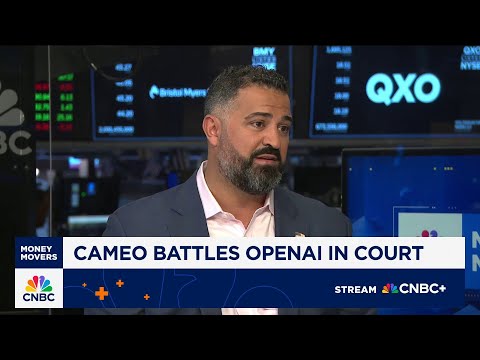
Cameo CEO on OpenAI lawsuit: Problem is using our name, not Sora AI
CNBC Television· 2025-10-30 16:32
Legal Dispute - Cameo is suing OpenAI for trademark infringement related to OpenAI's Sora 2 feature, also named Cameo [1] - Cameo holds a federal trademark for "downloadable video assets made by celebrities" for over 5 years, making it incontestable [3] - Cameo issued a cease and desist to OpenAI, which was ignored, leading to the lawsuit [6] Business Impact - The urgent need for an injunction is driven by the potential negative impact on search engine results during Cameo's busiest season, which accounts for 30% of annual revenue between Thanksgiving and Christmas [7] - Cameo emphasizes the importance of its watermark as a "digital certificate of authenticity" in the age of AI, highlighting the personal connection and magical moments it provides [9] - Customer confusion is already occurring, with customers mistakenly contacting Cameo's customer service regarding Sora Cameo [11] - Social media is seeing users tagging Cameo in videos created on Sora, further blurring the lines between the two services [12] AI and Authenticity - Cameo acknowledges the potential of AI but insists that OpenAI should have chosen a different name for its feature [6][8] - Cameo uses AI for customer reviews and algorithm improvements, indicating an acceptance of AI in certain contexts [9] - The core value of Cameo lies in the "hearts and minds" and the personal connection it facilitates, which AI imitations cannot replicate [9] Concerns Regarding Unauthorized Use - Sora allows users to create "cameos" of themselves, but also includes public figures without their permission [4][5] - Martin Luther King's estate faced issues due to unauthorized videos created using Sora [5]

Melius' Ben Reitzes: We're telling investors to 'sit tight' on these AI names
CNBC Television· 2025-10-08 15:16
Market Overview & Investment Strategy - Melius Research advises investors to "sit tight" amidst market volatility, drawing parallels to the late 1990s tech boom, suggesting significant growth potential remains [1][2][6] - The firm recommends focusing on the "elite three" semiconductor companies: Nvidia, Broadcom, and AMD, highlighting the massive total addressable market (TAM) for compute and networking [6] - Melius Research anticipates a value shift, with hardware companies gaining prominence and software-as-a-service (SaaS) companies potentially facing multiple compression [9][11] Key Players & Opportunities - Nvidia is positioned as a primary beneficiary of the AI boom, particularly through its collaboration with OpenAI [4] - Dell is expected to play a significant role in enterprise AI adoption, with Melius Research raising its target price to $200 [6][7] - Coreweave, an up-and-coming hyperscaler aligned with Nvidia, is also recommended, expected to benefit from overflow demand [7] Technology Trends & Impact - The rise of AI applications like Sora AI will drive substantial demand for inferencing compute [3] - AI is "eating software," leading to a revaluation of hardware and a blurring of lines between hardware and software companies [8][9] - Legacy tech companies like IBM and Dell are finding new opportunities in the AI space, reinventing themselves around infrastructure and on-premise solutions [8][10] Intel's Position - Despite past disappointments, Intel is receiving renewed attention, partly due to investments and collaborations, with potential for future success [12][13] - The US government's support for Intel is viewed positively, though the company's AI strategy is considered less visible compared to competitors [15]