TOPCon电池设备

Search documents
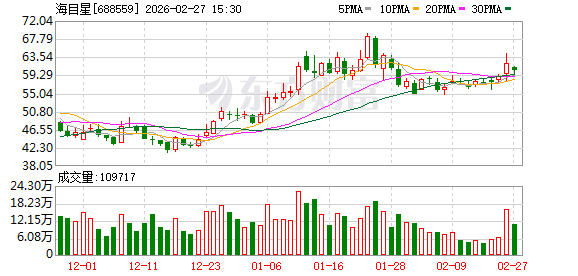
海目星:2025年亏损8.76亿元
Zhong Guo Zheng Quan Bao· 2026-02-28 01:54
Core Viewpoint - The company, Haimoxing (688559), reported a decline in revenue and an increase in net losses for the year 2025, indicating ongoing challenges in profitability and market conditions. Financial Performance - The company achieved an operating revenue of 4.188 billion yuan, a year-on-year decrease of 7.43% [4] - The net profit attributable to shareholders was a loss of 876 million yuan, compared to a loss of 163 million yuan in the same period last year [4] - The non-recurring net profit was a loss of 952 million yuan, compared to a loss of 216 million yuan in the previous year [4] - The basic earnings per share were -3.59 yuan, with a weighted average return on equity of -31.26%, a decrease of 24.99 percentage points from the previous year [4][17] Valuation Metrics - The price-to-book ratio (LF) is approximately 6.34 times, and the price-to-sales ratio (TTM) is about 4.16 times [4] - The historical price-to-earnings ratio (TTM) has shown significant fluctuations, reflecting the company's financial instability [5][6][12] Business Overview - The company specializes in laser and automation solutions, including manufacturing equipment for lithium batteries and photovoltaic components [12] - Recent challenges include cyclical fluctuations in the lithium and photovoltaic industries and intensified market competition [12] - The company has been investing heavily in strategic R&D and global market expansion, which has increased operational costs and impacted short-term profits [12] Future Outlook - The company plans to deepen business transformation, optimize its business structure, and strengthen core technological barriers to enhance competitiveness and risk resilience [12]


太空光伏万亿前景,激光巨头能搭上快车吗?
Xin Lang Cai Jing· 2026-01-13 11:33
Core Viewpoint - The concept of "space photovoltaics" is gaining traction among major solar companies, with a focus on perovskite tandem solar cells as a potential game-changer in the space energy sector [1][3][11] Group 1: Industry Developments - HaiMoxing claims to be a core supplier of laser equipment for JinkoSolar and Trina Solar, actively collaborating on the development of perovskite tandem solar cells [1][13] - JinkoSolar's chairman, Li Xiande, emphasized the need to explore market opportunities in space photovoltaics, while Trina Solar's chairman, Gao Jifan, announced plans to accelerate the commercialization of perovskite technology [3][11] - The Starship rocket is theoretically capable of deploying 300-500 GW per year, with plans to launch 1 million tons of satellites annually, each providing 100 kW of AI computing power, potentially adding 100 GW of computing capacity each year [1][3] Group 2: Technical Advantages of Perovskite - Perovskite solar cells are lightweight, with a weight reduction of over 90% compared to gallium arsenide and 92% compared to crystalline silicon, allowing for significant cost savings in satellite launches [4][12] - The energy output of perovskite cells can reach 10-30 W/g, compared to 3.8 W/g for gallium arsenide and 0.38 W/g for crystalline silicon, making them a more efficient option for space applications [4][12] - Perovskite cells are less affected by environmental factors in space, which could enhance their stability and longevity compared to traditional materials [4][12] Group 3: Collaborations and Industry Alliances - HaiMoxing is deeply involved in R&D partnerships with leading solar companies, positioning itself to capture future market opportunities in perovskite technology [14] - Other companies, such as Junda Co. and Aerospace Hongtu, are forming strategic alliances to develop perovskite applications for space energy solutions [14] - A growing number of laser equipment manufacturers, including Dier Laser and Qinghong Laser, are making advancements in perovskite technology, indicating a competitive landscape in this emerging field [6][14] Group 4: Challenges Ahead - Despite the promising outlook, the large-scale application of perovskite technology in space photovoltaics faces significant challenges, including the need for extensive in-orbit data validation and the development of consistent packaging and aerospace-grade standards [9][18] - The path to achieving substantial orders and revenue contributions remains long for laser equipment manufacturers involved in this sector [18]


300724,高管股东集体减持
第一财经· 2025-09-07 12:06
Core Viewpoint - The article discusses the recent stock performance and shareholder behavior of Jiejia Weichuang (300724.SZ), a leading photovoltaic cell equipment manufacturer, highlighting the contrast between rising stock prices and ongoing shareholder sell-offs [3][4]. Group 1: Shareholder Actions - Multiple shareholders, including major stakeholder Li Shijun, have announced plans to reduce their holdings, with Li planning to cash out approximately 320 million yuan, bringing his total cash-out since 2021 to over 600 million yuan [3][6][7]. - Li Shijun's cumulative reduction amounts to 464.99 million shares, totaling around 668 million yuan, with potential total cash-out nearing 1 billion yuan if the latest plan is fully executed [7]. - Other shareholders have also participated in selling, with a total of over 230 million yuan cashed out in recent months [7]. Group 2: Company Performance - Jiejia Weichuang's stock price has increased by over 70% year-to-date, with a notable 37% rise in the last two weeks, reflecting strong market interest amid a stabilizing photovoltaic industry [5][8]. - The company reported a revenue of 8.372 billion yuan for the first half of 2025, a year-on-year increase of 26.4%, and a net profit of 1.83 billion yuan, up 49.26%, marking the best performance since its IPO [8][9]. - In Q2 2025, the company achieved a revenue of 4.273 billion yuan, with a year-on-year growth of 5.66%, and a net profit of 1.122 billion yuan, reflecting significant growth compared to previous quarters [8][9]. Group 3: Industry Context - The photovoltaic industry is experiencing a phase of adjustment, with production growth rates for battery cells and modules remaining below 15% in the first half of 2025, while exports have shown signs of recovery [8][9]. - The global forecast for new photovoltaic installations has been revised upward, indicating a growing demand primarily from emerging markets, despite anticipated slowdowns in growth rates [9][10]. - The industry faces challenges such as capacity clearing and intensified competition among new battery technologies, necessitating ongoing investment in research and development to maintain a competitive edge [10].