
wBETH

Search documents
USDe崩盘、wBETH折价:DeFi风险如何层层叠加?
Sou Hu Cai Jing· 2025-11-01 03:53
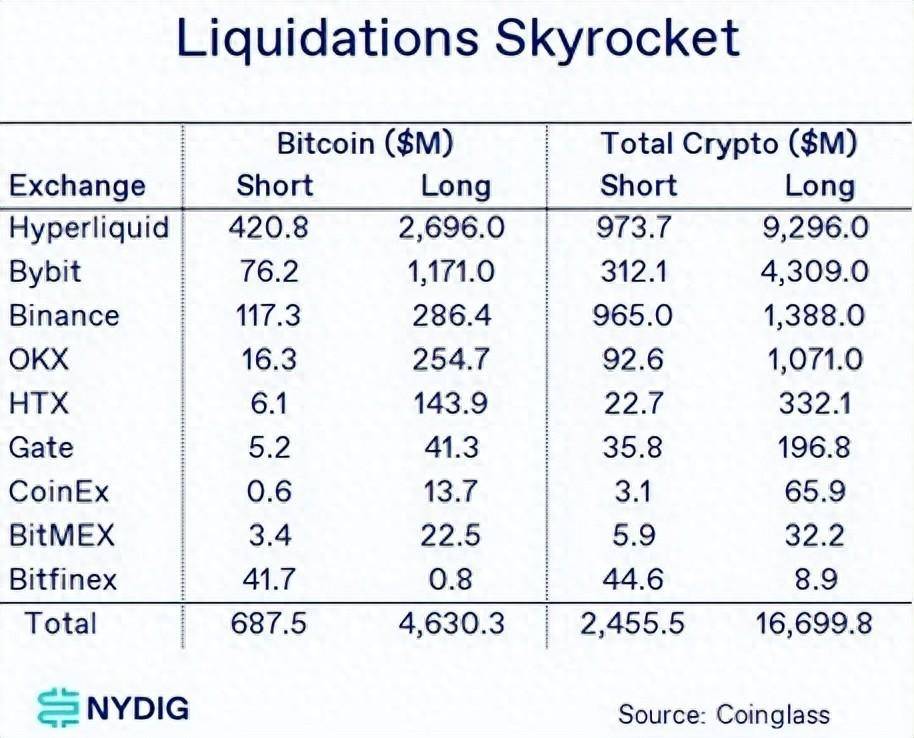
Group 1 - The article discusses the significant market pressure during the recent crypto market liquidation event, which erased $19.2 billion in wealth within hours [1] - The expansion of DeFi applications is exposing vulnerabilities within the industry, despite its praised efficiency [1][2] - The market crash on October 11 highlighted the advantages of CeFi services, which performed robustly during the crisis [1] Group 2 - The liquidation surge was exacerbated by leveraged trading, occurring on both centralized exchanges (CEX) like Binance and decentralized exchanges (DEX) like Hyperliquid [2] - Hyperliquid, a DEX operating on its own blockchain, has seen its total value locked (TVL) triple over the past year, contrasting with a significant decline in traditional CEX trading volumes [3][4] - The scale of forced liquidations reached a record high, with a total of $19.2 billion lost across all crypto assets, including $5.3 billion in Bitcoin alone [4][5] Group 3 - Altcoins experienced even more severe liquidations compared to Bitcoin, with Ethereum and Solana seeing significant losses as well [7][8] - The relative liquidation scale for Ethereum and Solana was approximately 3.7 times and 7.6 times that of Bitcoin, respectively, indicating higher leverage and steeper price declines [8][9] Group 4 - Offshore CEXs faced a 17.6% decline in open contracts, equating to about $7.9 billion in nominal value, while regulated U.S. futures markets showed more resilience with only a 4.4% decline [10] - Signs of stress in the crypto market emerged, with widening price spreads and disordered relationships between perpetual contracts and spot prices [11][14] Group 5 - The article highlights the challenges in determining Bitcoin's price due to significant discrepancies across different exchanges, which can impact trading and lending activities [16] - Stablecoins are not strictly "pegged" to $1, but rather fluctuate around that value based on market dynamics, as evidenced by recent volatility [18][19] Group 6 - The DeFi sector is facing liquidity and technical risks, with examples of significant price discrepancies for derivative tokens like wBETH [22][23] - The lending market, both CeFi and DeFi, has shown remarkable resilience, with minimal liquidations reported during the recent turmoil [25][26] Group 7 - The article concludes with a focus on emerging risks in the crypto ecosystem, particularly related to complex cryptographic primitives and their integration into Bitcoin through various DeFi infrastructures [27]

Is BNB Bull Run Due For Correction Amid Community Backlash?
Yahoo Finance· 2025-10-16 10:09
Group 1 - BNB's long-term uptrend faces potential threats due to market data divergence and community backlash over recent technical issues [1] - The aggregated spot cumulative volume delta (CVD) increased from $2.34 billion in February to $3.3 billion, while the aggregated futures CVD fell from -$41 billion to -$45.8 billion, indicating a shift in investor behavior [2] - The rise in spot CVD alongside a decline in futures CVD suggests that investors are focusing on long-term positions, which may strengthen BNB's fundamentals [3] Group 2 - A decline in CVD combined with open interest provides insights into market positioning; a simultaneous decline suggests short covering, while an increase in both signals bullish sentiment [4] - Currently, BNB's open interest has decreased by 36% over the past week to 555,000 BNB, indicating active selling or profit-taking [5] - Recent technical issues, including oracle mispricing and temporary depegging of wrapped assets, have negatively impacted user confidence in Binance and BNB [6][7]
X @Cointelegraph
Cointelegraph· 2025-10-15 11:30
🔎 RESEARCH: New orderbook data reveals what really happened on Oct 10, when more than $19B was wiped out in crypto’s largest liquidation event.Binance relied on its internal pricing to value USDE, bnSOL, and wBETH collateral instead of external oracles, raising serious risk concerns. ...
Binance Pays $283 Million After Depeg Triggers Liquidations
Yahoo Finance· 2025-10-13 23:15
Core Insights - Binance confirmed reimbursement of $283 million to users affected by liquidations due to asset depegging during market volatility [1][5] - The exchange maintained that its core systems remained functional and attributed the disruption to market conditions rather than internal failures [2] Incident Overview - On October 10, a market crash led to forced liquidations across multiple platforms, with Binance identifying three key assets involved: USDe, BNSOL, and wBETH [3] - These assets briefly detached from their expected values, causing significant price swings, although some reported "zero price" events were due to display errors [4] Compensation Details - The $283 million payout covered users whose positions were liquidated while using affected tokens as collateral across Binance's services [5] - Compensation was calculated by comparing liquidation prices to external market reference prices recorded at midnight UTC the following day [5] Additional Issues and Responses - Binance acknowledged delays in internal transfers and Earn product redemptions, promising automatic compensation within 72 hours for affected users [6] - The rapid reimbursement process was noted as a rare move aimed at reinforcing user trust amid recent leadership changes and scrutiny of centralized exchanges [7] Market Context - Analysts observed that while $283 million is substantial, it represents a small portion of Binance's total trading volume and reserves, highlighting the importance of trust in centralized platforms during repeated crises [8]
Binance Reimburses $283M After Market Crash and Asset Depegging Issues
Yahoo Finance· 2025-10-13 15:01
Core Insights - Binance reimbursed users affected by the October 10 depegging of several Earn assets, clarifying that the price drops were due to a display error rather than actual token failures [1][2] - The total compensation amounted to approximately $283 million, completed within 24 hours, covering users whose positions were liquidated while holding affected assets [2][4] - Analysts suggest the payout reflects both reputational risk management and goodwill, especially in light of recent issues faced by Binance [4][7] Company Operations - Binance's core trading systems remained operational during the market volatility, attributing the fluctuations to overall market conditions rather than platform faults [1][2] - The forced liquidation volume processed by Binance was relatively low compared to the total trading volume [2] Market Context - The "Black Friday" crash led to significant sell-offs in the crypto market, affecting various assets including USDe, BNSOL, and wBETH [4][5] - The incident is viewed as part of a series of challenges faced by Binance, raising concerns about platform-specific liquidity fragmentation [5][6] Strategic Implications - The $283 million payout, while substantial, is considered small relative to Binance's overall earnings, indicating a strategic move to reinforce user trust and brand image [7] - The current market narrative is shifting towards the comparison between centralized exchanges (CEX) and decentralized exchanges (DEX), influencing Binance's approach [7]
X @Arthur Hayes
Arthur Hayes· 2025-10-12 23:43
Incident Overview - Approximately $60-90 million of $USDe was dumped on Binance, alongside $wBETH and $BNSOL, exploiting a pricing flaw [1][3] - This localized depeg triggered $500 million - $1 billion in forced liquidations, cascading into over $19 billion globally [2] - Attackers profited about $192 million via $1.1 billion in BTC/ETH shorts opened on Hyperliquid [2][4] Root Cause Analysis - Binance's Unified Account valued collateral using its own spot market instead of external oracles, creating a major vulnerability [3] - Binance announced a fix to move to oracle-based pricing on Oct 6, but the rollout wasn't until Oct 14, leaving an 8-day window for exploitation [3] - A coordinated manipulation of Binance's order books, amplified by a macro shock (Trump's tariffs) and systemic leverage, caused the crash [2] Responsibility and Aftermath - Binance's design flaw and delay in oracle rollout were the root cause of the incident [5] - Binance admitted "platform-related issues," promised compensation, and rolled out minimum price floors + oracle integration [6] - Ethena (USDe) was not at fault, as the protocol remained 1:1 collateralized, redemptions were normal, and the peg held everywhere else [6]
Traders Blame Binance, But Did Coinbase Also Amplify The Market Crash?
Yahoo Finance· 2025-10-12 18:39
Core Insights - The cryptocurrency market experienced significant turmoil following President Trump's announcement of new tariffs, with Binance becoming a central focus due to its role as a liquidity engine [1] - Users faced exacerbated losses due to Binance's cross-margin system, which linked all assets in a trader's account, leading to total account liquidations from a single margin call [2] Group 1: Binance's Operational Issues - During the market sell-off, Binance's interface reportedly froze, preventing traders from closing or hedging their positions, which contributed to increased losses [2] - The structural weaknesses in Binance's system led to widespread user anger, with accusations that the exchange profited from market volatility through liquidation fees [3] Group 2: Speculation on Market Manipulation - An analysis by on-chain researcher YQ indicated that three Binance-listed assets lost their pegs simultaneously during an internal pricing update, suggesting potential coordinated trading rather than random panic [4] - The estimated financial impact of these coordinated trades could range from $800 million to $1.2 billion extracted from the market [5] - While definitive proof of coordination is lacking, the evidence raises reasonable suspicion of a calculated attack, as the timing and profit patterns align with such an event [6] Group 3: Broader Market Context - Concurrently, blockchain data revealed notable movements from Coinbase, the largest US exchange, which deepened suspicions of market coordination during the downturn [7]
X @Wu Blockchain
Wu Blockchain· 2025-10-12 01:24
Market Analysis & Potential Risks - The October 11 crash may have been a coordinated attack on Binance, exploiting vulnerabilities in its Unified Account margin system [1] - The attack exploited the use of volatile assets like USDE, wBETH, and BnSOL as collateral within Binance's system [1] - The depegging of these assets triggered massive liquidations, resulting in estimated losses of $500 million - $1 billion [1] - The timing of the crash, between Binance's oracle update announcement and implementation, suggests potential coordination [1] - Analysts draw parallels between this event and the LUNA-UST collapse, highlighting the systemic risks associated with using non-fiat stablecoins as high-collateral assets [1] Systemic Risk - The industry warns that using non-fiat stablecoins as high-collateral assets increases systemic risk [1]