AI Engineer

Search documents
The Geopolitics of AI Infrastructure - Dylan Patel, SemiAnalysis
AI Engineer· 2025-06-18 00:55
As AI reshapes the global balance of power, the infrastructure behind it—chips, data centers, power, and supply chains—has become a new arena for geopolitical competition. This talk explores how nations are racing to secure critical AI hardware, control compute capacity, and assert influence over the technologies and talent that define the future. About Dylan Patel Dylan is the founder, CEO, and Chief Analyst for SemiAnalysis, the preeminent authority on all things AI and semiconductors. Through Dylan’s unw ...

Case Study + Deep Dive: Telemedicine Support Agents with LangGraph/MCP - Dan Mason
AI Engineer· 2025-06-17 18:58
Industry Focus: Autonomous Agents in Healthcare - The workshop explores building autonomous agents for managing complex processes like multi-day medical treatments [1] - The system aims to help patients self-administer medication regimens at home [1] - A key challenge is enabling agents to adhere to protocols while handling unexpected patient situations [1] Technology Stack - The solution utilizes a hybrid system of code and prompts, leveraging LLM decision-making to drive a web application, message queue, and database [1] - The stack includes LangGraph/LangSmith, Claude, MCP, Nodejs, React, MongoDB, and Twilio [1] - Treatment blueprints, designed in Google Docs, guide LLM-powered agents [1] Agent Evaluation and Human Support - The system incorporates an agent evaluation system using LLM-as-a-judge to assess interaction complexity [1] - The evaluation system escalates complex interactions to human support when needed [1] Key Learning Objectives - Participants will learn how to build a hybrid system of code and prompts that leverages LLM decisioning [1] - Participants will learn how to design and maintain flexible agentic workflow blueprints [1] - Participants will learn how to create an agent evaluation system [1]
The Web Browser Is All You Need - Paul Klein IV
AI Engineer· 2025-06-17 18:47
Company Overview - Browserbase provides infrastructure connecting large language models and the web, enabling end-to-end workflow automation [1] - Browserbase views itself as the "last-mile" interface between large language models and the web [1] Funding & Investment - Browserbase raised $27.5 million in its first 12 months [1] - The funding includes a $6.5 million seed round and a $21 million Series A [1] - CRV, Kleiner Perkins, and Okta Ventures led the Series A funding [1] Technology & Innovation - The web browser may become the default MCP server for the internet, enabling production AI Agents [1] - Browserbase offers fast, reliable, multi-region headless-browser infrastructure for developers and AI agents [1]

Veo 3 for Developers - Paige Bailey
AI Engineer· 2025-06-17 18:35
Model Overview - Google DeepMind's Veo 3 is a state-of-the-art video generation model [1] - Veo 3 generates video with synchronized audio from text and image prompts [1] - Veo 3 understands intricate details, maintains coherence, and simulates realistic physics and camera movements [1] Capabilities & Features - Veo 3 offers advanced capabilities like semantic context rendering and cinematic control [1] - Veo 3 can generate dialogue, sound effects, and music [1] Accessibility & Integration - Veo 3 is accessible via Vertex AI (preview) [1] - Developers can integrate Veo 3 into their workflows or test it in the Gemini App, Flow, and via the Gemini APIs on Google Cloud [1] Potential Applications - Veo 3 empowers innovation in filmmaking, game development, and education [1]
Good design hasn’t changed with AI - John Pham
AI Engineer· 2025-06-17 04:15
Bad designs are still bad. AI doesn’t make it good. The novelty of AI makes the bad things tolerable, for a short time. Building great designs and experiences with AI have the same first principles pre-AI. When people use software, they want it to feel responsive, safe, accessible and delightful. We’ll go over the big and small details that goes into software that people want to use, not forced to use. About John Pham I'm John Pham, an engineer and a self-taught designer. I seek the dopamine hits of buildin ...
Building AI Products That Actually Work - Ben Hylak, Sid Bendre
AI Engineer· 2025-06-17 03:50
You've made the demo. How do you make the product? A lot of AI products don't actually work. Even worse, a lot of the techniques being advertised for making AI products better don't work either. We'll cover the challenges + techniques we've seen actually work in the real world. About Ben Hylak Ben Hylak is co-founder at Raindrop, building Sentry for AI products. He was previously a designer at Apple for 4 years, building the Apple Vision Pro. About Sid Bendre Sid Bendre is the co-founder of Oleve, a company ...
Model Maxxing: RFT, DPO, SFT with OpenAI — Ilan Bigio, OpenAI
AI Engineer· 2025-06-17 03:49
AI Model Fine-Tuning and Prompt Engineering - Workshop covers SFT, DPO, RFT, prompt engineering/optimization, and agent scaffolding [1] OpenAI Expertise - Ilan Bigio, a founding member of OpenAI's Developer Experience team, leads technical development for Swarm, the precursor to the Agents SDK [1] - Ilan Bigio contributed to Codex CLI and created the AI phone ordering demo showcased at DevDay 2024 [1] - Ilan Bigio partnered with companies like Cursor, Khan Academy, and Klarna to shape their AI products [1] AI Application and Development - Ilan Bigio created ShellAI, an open-source, AI-powered terminal assistant [1] - OpenAI provides in-depth technical guides on topics like Function Calling, Latency Optimization, and Agent Orchestration [1] Educational Background - Ilan Bigio designed and taught courses at Brown [1]
Safety and security for code executing agents - Fouad Matin
AI Engineer· 2025-06-17 00:09
Code is the lingua franca for both software engineers and highly capable AI models. As we give agents the ability to build, test, and run code that they generate, the command line becomes their canvas—and their attack surface. This keynote explores what it takes to bring code-executing agents from research to real-world deployment while maintaining control and security. We’ll cover how terminals offer AI an ideal interface, why they’re deceptively risky, and what it means to embed security, guardrails, and ...
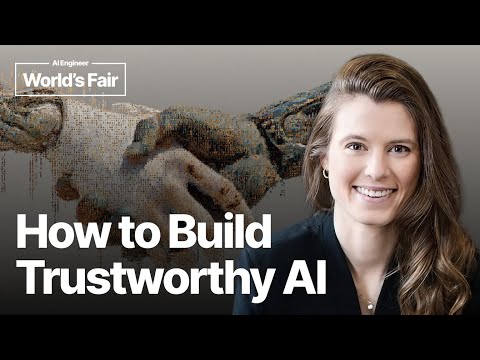
How to Build Trustworthy AI — Allie Howe
AI Engineer· 2025-06-16 20:29
Core Concept - Trustworthy AI is defined as the combination of AI Security and AI Safety, crucial for AI systems [1] Key Strategies - Building trustworthy AI requires product and engineering teams to collaborate on AI that is aligned, explainable, and secure [1] - MLSecOps, AI Red Teaming, and AI Runtime Security are three focus areas that contribute to achieving both AI Security and AI Safety [1] Resources for Implementation - Modelscan (https://github.com/protectai/modelscan) is a resource for MLSecOps [1] - PyRIT (https://azure.github.io/PyRIT/) and Microsoft's AI Red Teaming Lessons eBook (https://ashy-coast-00aeb501e.6.azurestaticapps.net/MS_AIRT_Lessons_eBook.pdf) are resources for AI Red Teaming [1] - Pillar Security (https://www.pillar.security/solutionsai-detection) and Noma Security (https://noma.security/) offer resources for AI Runtime Security [1] Demonstrating Trust - Vanta (https://www.vanta.com/collection/trust/what-is-a-trust-center) provides resources for showcasing Trustworthy AI to customers and prospects [1]
Windsurf everywhere, doing everything, all at once - Kevin Hou, Windsurf
AI Engineer· 2025-06-16 19:59
Core Functionality & Vision - Windsurf is rapidly growing with key features like web search, MCP support, auto-generated memories, and parallel agents [1] - The company's core philosophy centers on creating a shared timeline between humans and AI for intuitive interaction [1] - The vision is for Windsurf to integrate with various developer tools such as Google Docs, Figma, GitHub, Notion, and Linear [1] - Windsurf aims to expand beyond coding to include tasks like interacting with third-party services and writing design documents [1] - The goal is to create a nearly autonomous AI that assists developers in the background [1] Model & Benchmarking - SWE-1 is introduced as a new software engineering model trained for entire workflows [1] - End-to-End Task Benchmark and Conversational SWE Task Benchmark showcase Windsurf's results [1] - A data flywheel drives Windsurf's continuous improvement through a feedback loop [1] Future Outlook - The industry emphasizes the harmony of model, data, and application for building successful AI products by 2025 [1]